



A SaaS platform ecosystem strategy is a plan for letting customers, partners and your own team build governed capabilities on top of a stable shared core, instead of shipping every request into the product yourself. For SaaS owners in the United States and other English-speaking markets, the practical path has five maturity stages, and each one changes who can build and who decides what lasts.
We built Vezel around this idea. Vezel adds an AI extension layer to an existing B2B SaaS product, so extensions run inside your app on your own APIs, permissions and design system. This guide shows how to move up the stages, where partners fit, and how usage data decides what gets promoted.
What Is a SaaS Platform Ecosystem Strategy?
A SaaS platform ecosystem strategy is a deliberate decision to let other builders extend your product, within rules you control. The builders can be customer admins, end users, consultants or partners. You keep the core focused, and they create the last-mile capabilities that your roadmap would never reach.
The word "platform" gets used loosely. Plenty of products simply have more settings. A useful test: can customers build on it, not just adjust it? And does it stay governed, with permissions, versioning and publishing intact, instead of turning into unmanaged sprawl?
MIT Sloan describes a common starting point for established companies: find ways to better meet the needs of existing customers first. Do not expect direct revenue from partners at the outset. That advice fits vertical SaaS well, because your first ecosystem members are your own customers.
Why Does Shipping Every Customer Request Into the Core Break Down?
It breaks down because custom requests and the shared backlog compete for the same engineering capacity, and every request built into the core adds settings, special cases and maintenance. The product slows down, deals wait on roadmap promises, and customers drift into spreadsheets.
Two kinds of demand hit your team at once. Custom requests come from one customer or a small group: a dashboard, an approval flow, a specialized report. The product backlog holds the features you want for everyone. Both are legitimate, and both pass through the same cycle of prioritizing, designing, building, testing and releasing.
The costs show up in familiar places:
- Core bloat: exceptions and one-off options pile up until the whole team moves slower.
- Technical debt: every bespoke build is code someone must test, support and upgrade, with no clean way to retire it.
- Stalled deals: a prospect likes the product but needs one missing workflow, so sales makes roadmap promises.
- Guesswork bets: you commit engineering time before you know whether anyone will use the feature.
The fix starts with one distinction. Creating a capability is a different decision from making it a permanent part of the core. Today most teams merge the two questions. "Would this be useful?" and "Should we maintain it forever for everyone?" deserve separate answers.
The Five Maturity Stages From Closed Product to Governed Extension Ecosystem
Most SaaS products sit at stage one, two or three. Each stage widens who can build, and each adds a governance need. Skipping stages is the usual mistake: opening APIs to partners before you can control publishing, or letting customers build before permissions carry through.
| Stage | Who can build | Main risk | Next move |
|---|---|---|---|
| 1. Closed product | Only your engineers | Backlog and stalled deals | Tag requests by how many customers need them |
| 2. Configurable | Admins, through settings | Settings sprawl | Stop adding options; add a build path |
| 3. Developer APIs | Customer or partner developers | Only technical users benefit | Add in-product creation for non-developers |
| 4. In-product extensions | Admins and end users, in plain English | Unmanaged sprawl | Add review, publishing and versioning |
| 5. Governed ecosystem | Your team, customers and partners | Governance that lags adoption | Use usage data to promote, share or retire |
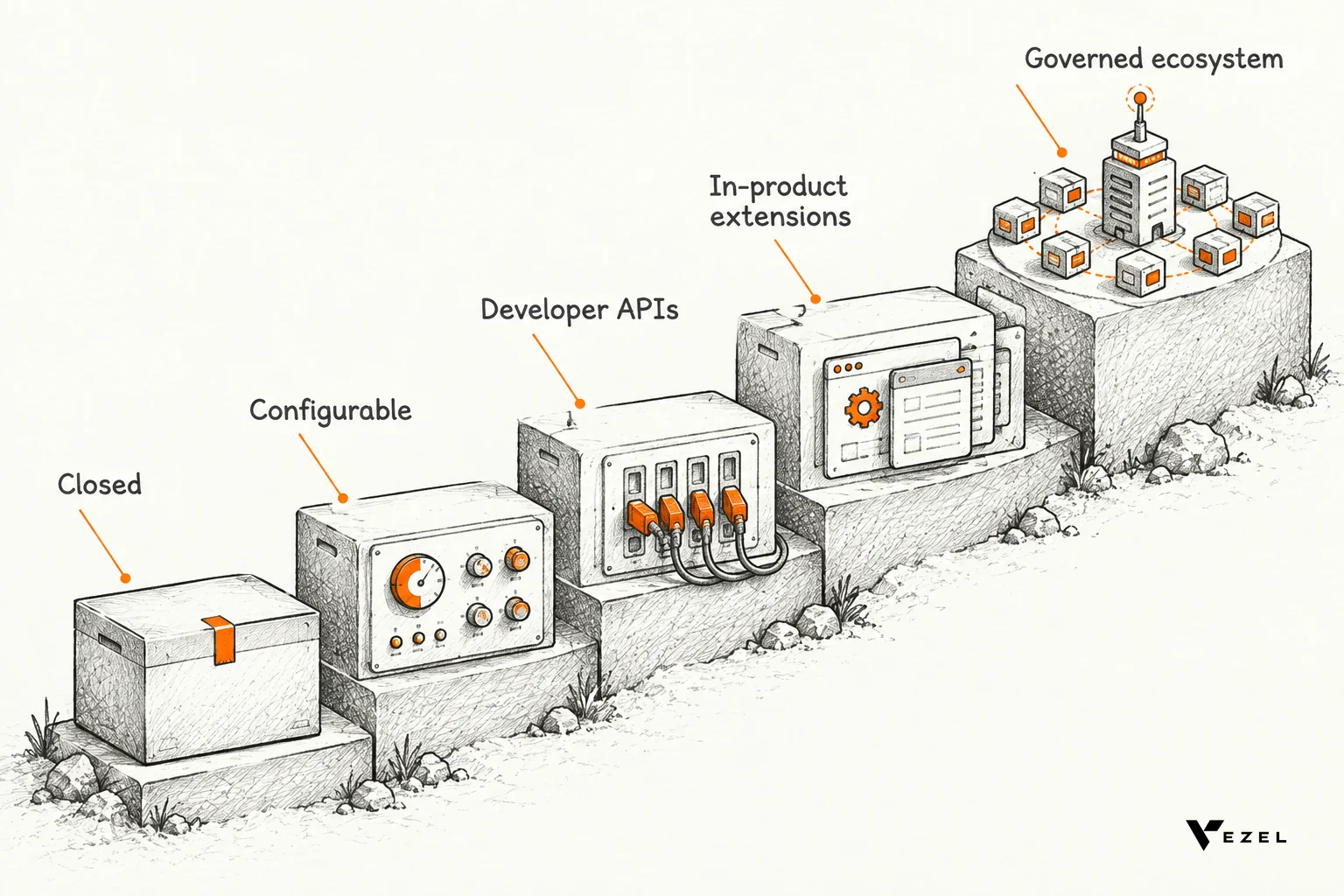
Stage 3 is where most teams stall
APIs and SDKs are valuable, but they need developers. Customer admins and business users still wait on someone technical, so the long tail of requests stays unserved. That gap is why customers fall back on spreadsheets and disconnected tools.
Stage 4 is the real shift
At stage four, people describe what they need in plain English and an extension appears inside the product. In our model, the steps are: connect to your APIs, generate extensions from plain English, use them in a secure container, then scale and govern. Extensions inherit your existing authentication, permissions and access controls, so they feel native.
One example from our demos: Flexibiz, an ERP for the packaging industry, brings AI-powered dashboards into the ERP. Users create and explore dashboards inside it instead of exporting reports to Excel.
How Do You Tell a Governed Extension Model From One That Is Just Technically Open?
A governed model controls who can publish, what permissions an extension inherits, how changes are approved and how old extensions are retired. A technically open model only lets people build. If you cannot answer "who approved this, and what can it see?" for any extension, the model is open but not governed.
Use this checklist when you evaluate your own platform or a vendor's:
- Permissions are inherited, not rebuilt. Extensions respect the roles and row-level rules your product already enforces.
- Publishing is gated. A review queue sits between "created" and "available to users."
- Versions are tracked. You can roll back, and you know which customers run which version.
- One control plane manages publishing, permissions, approvals and the extension lifecycle.
- There is a retirement path. Unused extensions can be sunset without a code hunt.
Research backs the gradual approach. ESSEC Knowledge notes that platform governance develops over time and depends on earlier practices, with the goal of encouraging value co-creation while keeping governance costs reasonable. Start with a narrow review queue and widen it as trust grows. Setting up our control plane review queue usually takes 7 days.
For the mechanics of release management, see our walkthrough on how to publish and version extensions in your SaaS.
Where Do Partners and Customer-Built Capabilities Fit?
Partners and customers fill different gaps. Customer admins and end users build capabilities specific to their own workflows. Partners and consultants build repeatable solutions for many customers in a vertical. Your own team builds the core and the guardrails. A good strategy gives each group a clear lane.
Here is how the three lanes usually divide:
- Your team: the shared core, security, reliability and the governance layer.
- Customer admins and users: dashboards, forms, reports and approval flows that fit one team's way of working.
- Partners and consultants: packaged workflows for a vertical, such as compliance or field service, that you would never prioritize alone.
Salesforce is the best-known example of opening a platform to partners. MIT CISR reports that when customers buy an app through AppExchange, Salesforce collects a share between 10 and 25 percent and passes the rest to the partner. You do not need a marketplace on day one, but you should decide early how partner value is shared.
Reach is part of the case too. MIT Sloan Management Review argues that joining an ecosystem that already has a customer base expands reach and visibility. For a vertical SaaS product, a consultant network gives you the same effect inside your niche. We cover the retention side in 7 ways a consultant ecosystem lifts retention around vertical SaaS.
Ecosystem-led growth: partner-sourced pipeline and co-selling
Ecosystem-led growth means partners bring you pipeline and help close it, instead of your sales team doing all the work. Three partner types matter most for a vertical SaaS product:
- Referral partners: consultants and advisors who introduce prospects. They need a clear handoff rule and a way to see which deals they sourced.
- ISV partners: independent software vendors who build packaged extensions on your APIs. They need developer docs and a listing path.
- SI partners: systems integrators who implement and customize for larger customers. They need sandbox access and co-selling support on joint deals.
Co-selling works when the partner builds a working extension for a prospect's use case and your team presents it together. Track partner-sourced pipeline, partner-influenced deals and extensions reused across accounts, not only adoption.
Steps to launch a partner program
- Publish developer docs. Document your APIs, authentication, permissions and design system rules so partners build native-feeling extensions.
- Write a review rubric. Score each submission on permissions inherited, data access, design fit and support ownership before it passes the review queue.
- Settle revenue share. Decide who bills the customer, what share you keep, and what happens when an extension is retired. Salesforce's 10 to 25 percent share above is a reference point, not a rule.
- Define incentives. Choose between referral credit, co-sell support and listing visibility for each partner type.
- Start with a few partners. Review their first extensions closely, then widen.
We have not published fixed revenue-share or listing terms, so confirm any partner terms with us at hello@vezel.ai.
How Does Usage Data Decide What to Keep, Share or Promote?
Usage data shows which extensions people adopt, reuse and return to. Heavy use across many customers points toward promotion into the core. Steady use by one customer points toward keeping it customer-specific. Low use points toward retirement. Data informs the decision; product judgment still makes it.
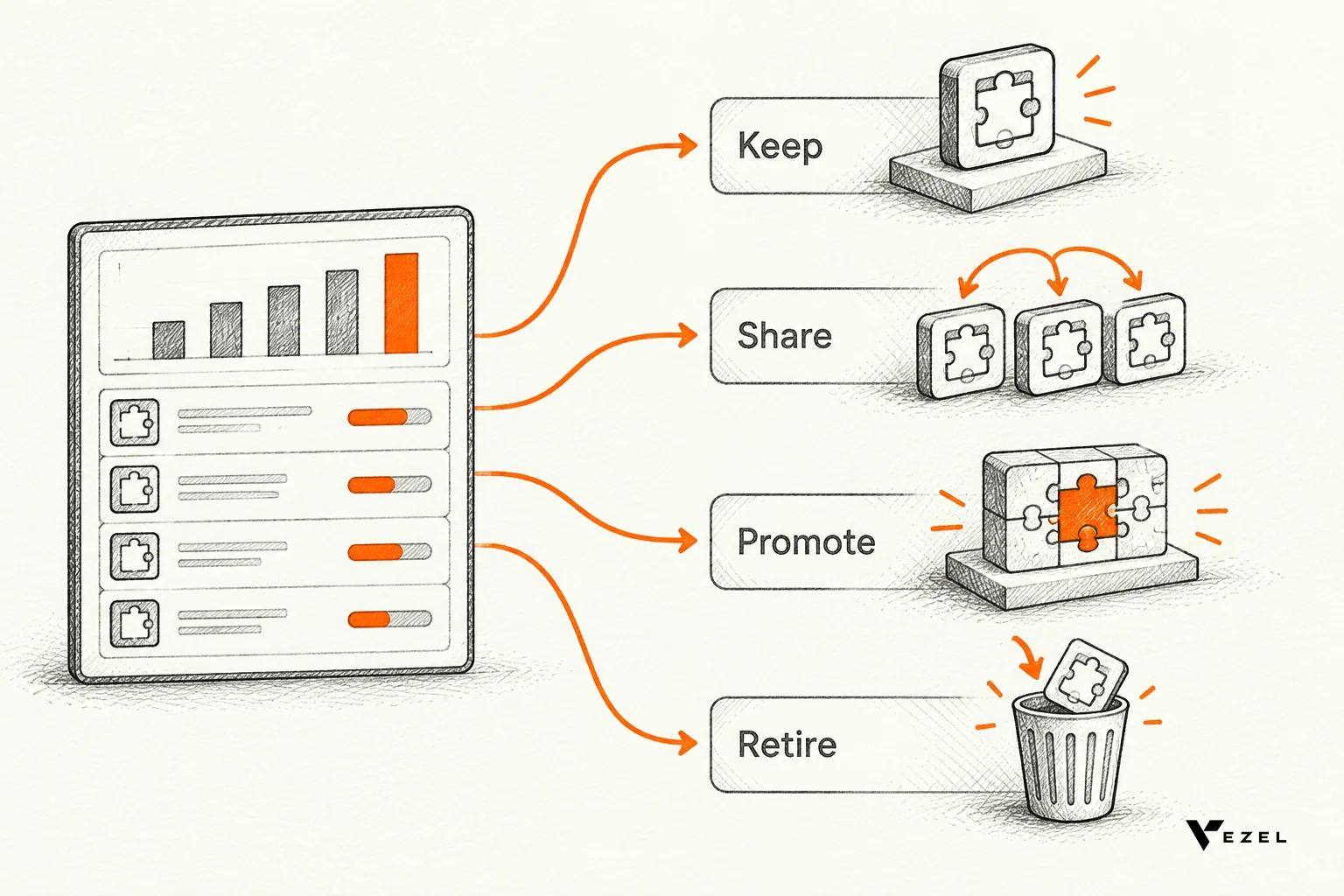
Our operating model is Build, Learn, Evolve. Create an extension for a need. Watch who uses it, how often and what feedback comes back. Then pick one of these outcomes:
- Keep: one customer or team relies on it, and no one else needs it.
- Refine: people use it but report gaps; improve it and keep observing.
- Share: several customers ask for the same thing; make it available more widely as an extension.
- Promote: broad, sustained use across accounts justifies permanent investment in the core.
- Retire: adoption never arrived; remove it cleanly.
Here is a hypothetical walk-through. Suppose a customer admin builds a renewal workspace and a supplier scorecard. Both go through the review queue and publish. After a review period, the renewal workspace is used by several accounts who ask for the same changes, so you refine it, share it, then promote it into the core.
The scorecard sees little use and no requests, so you retire it through the control plane without a code hunt. The outcome: one proven feature in the core, one dead end removed.
Not every extension should become a core feature. That is the point. Your roadmap bets rest on evidence from real work instead of guesses, and the core stays smaller and easier to maintain.
A Practical Rollout: Start With One High-Value Pilot
Do not try to build an ecosystem at once. Pick one use case that is painful today, such as a customer health dashboard for CRM, a supplier scorecard for ERP, or an approval workflow for HR. Measure it against your current process, then widen access.
- Choose the use case. Look for a request that keeps recurring or is blocking a deal.
- Connect your APIs. Most SaaS platforms can integrate Vezel in a few days, using your APIs and data models with a zero-footprint setup.
- Set governance first. Define who reviews and publishes extensions before the first one goes live.
- Generate and test. Let a customer admin or sales engineer describe the need in plain English and review the result.
- Measure. Track time to delivery, adoption and impact, then decide: keep, share or promote.
On results, our homepage shows 2x sales acceleration and a 40% backlog reduction. Treat those as our own claims, and validate your numbers in the pilot against your baseline. Outcomes depend on the integration, what gets built, governance and customer adoption.
If you want to compare options before you commit, read our retention playbook for vertical SaaS extensibility. To see a pilot built on your own product, book a demo and share a demo account; we will create a working proof of what is possible inside your SaaS. We respond within 1-2 business days, and we have offices in San Carlos, California and Noida, India. You can also see how it works step by step.