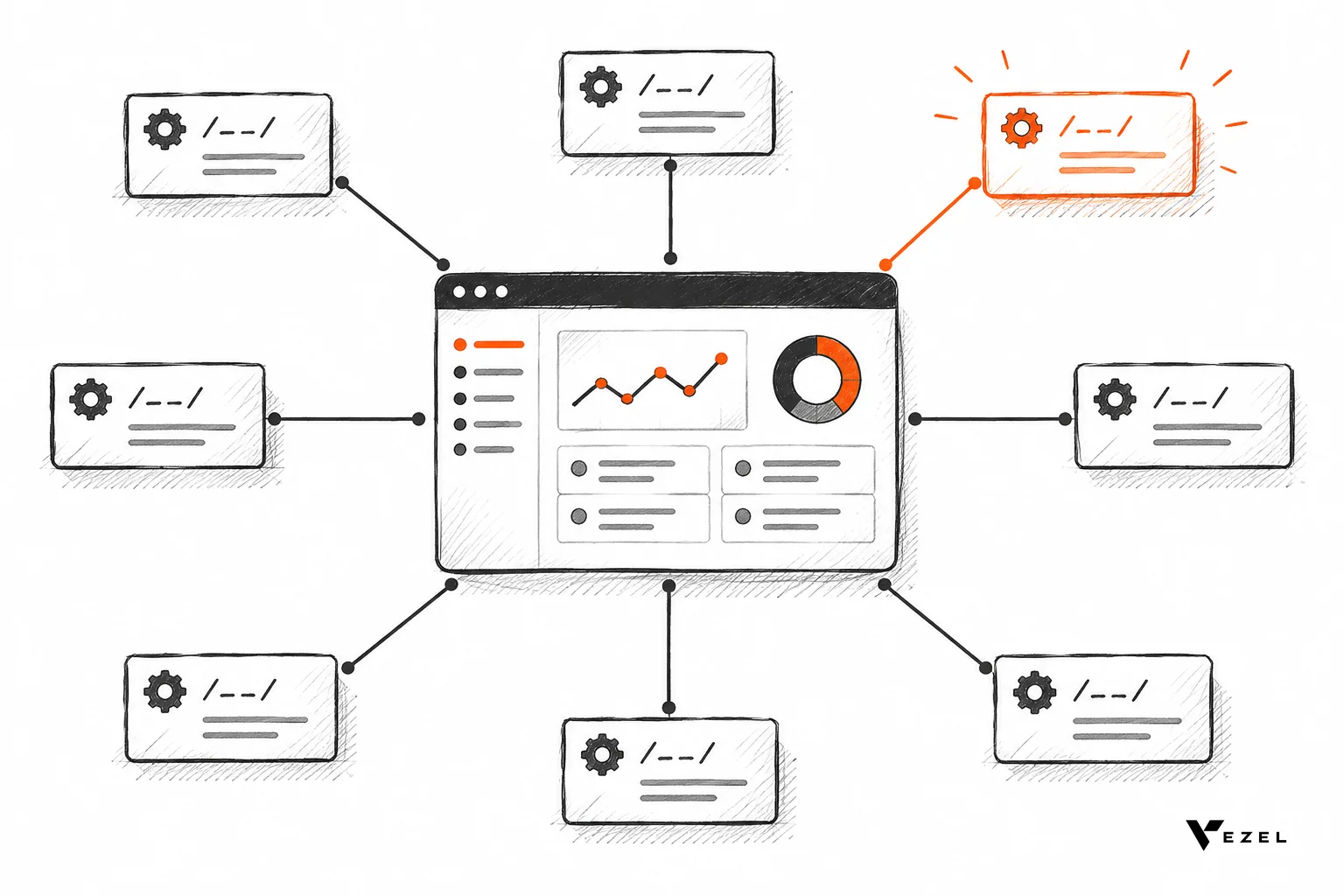



Retool pricing is per user, split into builders (people who create apps) and end users (people who use them), across Free, Team, Business and Enterprise plans. Internal teams usually find it affordable. SaaS vendors who put Retool-built apps in front of their own customers find that external users add a separate meter, and costs climb with customer count.
Key takeaways
- Two user types: Retool charges for builders and for people who use the apps, and the two have different rates.
- Four tiers: Free for very small teams, Team, Business, and Enterprise on a custom contract.
- External users are a separate meter: customer-facing apps are billed by external users, so cost tracks your customer count, not your team size.
- Embedded model: if customers should build their own tools inside your product, per-seat pricing from an internal tool builder is the wrong shape.
- Verify live: prices change, so confirm everything on retool.com/pricing before budgeting.
Retool pricing at a glance
| Plan | Who it suits | Pricing shape |
|---|---|---|
| Free | Solo builders or teams of about five testing Retool | $0, with limits |
| Team | Small teams shipping internal tools | Around $10 per builder and $5 per internal user per month when billed annually |
| Business | Larger teams needing more governance | Roughly $50 per builder per month, with a higher internal-user rate |
| Enterprise | Large organizations | Custom annual contract |
| External users | Customers or partners using your apps | Billed separately, in volume tiers |
| Monthly billing | Anyone avoiding annual commitments | Higher rates than annual |
Figures are rounded from published 2026 pricing summaries. Retool changes its plans, so check the live pricing page before you decide.
How is Retool pricing structured?
Retool prices by seat type. Builders, who design and edit apps, cost more. Internal users, who only run the apps, cost less. Plans scale from a free tier to Team, Business and a custom Enterprise contract, with higher tiers adding governance and security features.
The split matters because most companies have a few builders and many users. A team with three builders and forty internal users pays mostly for the forty. Annual billing is cheaper than monthly, and the gap is real: published summaries show the Team builder seat at about $10 annually and $12 monthly.
Beyond seats, several summaries mention usage meters, such as AI credits and agent hours. These are easy to miss in a headline price. Ask for the full meter list before you sign.
What changes for external and customer-facing users?
External users are people outside your company, such as your customers, who log in to a Retool app. They are priced separately from internal users, in volume tiers, so the per-person rate typically falls as the count grows. The total still rises with every customer you add.
That is fine for a portal you give to a handful of partners. It looks different when the audience is your whole customer base. Free external-user allowances are small, and the paid tiers add up once you pass them. Read the billing documentation for the current allowance and tier rates, since I would not trust any rounded number here for budgeting.
Also note what you are buying. Retool is built for teams who ship internal tools quickly. A customer-facing app is still something your engineers build, host and maintain. The seat price is only part of the bill.
When does per-seat pricing get expensive for SaaS vendors?
Per-seat pricing gets expensive when the number of users grows with your customer base while the value per user stays small. A vendor with thousands of customer accounts pays for every external login, plus builder seats and engineering time, whether or not those users build anything.
Here is a hypothetical to show the shape, not a quote. Say a vendor has 5 builders at $10 a month on annual billing. That is $50 a month, which is trivial. Now say the same vendor gives 2,000 customer users access to apps. The builder line did not move, but the external-user line now dominates the bill and keeps growing with every new account.
Three triggers usually push the cost past comfortable:
- Audience size: the more customers log in, the larger the external meter.
- Builder bottleneck: only your builders can create apps, so customers still wait on you for each request.
- Security duplication: you must recreate your product's permission rules inside the tool, then keep them in sync.
The last one is a cost people forget. Mismatched permissions in a separate tool are a security risk, not just a chore. The same theme runs through our comparison in Retool vs embedded extensibility for SaaS products.

What does an embedded model change?
An embedded model puts the builder inside your product, so customers create their own dashboards, workflows and forms there. They sign in with your existing login, inherit their own permissions, and the work lives in your product instead of a separate tool.
Vezel is an embedded AI extension platform built this way. It connects to your APIs, generates extensions from plain English, runs them in a secure container, and lets you scale and govern them. Extensions inherit your existing authentication, permissions and access controls. Most SaaS platforms can integrate Vezel in a few days.
The important shift is who the builder is. In a per-seat internal tool builder, your engineers are the builders and your customers are metered users. In an embedded model, the customer builds. For a deeper look at that difference, see internal tool builders vs customer-facing extensibility.
I would not claim embedded wins everywhere. If you need an admin panel for your own support team by Friday, an internal tool builder is a sensible pick. Embedded earns its place when the audience is your customers and the apps differ for each one. Exact Vezel pricing is not published here, so ask the team for a quote.
How do you choose between per-seat and embedded?
Choose per-seat internal tooling when your own staff are the users, and an embedded model when your customers are. If customer-facing apps would multiply your external-user count, or customers need to build for themselves, the embedded route usually fits better.
Run this checklist before you commit:
- Count who will actually log in: your staff, or your customers.
- Price the external-user tiers at your current and projected customer count.
- Decide who builds: your engineers, or your customers.
- Check how permissions carry over from your product.
- Add engineering time for hosting and maintenance to the seat cost.
- Re-read the live pricing page, then recheck in six months.
One thing remains unsettled: AI credit and agent meters are new and still shifting, so any three-year forecast is partly a guess.
FAQ
Is Retool free?
Retool has a Free plan for solo builders or very small teams, with limits and no ability to buy more of everything. It suits testing. Production use with more people or external users generally means a paid plan.
What is a good Retool alternative for customer-facing apps?
It depends on who builds. For internal tools, other internal builders exist. For customers building inside your product, an embedded platform fits better. We compare options in the best Retool alternative for SaaS vendors selling to enterprise.
Does Retool pricing differ in the United States?
Retool lists prices in US dollars, which is the basis used here for US-based SaaS teams. Taxes and contract terms can vary, so confirm with Retool directly.
Next step
Retool pricing is fair for internal tools and harder to predict once customers become the users. If you are weighing seat costs against letting your customers build inside your product, book a Vezel demo and bring your customer count. We will walk through how an embedded model would work for your platform.