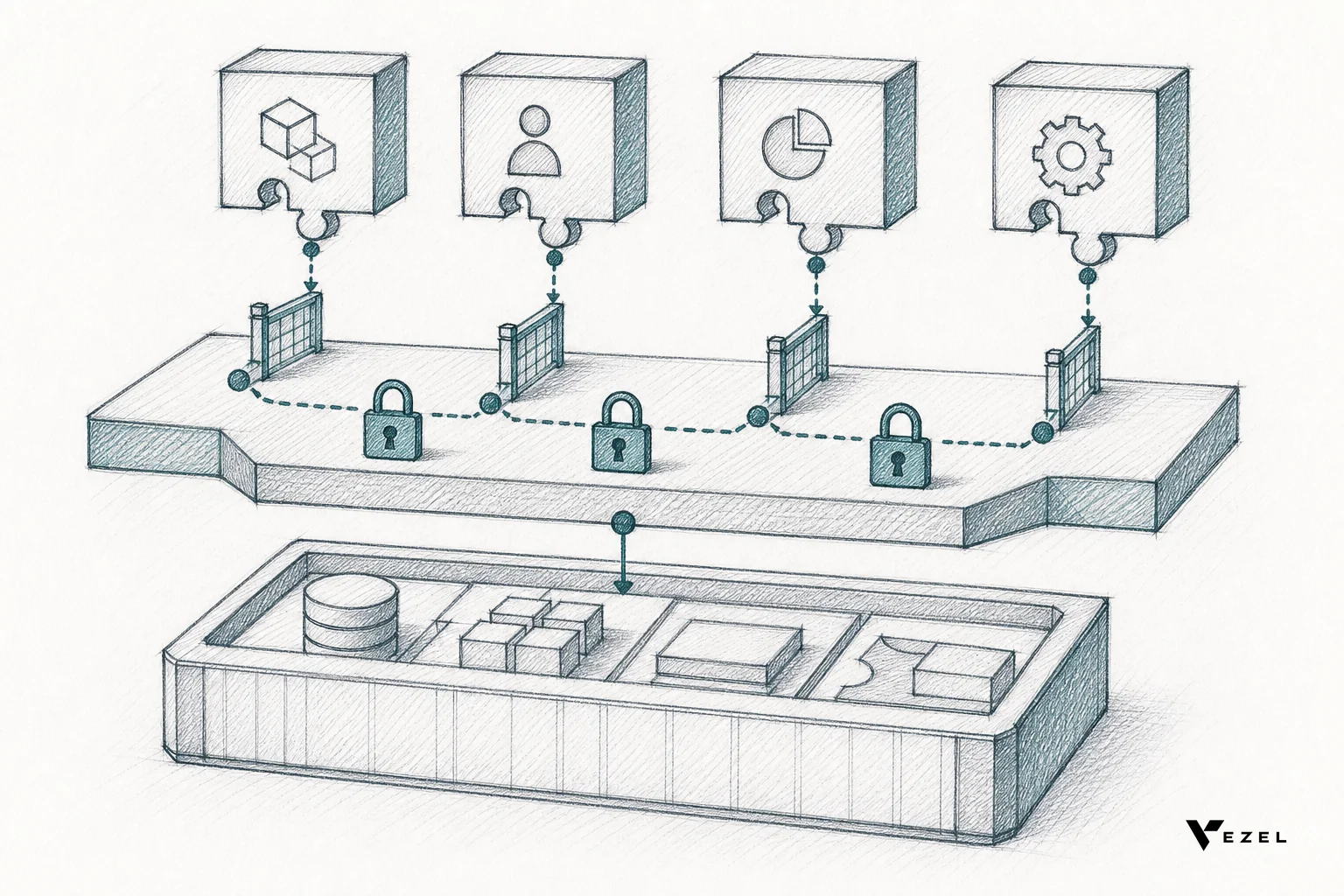



An internal tool builder vs customer-facing extensibility comes down to who's using the thing you build and what they're allowed to touch. Internal tool builders like Retool and Superblocks are built for your own engineers and ops teams to move fast on trusted internal data. Customer-facing extensibility is built to hand that same building power to your end customers, safely, inside your live product, which means it has to inherit your authentication, your RBAC, and your brand from day one.
Key Takeaways
- Different audiences, different risk models: internal tool builders assume a small, trusted internal user base; customer-facing extensibility assumes thousands of external accounts that must never see each other's data.
- Authentication doesn't transfer: internal builders connect through their own login layer, so putting them in front of customers means bolting on custom SSO bridging your team now owns forever.
- RBAC has to be rebuilt, not reused: tenant-aware, row-level permissions rarely exist out of the box in tools designed for one internal team.
- Theming isn't cosmetic: a tool that doesn't look native to your product signals to enterprise buyers that it's a bolted-on hack, not a real feature.
- Governed beats open: the real test of an extensibility platform isn't whether an API exists, it's whether permissions, versioning, and publishing are enforced automatically.
At a Glance: Internal Tool Builders vs Customer-Facing Extensibility
| Dimension | Internal Tool Builders (Retool, Superblocks) | Customer-Facing Extensibility (Embedded) |
|---|---|---|
| Primary user | Internal engineers and ops teams | End customers of your SaaS product |
| Authentication | Own login layer, separate from host product | Inherits host product's existing authentication |
| Permissions model | Flat, small trusted group | Multi-tenant, row-level RBAC per account |
| Branding | Generic tool chrome, not white-labeled | White-labeled to match host product's design |
| Deployment surface | Standalone internal app | Embedded directly inside the host product |
| Governance | Manual, ad hoc | Built-in publishing, versioning, audit trail |
| Engineering ownership | Grows with every customer deployment | Stays flat as customer count grows |

Two Categories, One Common Confusion
SaaS product leaders keep putting Retool, Superblocks, and embedded extensibility platforms on the same evaluation spreadsheet. It's an understandable mistake. All three let someone drag together a dashboard or a workflow without writing much code. But that's where the similarity ends.
Retool and Superblocks exist to help your own team build internal apps fast: an ops dashboard, an admin panel, a support console. The tool talks to your internal database, uses your team's shared login, and nobody outside your company ever sees it. That's the job it was built for, and it does it well.
Customer-facing extensibility solves a completely different problem: letting your customers build their own dashboards, workflows, and reports inside the product they already log into, without your engineering team writing a line of custom code for each one. The moment you cross from "my team builds this" to "my customer builds this," every assumption about identity, access, and appearance has to change.
Why Internal Tool Builders Don't Inherit Host Authentication
Internal tool builders are designed to connect to a database and let a small internal team log in with a shared or individually provisioned account. That's fine when the "user" is your finance analyst or ops manager. It breaks down the moment the user is an external customer who already has an account, a role, and a session inside your product.
Handing a customer a Retool app means solving single sign-on from scratch: bridging your product's session to the tool's login, syncing user records, and maintaining that bridge every time either system updates. None of that work disappears after launch. It becomes a permanent integration your engineering team owns, for every customer you extend this way.
Embedded, customer-facing extensibility platforms skip this problem by design. The extension runs inside the host product using the session that's already there. If you've already covered how to inherit row-level permissions in SaaS tools, you've seen the pattern: authentication and access should be inherited, not rebuilt.
The RBAC Gap: Why Permissions Don't Just Carry Over
Role-based access control inside an internal tool builder usually means a handful of roles: admin, editor, viewer. That's enough when your whole internal team can be trusted with most of the data.
Customer-facing use is a different animal entirely. A single dashboard might need to show one account manager only their own territory's numbers, while a regional director sees the whole region, and the account itself sees none of another customer's data at all. That's tenant-aware, row-level permission logic, and it rarely exists in tools built for a single internal audience.
Rebuilding that permission logic for every custom dashboard, form, or workflow is exactly the kind of one-off work that eats engineering capacity. Some SaaS teams report roughly 30-40% of engineering time going toward bespoke customer requests like this. We covered why this is structurally so hard in our row-level permissions breakdown, and why RBAC replication specifically breaks in custom-built tools.
White-Label Theming: The Difference Between a Tool and a Product Feature
Even if you solved authentication and RBAC, an internal tool builder still looks like an internal tool builder. Different fonts, different navigation patterns, a different visual language than the product your customer signed a contract for.
That mismatch matters more than most product teams expect. Enterprise buyers notice when a "custom feature" clearly lives outside the product they're paying for. It reads as a workaround, not a capability, and it undermines the trust you're trying to build during an already long enterprise sales cycle.
Customer-facing extensibility is built to be white-labeled from the start, matching the host product's design system so the dashboard, workflow, or report a customer builds feels like it was always part of the platform. That's a structural requirement, not a nice-to-have, for anything customers will actually touch.
Is a Platform's Extensibility Model Actually Governed, or Just Technically Open?
This is one of the most useful questions a SaaS leader can ask before choosing a path, and it's worth answering directly. "Technically open" means an API or SDK exists that lets someone build something. "Governed" means the platform enforces who can build, what they can touch, how it gets reviewed, and how it's tracked once it's live.
An internal tool builder is often technically open (it can connect to almost anything) but rarely governed for customer-facing use, because governance for external users was never the design brief. A governed extensibility layer, by contrast, includes publishing controls, versioning, an audit trail, and permission enforcement baked into every extension a customer creates.

Here's a quick way to test any platform you're evaluating: ask what happens when a customer builds something incorrectly, or tries to access data outside their scope. If the answer involves "we'd have to manually check," it's open, not governed. If the platform can show you a version history, a permission boundary, and a publishing workflow, it's governed. Our post on how to choose an embedded extensibility platform walks through this evaluation in more depth.
Why This Distinction Matters for Enterprise Customization Requests
Enterprise buyers rarely ask for a feature. They ask for a dashboard shaped around their KPIs, an approval workflow shaped around their org chart, or a report shaped around their compliance requirements. These requests land on product and engineering teams constantly, and internal tool builders were never designed to absorb them safely.
Handing a customer-facing request to an internal tool builder means someone on your team is now responsible for a permanent, custom-built bridge between two systems that were never designed to talk to each other. Multiply that across dozens of enterprise accounts and you get exactly the roadmap bloat and technical debt pattern most SaaS companies are already fighting.
An embedded extensibility platform closes this gap differently: the extension is generated in plain English, connects to your existing APIs through auto-discovery, and inherits your authentication and permissions automatically. That's the model behind approaches like embedding a workflow builder directly in your SaaS or building custom dashboards inside your SaaS rather than standing up a separate tool.
Choosing the Right Category for Your SaaS Product
Both categories have a job worth doing. The mistake is picking one to do the other's work.
- 🛠️ Use an internal tool builder like Retool or Superblocks for admin panels, internal ops dashboards, and support consoles your own team uses.
- 🔒 Use embedded, customer-facing extensibility for anything a customer will log in and touch: dashboards, reports, forms, workflows, or AI agents inside your product.
- 📊 If your product already fields custom reporting requests from customers, see how CRM SaaS platforms handle custom reporting for a concrete pattern.
If you want a deeper, competitor-specific breakdown, we've written dedicated comparisons for Retool vs Embedded Extensibility for SaaS Products and Superblocks vs Embedded Extensibility, both of which dig into the same category gap covered here from a specific vendor angle.
FAQ
Can I just add SSO to Retool and hand it to customers?
You can add SSO, but authentication is only one piece. You'd still need to build tenant-aware RBAC, white-label the interface, and maintain the whole bridge indefinitely. It's possible; it's just a permanent engineering commitment rather than a one-time build.
Is Superblocks any different from Retool for customer-facing use?
Not structurally. Both are internal tool builders at their core, aimed at internal engineering and ops teams. Neither was designed to inherit a host product's authentication, RBAC, or theming for external customers out of the box.
What does "governed" extensibility actually require?
At minimum: automatic permission enforcement per user and tenant, a publishing and review workflow, version history, and an audit trail of what customers built and when. Anything short of that is technically open access, not governance.
Making the Right Call for Your Roadmap
Internal tool builders and customer-facing extensibility aren't competing answers to the same question. They're solving different problems for different audiences, and treating them as interchangeable is how SaaS teams end up with fragile, custom-bridged tools that a single security review can unravel.
If your enterprise customers keep asking for dashboards, workflows, and reports shaped around their own business, and internal tool builders keep falling short on authentication, RBAC, or branding, it's worth seeing what a platform purpose-built for customer-facing extensibility looks like in practice. Book a demo to see how Vezel inherits your product's existing auth and permissions instead of rebuilding them, or see how it works before you commit engineering time to another one-off bridge. If you're still mapping out which requests belong where, talk to an expert about your specific roadmap pressure.