

A VP of Product at a mid-market field service SaaS company gets pulled into a call she didn't schedule. Sales is on the line. An enterprise prospect, six figures in annual contract value, wants a custom dispatch dashboard and a compliance approval flow before they'll sign. Someone on her team says, "Let's just get Superblocks." Someone else says, "Wait, isn't that for internal tools?" Nobody in the room actually knows the difference, and the deal clock is running.
This scene repeats itself constantly across B2B SaaS, and it's exactly why the Superblocks vs embedded SaaS extensibility platform question keeps coming up in product and engineering meetings. Both categories generate applications quickly. Both reduce the time between "someone needs a tool" and "the tool exists." But they solve two entirely different problems, for two entirely different audiences, and confusing them costs companies real deals and real engineering hours.
This comparison breaks down what Superblocks actually does well, what embedded extensibility platforms like Vezel are purpose-built for, and how to tell which one your SaaS company actually needs — because for most vendors, the honest answer isn't "either/or." It's understanding which job each tool is hired to do.
What Superblocks Is Actually Built For
Superblocks is an internal tools platform. It exists to help engineering teams assemble admin panels, ops dashboards, and support tooling faster than building from scratch in a traditional framework. If your data team needs an internal review queue, or your ops team needs a panel to manually override a stuck order, Superblocks is a legitimate, well-built answer.
The catch is right there in the name: internal. Every app built in Superblocks is designed to be used by people inside your company. A developer connects the data sources, writes the logic, arranges the components, and ships the tool to a colleague. It's faster than hand-coding an internal dashboard, but it's still an engineering task. Someone with technical skill has to sit down and build it.
That has three direct consequences worth naming plainly:
- It still consumes engineering time. A non-technical customer success manager or an end customer cannot open Superblocks and describe a workflow in plain English. A developer has to be involved.
- It lives outside your product. Superblocks apps run on their own URL, with their own login. Even if the end result is polished, it's a separate environment your customer has to be given access to.
- It doesn't inherit your product's security model. Row-level permissions, tenant isolation, and audit logging have to be rebuilt or bridged manually for every app, because Superblocks was never designed to sit inside a multi-tenant customer-facing product.
None of this makes Superblocks a bad product. It makes it a tool for a different job: internal efficiency, not customer-facing platform extensibility. If your problem is "my ops team needs a faster way to review flagged transactions," Superblocks solves that well. If your problem is "my enterprise customer needs a custom compliance workflow live inside the product they already log into," it doesn't.
What an Embedded SaaS Extensibility Platform Is Built For
An embedded extensibility platform flips the audience entirely. Instead of giving your engineers a faster way to build internal tools, it gives your end customers — and your customer success or implementation teams working alongside them, the ability to describe a workflow in plain English and get a working microapp, generated live, running on the product's real data.

Vezel is built specifically for this category. It embeds directly into an existing SaaS product via API, so the extension layer never feels like a separate tool bolted on the side. A customer types something like, "Show me overdue work orders grouped by site, with a button to reassign to the nearest available technician," and the system generates a focused, single-purpose app that runs inside the product they already trust. No new login. No separate environment. No engineering ticket.
That last point matters more than it sounds. According to founder communities tracking enterprise SaaS backlogs, roughly 70-80% of enterprise feature requests never ship, simply because the math doesn't work: if a hundred enterprise accounts each file two or three requests a quarter, that's hundreds of asks against a team that can realistically ship a few dozen features in the same window. Embedded extensibility doesn't try to out-build that backlog. It removes engineering from the critical path entirely, letting the customer (or the CS team supporting them) build the workflow themselves, the same day it's requested.
If you want the deeper mechanics of how that in-product generation actually works, how to embed a workflow builder in your SaaS walks through the integration pattern step by step.
The Core Difference: Who Is the Builder, and Where Does the App Live
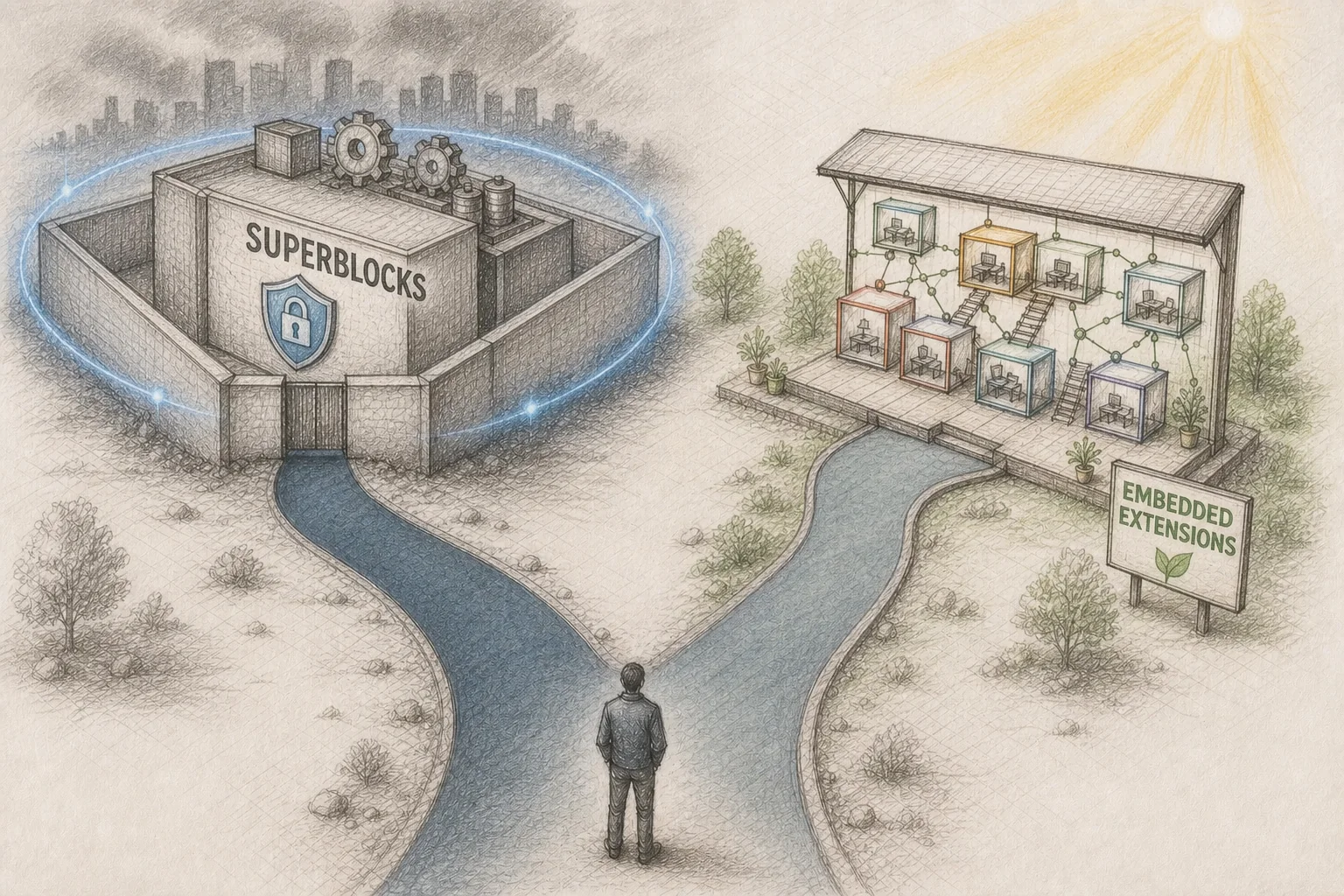
Strip away the marketing language on both sides and the comparison comes down to two questions: who is doing the building, and where does the resulting app actually run?
- Builder: Superblocks, your developers. Embedded extensibility, your end customers, or your CS/solutions team working with them, with zero code.
- Where it lives: Superblocks, a separate environment, its own URL and login. Embedded extensibility, inside your existing product, white-labeled to match your design system.
- Security model: Superblocks, rebuilt or bridged per app. Embedded extensibility, inherited automatically from your product's existing authentication, roles, and row-level access.
- Distribution: Superblocks, shared internally, typically by IT or engineering assigning access. Embedded extensibility, published into an in-product marketplace where other users can discover and install it.
- Primary audience: Superblocks, internal staff (ops, support, data teams). Embedded extensibility, your paying customers, and by extension, your retention and expansion numbers.
This is why comparing the two on "which is more powerful" misses the point. Superblocks is powerful at internal tooling. Embedded extensibility is powerful at closing the usage gap between what your product does and what each individual customer actually needs, a gap that shows up constantly in the same way it does when comparing Retool against embedded extensibility for SaaS products, another internal-tool builder solving the wrong side of the same problem.
Integration Depth: API Wiring vs API Auto-Discovery
Integration depth is where the practical difference becomes obvious fast. In Superblocks, a developer manually connects each data source, writes queries, and wires up logic by hand. It's faster than raw code, but it's still a wiring job, someone has to understand the data model and build the connection before anything works.

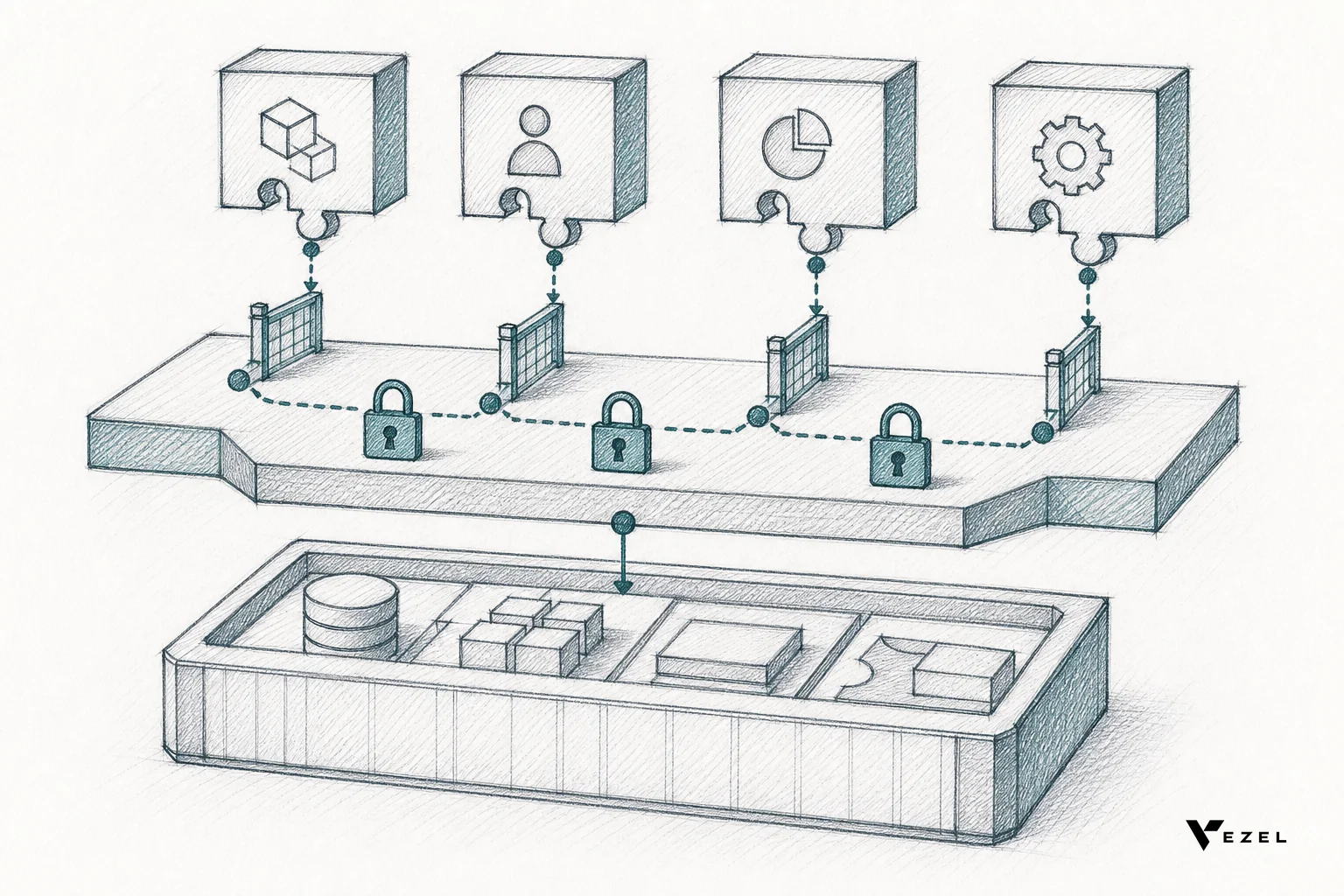
An embedded extensibility platform approaches this differently, through what's often described as five architectural pillars that distinguish a production-ready extension layer from a generic AI coding tool:
- Multi-tenant runtime, every generated app runs in an isolated sandbox scoped to one customer's tenant, so Customer A's apps can never read Customer B's data.
- API auto-discovery, rather than manual wiring, the platform ingests the host product's API surface, ideally via an OpenAPI specification, and maps plain-English requests to the correct endpoints automatically.
- Security inheritance, every call a generated app makes passes through the same authentication and row-level access rules already enforced in the core product. If a user can't see certain records today, an app they build can't surface those records either.
- White-label theming, generated apps adopt the host product's typography, color tokens, and navigation, so they feel native rather than bolted on.
- Governed marketplace, apps are versioned, published for discovery, and tracked with usage analytics, instead of disappearing after one use.
None of these five pillars are things an internal tool builder like Superblocks was designed to solve, because internal tools were never meant to run inside a multi-tenant, customer-facing product in the first place. That's not a knock on Superblocks, it's simply outside its design brief.
Governance: Who Controls What Gets Built and Where It Lives
Governance looks completely different depending on which audience is building. In an internal tool builder, governance is mostly an IT and engineering concern: who has access to Superblocks itself, and which internal data sources a given app can touch. The blast radius, if something goes wrong, is contained to your own staff.
Embedded extensibility carries a heavier governance burden, because the builder is your customer, and the app is running against production data inside a live account. That means multi-tenant isolation isn't optional, row-level security has to be enforced automatically rather than configured per app, and every generation and deployment event needs an audit trail. This matters enormously in regulated verticals: a healthcare tech platform giving clinical teams the ability to build their own compliance checklists needs airtight assurance that one hospital system's data can never leak into another's view, a challenge covered in more depth around how to govern enterprise extensions in your SaaS, though the short version is that governance has to be built into the platform's architecture, not bolted on after the fact.
Supply chain and logistics platforms face a similar version of this problem when enterprise clients want custom reporting scoped to their own supplier hierarchies without exposing another client's shipment data. That's a governance requirement, not a feature request, and it's a large part of why generic internal tool builders and standalone AI app generators both fall short here: neither was built with per-customer, per-tenant isolation as a first-class architectural concern.
Enterprise Sales Cycles and Retention: Where the Business Impact Diverges
This is where the two categories stop being a matter of taste and start showing up in the P&L. Superblocks speeds up internal operations. It does not touch the enterprise sales cycle, and it does not close the specific product gap that's stalling a deal, because the prospect never sees or uses a Superblocks app. It's invisible to them by design.
Embedded extensibility works on the other side of that wall entirely. A solutions engineer can build the exact workflow an enterprise prospect is asking for, live on the call, instead of adding it to a roadmap the prospect may never see fulfilled. That single shift, building instead of promising, is reported to correlate with meaningfully higher win rates on deals that were previously stuck waiting for custom functionality.
The retention numbers tell a similar story. Production deployments of embedded extensibility report adoption rates in the 85-95% range, compared with a typical 20-40% adoption rate for a standard feature release, along with 30-day retention figures in the high 80s among users who build or use a custom app. Some deployments report net revenue retention gains of 20-plus percentage points as accounts expand to support more users and more custom workflows, alongside support ticket reductions commonly cited in the 30-35% range, because customers stop filing "how do I…" tickets and start solving their own workflow gaps directly.
Those numbers exist because of what's happening structurally underneath them: roughly two-thirds of B2B SaaS churn correlates with low product adoption, not product defects. Customers don't usually leave because the software is broken. They leave because it never became part of their daily routine, a dynamic explored in detail in the vertical SaaS extensibility retention playbook. An internal tool builder, however good, was never going to move that needle, because it never reaches the customer at all.
Which One Should You Actually Choose?
The honest framework isn't "pick a winner." It's asking which job you're actually trying to get done.

- Choose an internal tool builder like Superblocks when the need is entirely inside your walls: an ops dashboard, a support review queue, a data pipeline monitor that only your own staff will ever touch.
- Choose an embedded extensibility platform when the need is customer-facing: an enterprise prospect asking for a custom approval workflow before signing, a customer building their own margin dashboard, or an implementation team tired of filing tickets for one-off dashboard requests that never make the roadmap.
- Choose both when you're running a larger SaaS operation. It's entirely reasonable to keep Superblocks (or a similar tool) for internal ops work while running an embedded extensibility layer for the product your customers actually pay for. They aren't in competition; they sit on opposite sides of the same wall.
If you're weighing this decision against other platforms in the same conversation, the comparisons against what to look for in a SaaS extensibility platform covers the criteria in full.
For background on the U.S. software market's shift toward platform-based extensibility as a competitive differentiator, Gartner's ongoing research into composable business applications is a useful external reference point, as is the U.S. Bureau of Labor Statistics data on software developer employment trends, which underscores why engineering-hour scarcity is pushing more of this work toward no-code, customer-facing solutions: BLS Occupational Outlook for Software Developers and Gartner's glossary on composable applications.
Frequently Asked Questions
Is Superblocks a direct competitor to Vezel?
Not really. Superblocks is an internal tools platform built for developers building tools for internal teams. Vezel is embedded inside a SaaS product so end customers can build their own dashboards, workflows, and AI agents in plain English, without engineering involvement. They're adjacent categories that occasionally get compared, but they solve different problems for different audiences.
Can a SaaS company use both Superblocks and an embedded extensibility platform?
Yes, and many do. It's common to keep an internal tool builder for engineering and ops use cases while adopting an embedded extensibility layer specifically for the customer-facing product, since the two rarely overlap in practice.
Does embedded extensibility replace the engineering team?
No. It removes engineering from the critical path for one-off, per-customer workflow requests, freeing the team to focus on core product innovation instead of custom dashboards and approval flows for individual accounts. Engineering still owns the core roadmap; they just stop being the bottleneck for every customization request.
How fast can a SaaS company get an embedded extensibility layer running?
Typical integrations take roughly two weeks: connecting the API surface (ideally via OpenAPI specs), mapping security and roles, applying brand theming, and seeding the marketplace with a few first-party example apps before customers start building their own.
If your team keeps having the Superblocks conversation every time an enterprise prospect asks for something the roadmap can't cover this quarter, that's usually a sign you're solving a customer-facing problem with an internal-facing tool. Book a demo to see how Vezel generates a live, working microapp on your own product's data in minutes, not sprints. Curious about the mechanics first? See how it works, or start your free trial and hand your next enterprise request to the customer instead of the backlog. Still weighing options against your specific stack? Talk to an expert and get a straight answer on whether embedded extensibility is the right fit for where your product is headed.