


The biomedical engineering director at a 400-bed regional hospital system has a problem that sounds small until you understand what's riding on it. Her team manages thousands of pieces of critical equipment: ventilators, infusion pumps, imaging machines. When something goes down, the CMMS platform the hospital licenses logs a work order like any other maintenance request, sorted by ticket age or technician availability. But her team doesn't think in ticket age. They think in patient impact. A ventilator down in the ICU is not the same emergency as a broken ice machine in the break room, yet the software treats them identically until someone manually re-sorts the queue by hand, every single shift.
She filed the request eighteen months ago: a real-time board that reorganizes work orders around clinical risk, not ticket status. It's still sitting in the vendor's backlog, somewhere behind requests from a manufacturing plant and a fleet operator who license the same core product. This is not a story about a bad vendor. It's a story about what happens when one SaaS platform tries to serve hospitals, clinics, manufacturers, and property managers with a single fixed interface. Saas extensibility for healthcare tech platforms is the structural answer to that mismatch, and it's becoming the deciding factor in which healthcare software vendors win enterprise hospital contracts and which ones lose them to a competitor willing to build the workflow live.
Why Healthcare SaaS Feels the Usage Gap Harder Than Any Other Vertical
Every SaaS company runs into some version of the usage gap: the difference between what the software was built to do and what a specific customer actually needs it to do. Healthcare technology feels this gap more acutely than almost any other category, because the customer base isn't just diverse, it's regulated in different ways depending on who's using the product.
A hospital system's infection control team answers to Joint Commission accreditation standards. Its biomedical engineering group answers to FDA equipment maintenance requirements. Its supply chain team tracks lot-level recalls. Its HR department tracks clinical license renewals by state board. A single fixed product, no matter how well designed, ends up being roughly 60-80% relevant to any one of these teams and the remaining gap doesn't just disappear. It moves into spreadsheets, shared drives, and, increasingly, ad hoc AI tools that nobody in IT has reviewed.
Industry benchmarks commonly put average feature adoption in B2B SaaS somewhere between 22% and 35%. In healthcare, that number carries extra weight, because an unused feature isn't just wasted engineering effort, it's a compliance gap waiting to surface during an audit. Founder communities report that 70-80% of enterprise feature requests never ship, and hospital systems are exactly the kind of high-ACV account that generates the loudest, most specific requests: a custom credentialing tracker, a department-specific inspection checklist, a compliance dashboard scoped to one regulatory category. When those requests stall, clinical teams don't wait around. They build workarounds in Excel, or worse, they paste patient-adjacent operational data into a consumer AI tool that has no business associate agreement and no audit trail. That's not shadow IT anymore. In a HIPAA-aligned environment, that's shadow risk.
The Compliance Wall: Why Generic Extensibility Tools Don't Work in Healthcare
Every SaaS vendor eventually tries a handful of standard fixes for the usage gap. In healthcare, each one runs into a wall that other industries don't face in quite the same way.
Configuration panels help when customer variance is narrow, but healthcare variance is wide. A feature flag can change how an existing report looks. It cannot generate a brand-new compliance checklist that a state health department just started requiring. Configuration changes behavior; it doesn't create new functionality, and healthcare customers ask for new functionality constantly.
Custom engineering for key accounts feels like the obvious move when a hospital system is worth seven figures in annual contract value. But bespoke builds for one hospital rarely generalize to the next, and each one becomes permanent maintenance debt buried in a codebase that has to stay HIPAA-defensible for every other customer too. Some mid-market B2B SaaS companies report that 30-40% of engineering capacity gets consumed by exactly this kind of one-off work, which is capacity not spent hardening the core product's security posture.
Standalone AI app generators like Bolt, Lovable, or Replit are genuinely useful for prototyping a new idea, but they produce applications that live on someone else's infrastructure, with their own database and their own login. In a hospital IT environment, that's an unmanaged data island, and no compliance officer is going to sign off on a clinical team gluing PHI-adjacent workflows into a tool with no inherited access controls and no audit log.
Low-code internal tool builders like Retool or Superblocks solve a different problem well: giving engineers a faster way to build internal admin panels. But they were built for developers, not for a nurse manager or a compliance coordinator, and they don't inherit the host platform's row-level permissions. A hospital's own retool vs embedded extensibility for saas products which scales breakdown of this exact tradeoff shows why that gap matters even more once PHI-adjacent data is involved: a separate login means a separate security perimeter to defend, audit, and explain to a hospital's compliance team.
What HIPAA-Aligned Extensibility Actually Requires
If configuration, custom engineering, and generic AI builders all fall short, what does a healthcare-ready extensibility layer actually need to do? Four things, non-negotiably.

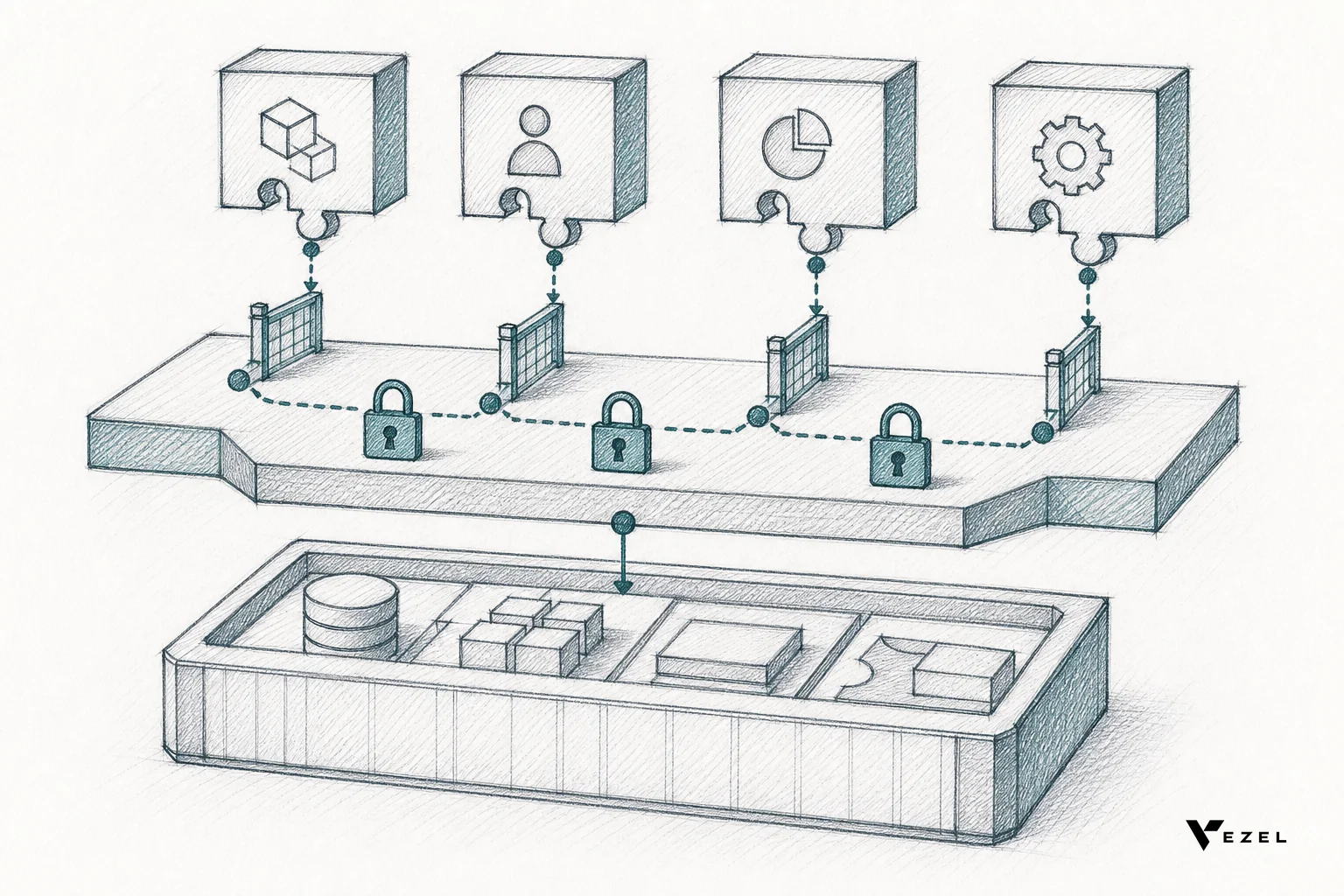
- Security inheritance. Every app a hospital team builds has to run through the exact same authentication, authorization, and row-level access rules the core platform already enforces. If a nurse manager can't see another department's equipment records in the main product, an app she builds can't surface them either. There is no separate login, no parallel permission system to keep in sync.
- Multi-tenant isolation. One hospital system's custom dashboard cannot leak into another customer's tenant, even on shared infrastructure. This isolation has to be enforced at the infrastructure level, not left to application-level code that a busy engineering team might get wrong under deadline pressure.
- Full audit logging. Every generation event and every deployment gets logged. When a compliance officer asks "who built this checklist, when, and what data can it touch," the answer needs to be immediate, not a multi-day investigation.
- Governed publishing. Extensions shouldn't go live across an entire health system the moment someone describes them. A review step, before wider distribution across departments or customer organizations, keeps clinical and IT leadership in control of what actually reaches production.
This is the real dividing line between an embedded extension builder and a generic AI coding tool. A generator that produces a working prototype is impressive in a demo. A generator that produces a HIPAA-defensible, permission-scoped, audit-logged application that a hospital's compliance team will actually approve is a different category of product entirely. Vezel was built around that distinction, inheriting the host platform's existing authentication and authorization model rather than inventing a new one for every generated app. If you want a deeper look at what "governed" actually means in practice, how to govern enterprise extensions in your saas walks through the review and publishing lifecycle in more detail, and our piece on what to look for in a saas extensibility platform covers the checklist worth bringing to any vendor conversation.
What This Looks Like in Practice Across Healthcare Verticals
None of this is theoretical. The pattern shows up wherever a healthcare SaaS platform serves multiple departments or multiple types of health system customers on one core product.

In CMMS and biomedical equipment management, a hospital's biomedical engineering team can build a real-time "critical equipment down" board that ranks work orders by patient impact instead of ticket age, resolving the exact gap from our opening example. A compliance and inspection team can build a mobile checklist that automatically adapts based on which piece of equipment a technician scans, producing an audit-ready history without anyone touching a spreadsheet.
In facilities and property management inside a larger health system, a facilities coordinator can build a tenant-facing maintenance tracker that replaces a constant stream of "what's the status?" phone calls with a live view anyone can check themselves. In medical device supply chain and distribution, a compliance team can build a checklist that cross-references incoming shipments against regulatory lot requirements automatically, catching a recall-flagged lot before it reaches a shelf. In healthcare HR and workforce management, a department head can build a credential-expiration tracker grouped by unit, with one-tap renewal reminders, so a lapsed nursing license never becomes a surprise during a state survey.
None of these are exotic AI features. They're the unglamorous, highly specific tools that a particular hospital department needs to get through a particular shift, exactly the kind of thing that's "too niche for the product roadmap" but too important to the customer to leave unbuilt.
The Business Case: Why Extensibility Shortens Healthcare Enterprise Sales Cycles
Hospital procurement teams rarely sign a contract without a list of workflow-specific requirements buried somewhere in the RFP. A compliance approval flow scoped to their exact role hierarchy. A department-specific reporting view. A credentialing dashboard that matches how their HR team already tracks license renewals. These aren't nice-to-haves; in many health systems they're the deciding factor between two otherwise comparable vendors.
When a solutions engineer can build the requested workflow live during a sales call, rather than promising it "on the roadmap for next quarter," win rates on that deal go up meaningfully. That single capability turns a stalled procurement conversation into a signed contract, often the same week. Our post on how to reduce saas engineering backlog from enterprise requests digs into how this plays out across sales cycles more broadly, and the pattern holds especially strongly in healthcare, where custom compliance workflows are frequently the very last blocker before signature.
The retention math backs this up too. Production deployments of application-generation extensibility report adoption rates in the 85-95% range, compared with a typical 20-40% adoption rate for a standard feature release, along with 30-day retention in the high 80s. For a healthcare SaaS vendor, that gap is the difference between an account that renews without a second thought and one that quietly drifts toward the spreadsheet-and-shadow-IT pattern described in vertical saas extensibility for enterprise customers a retention playbook. Reported reductions in "how do I..." support tickets, commonly in the 30-35% range, matter even more in healthcare, where support requests often carry compliance urgency behind them.
How to Start Building Extensibility Into Your Healthcare SaaS Platform
Rolling out an extension layer inside a healthcare product doesn't have to mean a multi-quarter engineering initiative. A focused pilot usually looks like this:
- Connect the API surface first. An OpenAPI specification lets an embedded extension builder auto-discover your data model and endpoints, rather than requiring engineers to hand-map every integration point.
- Map security inheritance before opening anything to end-users. Confirm that every generated app will run through your existing SSO, role, and row-level access rules. This step is non-negotiable in a HIPAA-aligned environment and should happen before any hospital user touches the builder.
- Seed the marketplace with first-party examples. A handful of ready-made templates, a credentialing tracker, an equipment-downtime board, a compliance checklist, give hospital teams a starting point instead of a blank prompt box.
- Pilot with one department or one health system account. A biomedical engineering team or a single hospital's compliance office makes a natural first cohort before rolling the capability out system-wide.
- Review, then publish. Route the first wave of generated apps through your governance process so clinical and IT leadership see exactly what gets built before it reaches a wider audience.
For SaaS teams that already have a workflow builder or dashboard layer on the roadmap, how to embed a workflow builder in your saas and how to build custom dashboards inside your saas both cover implementation details worth reviewing before the first pilot kicks off. You can also [See How It Works](#how-it-works) to understand the integration timeline from API connection to first live microapp.
Frequently Asked Questions About Healthcare SaaS Extensibility
Is embedded extensibility HIPAA compliant?
Compliance depends on the underlying architecture, not the marketing label. What matters is whether generated apps inherit the host platform's existing authentication, authorization, and row-level access controls, and whether every generation and deployment event is logged for audit purposes. An extensibility layer that meets those requirements can operate within a HIPAA-aligned environment; one that spins up a separate, ungoverned data island cannot.
How is this different from just giving hospital IT admin access?
Admin access typically means broad configuration control over existing settings. Embedded extensibility is narrower and safer: it lets a specific team build a specific, single-purpose application scoped to the permissions they already have, without granting broader administrative control over the platform itself.
Does this replace custom engineering entirely?
No, and it isn't meant to. Deeply novel platform capabilities still belong on the engineering roadmap. Extensibility exists for the long tail of department-specific, workflow-specific requests, the credentialing tracker, the equipment-downtime board, the recall checklist, that would otherwise sit unbuilt in a backlog for years.
What's the fastest use case to pilot first?
Most healthcare SaaS vendors see the quickest win with a single, well-scoped dashboard or checklist, something like a credential-expiration tracker or an equipment-status board, built for one department. It's specific enough to prove value fast and narrow enough to review thoroughly before wider rollout.
The hospital biomedical engineering director from the opening of this article shouldn't have to wait eighteen months for a feature that a properly governed extensibility layer could ship in an afternoon. Healthcare SaaS vendors who make that shift aren't just closing a usage gap, they're closing enterprise deals faster and giving hospital compliance teams a reason to trust the platform with more, not less. If you're ready to see what a HIPAA-aligned extension layer looks like inside your own product, book a demo with Vezel, explore a free trial to test it against your own API surface, or talk to an expert about what a pilot with one hospital account could look like for your roadmap.