


A VP of Product at a mid-market logistics SaaS company opens her sprint planning doc on a Monday and finds two of her four engineers already reassigned. Not to the mobile redesign she'd fought for all quarter. Not to the reporting engine the roadmap has promised customers since January. They're building a custom approval chain for a single enterprise account, because sales closed the deal on the promise that it would ship in six weeks.
This is not a one-time fire drill. It is the operating model at a lot of B2B SaaS companies, and it has a name: roadmap bloat. Every enterprise logo that walks in the door seems to arrive with its own list of "must-haves" that never quite match what the last enterprise logo asked for. Learning how to reduce SaaS roadmap bloat from enterprise deals isn't about saying no to big accounts. It's about building a structural way to say yes without letting one contract rewrite your entire engineering calendar.
This guide walks through why enterprise deals bloat roadmaps in the first place, how to tell which requests are actually worth building versus which ones are one-off distractions, and what a real structural fix looks like when configuration panels and custom engineering both run out of road.
Why Enterprise Deals Cause Roadmap Bloat in the First Place
SaaS economics depend on one core idea: build the product once, sell it to thousands of accounts, and let gross margin do the rest. That idea works beautifully until you notice that no two enterprise customers are doing the same job the same way. A compliance team, a field crew, and a finance department might all use the same core platform, but each one needs a different first screen, a different calculation, a different approval chain.
That mismatch is often called the usage gap, and it's the real engine behind roadmap bloat. Product teams already see it play out in their backlog. Founder communities consistently report that 70-80% of enterprise feature requests never ship, and the reason isn't poor prioritization. It's arithmetic. If a hundred enterprise accounts each file two or three requests a quarter, that's two to three hundred requests landing on a team that can realistically ship twenty or thirty features in the same window. No amount of hustle closes a gap that size.
For the largest accounts, the usual response is to hand-build the missing piece. Some industry estimates put the share of engineering capacity consumed by one-off, single-customer builds as high as 30-40% at mid-market B2B SaaS companies, a cost sometimes called the "whale tax." Worse, most of that bespoke work never gets reused by anyone else. It becomes permanent maintenance debt sitting quietly inside your codebase, slowing down every release that comes after it.
There's an organizational cost too. Sales promises the customization to close the deal. Engineering resists because the request doesn't generalize to other accounts. The resulting tug-of-war is what teams sometimes call "roadmap hijacking," where the loudest deal of the quarter, not the strongest strategic priority, decides what actually gets built next. If that pattern sounds familiar, our post on reducing SaaS engineering backlog from enterprise requests digs deeper into the mechanics of how that backlog forms.
1. Separate One-Off Requests From Platform-Worthy Features
Not every enterprise ask deserves a spot on your core roadmap, and not every one deserves to be waved off either. The teams that manage this well have a simple triage habit: before anything gets scheduled, they ask three questions.
- Would at least three other accounts use this exact workflow? If the answer is genuinely yes, it's a candidate for the core product. If it's a maybe, it's probably a one-off dressed up as a platform need.
- Does it touch the core data model, or does it just rearrange existing data? A request that needs a new object type, a new permission layer, or a new integration is a real engineering investment. A request that just wants existing data displayed differently, filtered differently, or approved differently is a configuration or extension problem, not a core-product problem.
- Is this a variant of a workflow you already support, or something genuinely new? A margin calculator that uses a customer's specific pricing logic is a variant. A brand-new module for an entirely different persona is a strategic bet that needs its own business case.

The trap most teams fall into is treating every enterprise request as if it belongs in the same bucket. It doesn't. A compliance checklist that only one hospital system needs is not the same problem as a reporting engine that every customer in your pipeline keeps asking for. Confusing the two is exactly how a single deal ends up consuming two sprints that were supposed to go toward core innovation.
2. Recognize the Conventional Fixes That Don't Actually Work
Most product teams have already tried the obvious moves. It's worth being honest about why each one stalls out, because the pattern repeats across almost every B2B SaaS category.
Just build more features. Every feature added to a shared core product adds complexity for every customer, not just the one who asked for it. More menus, more settings, more screens. The frontline users whose daily habits determine retention are the ones most sensitive to that complexity, so solving segment A's problem often makes the product worse for segment B.
Configuration panels and admin settings. Feature flags and custom fields work fine when customer variance is narrow. They break down when it's wide, for a simple reason: configuration changes how existing features behave, it can't create functionality that doesn't exist yet. If a customer's workflow needs a view or a calculation your product has never had, no amount of toggling produces it.
Custom engineering for key accounts. This works for a handful of strategic logos and stops scaling almost immediately after that. It's the whale tax described earlier, and it quietly converts your best engineers into a bespoke services team.
Low-code internal tools like Retool or Superblocks. These are genuinely excellent for internal ops dashboards and admin panels. They were never built for customer-facing use. They require the builder to think like an engineer, they live outside your product with their own login, and they don't inherit your platform's row-level security. Our comparison on Retool vs embedded extensibility for SaaS products covers this gap in more detail, and the same limitation applies to Superblocks.
Generic AI chatbots. Between 2024 and 2026, the default way SaaS companies "added AI" was a chat sidebar. These features are cheap to build and look good in a demo, but they tend to land at single-digit weekly usage after the novelty fades. A chatbot answer disappears the moment the tab closes, and by definition it's the same experience for every customer, which means it inherits the exact one-size-fits-all problem that caused the usage gap in the first place. This pattern has earned an informal name in product circles: "checkbox AI," shipped to satisfy a board narrative rather than a specific workflow, and it usually gets quietly sunsetted twelve to eighteen months later.
3. Evaluate Embedded Extensibility as the Structural Fix
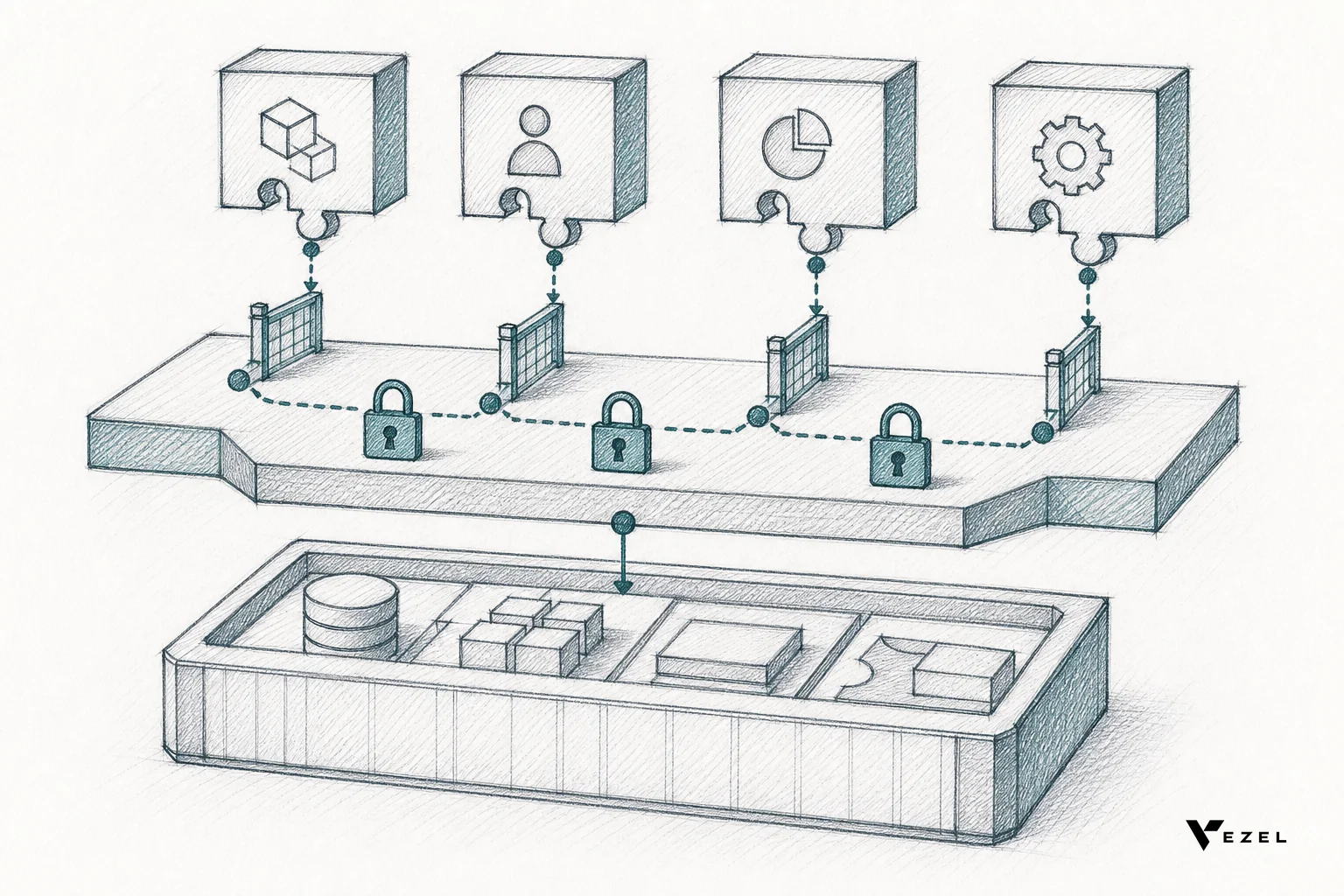
If none of the conventional fixes scale, what does? The category that's emerged to solve this directly is the embedded AI extension builder, sometimes called a white-label AI app builder. It's a platform layer integrated inside your existing SaaS product so end-customers, and your own implementation teams, can describe a workflow in plain English and get a working "microapp" back the same day.
The defining trait is that it's invisible as a separate product. The customer never leaves your platform, never creates a second login, and never has to think about it as "using a tool." They just gain the ability to shape part of the product they already trust. Five capabilities separate a production-ready version of this from a generic AI coding tool:
- Multi-tenant runtime. Every generated app runs in an isolated sandbox scoped to a single customer's tenant, enforced at the infrastructure level.
- API auto-discovery. The builder ingests your product's API surface, ideally via an OpenAPI spec, and maps natural-language requests to the right endpoints automatically, no manual mapping required.
- Security inheritance. Every call a generated app makes passes through the same authentication and row-level access rules your core product already enforces. If a user can't see a record today, an app they build can't see it either.
- White-label theming. Generated apps adopt your design system, typography, and navigation so they feel native rather than bolted on.
- Governed marketplace. Apps are versioned, published for discovery by other users, and tracked with usage analytics, so they don't disappear the moment one person stops using them.

This is a meaningfully different animal from standalone AI app generators like Lovable, Bolt, or Replit. Those tools are excellent for prototyping a new, standalone product. What they produce lives on separate infrastructure, with its own database and its own login, disconnected from your real customer data and your existing permission model. At one app that's manageable. Across hundreds of customers, it becomes an ungoverned sprawl that your compliance team will eventually have to explain to an auditor. If you want the deeper case for why this category exists at all, our post on why enterprise SaaS customization without engineering is now possible walks through the shift in more detail.
4. What to Look for When Evaluating an Extensibility Platform
Once you accept that embedded extensibility is the structural answer, the next question is how to evaluate the options in front of you. A few criteria matter more than the rest.
- Does it discover your API automatically, or does someone have to hand-map every endpoint? Manual mapping reintroduces the exact engineering bottleneck you're trying to remove.
- Does it inherit your existing auth and permissions, or create a parallel security model? This is the single biggest differentiator between a governed extension and a shadow-IT risk.
- Can a solutions engineer build the requested workflow live, on a sales call, instead of promising it "on the roadmap"? This is where extensibility starts to shorten deal cycles instead of just reducing backlog.
- Is there a real publishing and versioning layer, or does every app live as a one-off with no lifecycle management? Apps that can't be governed or rolled back become their own maintenance liability.
Sales teams feel this shift the fastest. A solutions engineer who can build the requested approval flow or dashboard during the call, rather than escalating it to engineering and waiting weeks for an answer, changes the entire negotiation dynamic. For a fuller breakdown of what to prioritize when you're comparing platforms, what to look for in a saas extensibility platform is worth reading alongside this guide, and our workflow-specific walkthrough on embedding a workflow builder in your SaaS covers the approval-chain use case in depth. You can also book a demo to see how the evaluation criteria above translate into an actual product walkthrough, or see how it works before committing to a call.
5. Reclaim Engineering Capacity Without Losing the Deal
The point of all this isn't to slow enterprise sales down. It's to stop letting enterprise deals dictate your entire engineering calendar while still closing them. Production deployments of embedded extensibility consistently report adoption in the 85-95% range for custom-built apps, compared with a typical 20-40% adoption rate for a standard feature release. Day-30 retention among users who build or use a custom app runs in the high 80s, well above the 35-40% retention figures often cited industry-wide for new features.

Support teams feel the difference too. Organizations report meaningful drops, commonly cited in the 30-35% range, in "how do I..." and feature-request tickets, because customers solve their own workflow problems instead of waiting on a queue. Net revenue retention also tends to move: accounts that build their own custom workflows expand to higher tiers to support more users and more data, with some deployments reporting NRR gains in the 20-plus percentage-point range.
None of that happens by accident. It happens because the underlying architecture changes what "yes" costs your team. Instead of a two-sprint custom build that becomes permanent maintenance debt, the request becomes a microapp that a customer success manager or the customer's own admin can generate, adjust, and own. If churn from missing workflows is already a live concern for your team, is missing workflows causing your saas churn and the vertical SaaS extensibility retention playbook both go deeper on the retention math behind this shift.
Frequently Asked Questions
How do I tell if a feature request is platform-worthy?
Ask whether at least three other accounts would use the exact same workflow, whether it requires a genuinely new data model or permission layer, and whether it's a variant of something you already support. If it fails all three, it's a candidate for self-serve extensibility rather than the core roadmap.
Does embedded extensibility replace my core product roadmap?
No. It removes the noise so your roadmap can focus on the features that matter to your entire customer base, while individual accounts self-serve the last-mile workflows that were never going to generalize anyway.
Will this work for a regulated industry like healthcare?
Yes, as long as the platform inherits your existing authentication and row-level permissions rather than creating a separate security model. Our post on how healthcare SaaS platforms can offer extensibility covers the compliance considerations specific to that vertical.
How is this different from a low-code tool like Mendix or Retool?
Those platforms are built for developers building internal tools, with their own login and their own environment. An embedded extension builder is designed for your end-customers to use in plain English, inside the product they already trust, inheriting its security model automatically.
Turn the Next Enterprise Deal Into Proof, Not a Problem
Roadmap bloat isn't a sign that your enterprise customers are asking for too much. It's a sign that your product only has one way to say yes: a bespoke engineering build that never gets reused. Once you start triaging requests correctly and give customers a governed way to build their own last-mile workflows, the next six-figure deal stops being a threat to your sprint calendar and starts being proof that your platform can flex without breaking.
Vezel embeds directly into your existing SaaS product so your customers, and your own implementation team, can turn a plain-English description into a working, secure, on-brand microapp the same day it's requested. Start your free trial to see it running against a sample data model, or talk to an expert about mapping your specific API surface. If the next enterprise deal on your desk already has a customization clause buried in it, book a demo and find out how fast you can turn that clause into a shipped feature instead of a backlog item.