


Three weeks before a contract is supposed to close, the enterprise prospect sends a follow-up. Not a red flag — just a list. A compliance approval flow scoped to their role hierarchy. A margin dashboard their ops team can configure. A shift-handoff report that matches how their supervisors actually run end-of-day. Standard stuff, they say. Nothing exotic.
Your sales lead forwards it to product. Product forwards it to engineering. Engineering looks at the sprint board and says: twelve weeks, minimum. The deal slips. Maybe it closes late. Maybe it doesn't close at all. And somewhere in the post-mortem, someone says the words that haunt every SaaS product leader: "We lost it because we couldn't customize fast enough."
That pattern is ending. Enterprise SaaS customization without engineering is no longer a theoretical concept — it's a production reality, and the companies adopting it are closing deals faster, retaining customers longer, and reclaiming the engineering capacity they've been hemorrhaging for years.
The Engineering Bottleneck That's Costing You Deals
The math is brutal. A mid-market B2B SaaS company with 100 enterprise accounts receives somewhere between 200 and 300 customization requests per quarter. A well-run engineering team ships 20 to 30 features in that same window. That means 70 to 80 percent of enterprise requests never get built, not because they're bad ideas, but because the arithmetic doesn't work.
Each unbuilt request represents a real workflow that a real customer needs. When it doesn't get built, one of two things happens. The customer lives with the gap and slowly disengages, still logging in, still technically "active," but quietly migrating their real work to spreadsheets and workarounds. Or they build something themselves, outside the platform, outside the security model, outside your visibility entirely. Either path leads to the same outcome: an account that looks fine in the dashboard until the renewal call, when it suddenly isn't.
Some vendors try to solve this by assigning engineers directly to key accounts. Industry estimates put the share of engineering capacity consumed by one-off, single-customer requests as high as 30 to 40 percent at mid-market SaaS companies. The bespoke builds almost never get reused. They become permanent maintenance debt embedded in the core codebase, slowing every future release. Sales promises customization to close deals; engineering resists because the request doesn't generalize; the tension repeats every quarter.
The bottleneck isn't a people problem. It's a structural one. And the structure is finally changing. To understand how to reduce your SaaS engineering backlog from enterprise requests, you first need to understand why the conventional fixes keep failing.
Why the Old Fixes Keep Failing
Vendors have tried every obvious approach. None of them scale.
Building more features adds complexity for every customer, not just the one who asked. More menus, more settings, more screens. Frontline users, the ones whose daily habits determine retention, are the most sensitive to this bloat. Adding a feature for segment A often makes the product less usable for segment B.
Configuration panels help when customer variance is narrow. They break down when it's wide, for a simple reason: configuration changes how existing features behave. It cannot create new functionality. If a customer's workflow requires a view, calculation, or sequence of steps that simply doesn't exist in the product, no amount of toggling will produce it.
Generic AI chatbots, the "ask your data a question" sidebars that proliferated between 2024 and 2026, land at single-digit weekly active usage after the initial novelty fades. A chatbot answer disappears when the tab closes. Users don't want to re-type the same prompt every morning; they want a button that just works. This pattern has earned an informal name in product circles: "checkbox AI", shipped to satisfy a board narrative rather than a specific customer workflow, quietly sunsetted 12 to 18 months later.
Standalone AI builders like Retool, Superblocks, or general-purpose tools like Lovable and Bolt are genuinely useful for prototyping. But they produce standalone applications that live on their own infrastructure, with their own authentication and their own URL. A customer has to leave the product they trust, log into a separate tool, and manage a second environment. There's no inherited security model. At one app, that's manageable. At hundreds of apps across hundreds of customers, it becomes an unmanageable governance problem. For a deeper look at how these tools compare, see Retool vs. embedded extensibility for SaaS products.
What Enterprise SaaS Customization Without Engineering Actually Means
The category that solves this is called an embedded AI extension builder, sometimes a white-label AI app builder, sometimes an in-product customization engine. The defining characteristic isn't the AI. It's the word embedded.
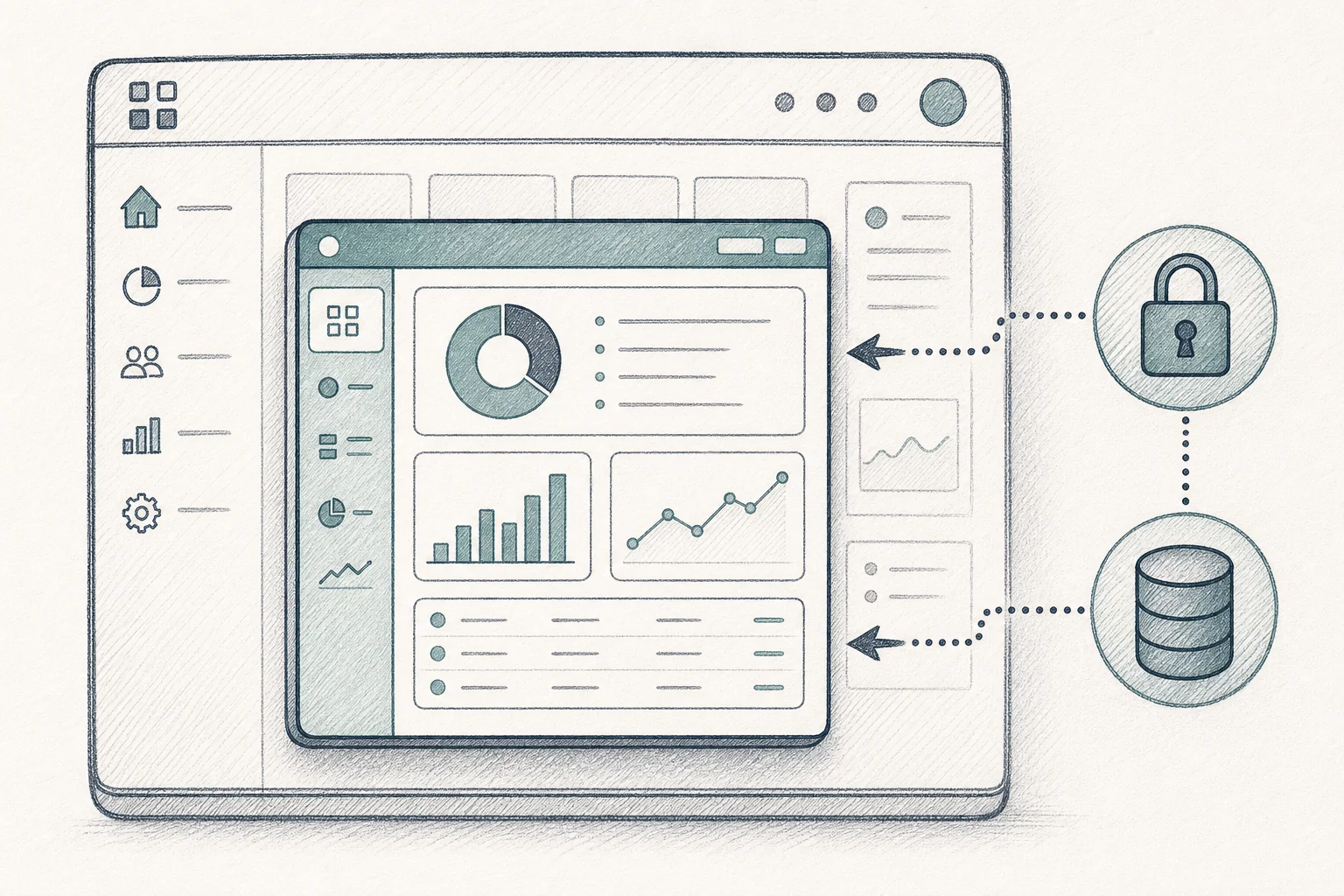
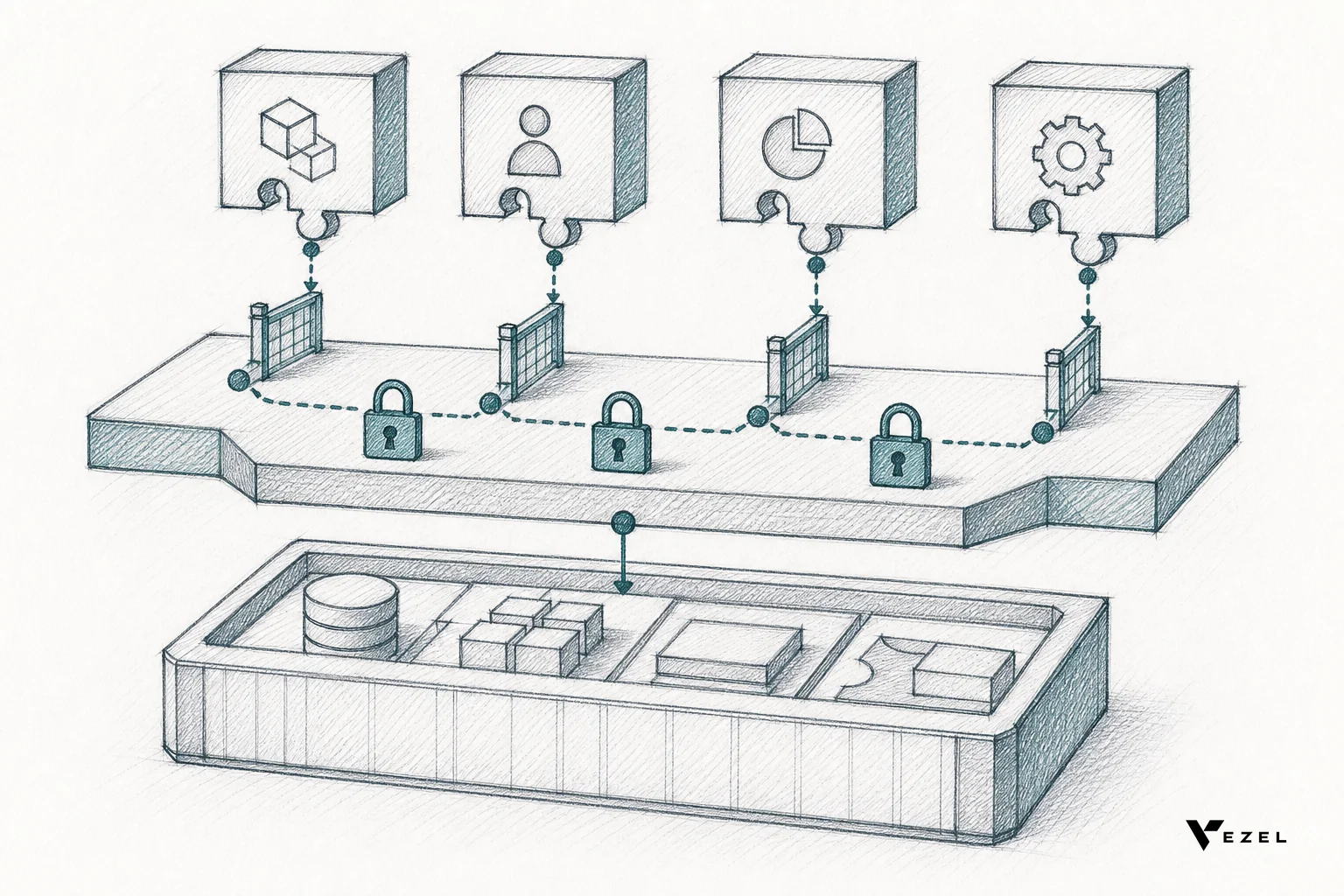
An embedded extension builder is a platform layer integrated inside an existing SaaS product. End-customers, or the vendor's own customer success and solutions teams, describe a workflow in plain English. The system maps that description to the host product's APIs and data model, generates a focused single-purpose application (a "microapp"), and deploys it inside the product the customer already uses. No separate login. No new URL. No parallel system to manage.
The microapp reads and writes real data through the host product's APIs. It inherits the existing authentication, role-based permissions, and row-level access controls. If a user can't see certain records in the core product, an app they build can't see those records either. From the end-customer's perspective, they're still inside the platform they trust, they've just gained the ability to shape part of it.
This is fundamentally different from what "AI in SaaS" has meant for the past two years. A useful way to see the distinction is a three-level maturity model:
- Level 1, Extraction: Single-shot AI calls, photo-to-form, text classification, summarization. Stateless, identical for every customer, minimal retention impact.
- Level 2, Conversation: Chat-based AI with tool use and memory. Better UX, but the output is ephemeral, it disappears when the session ends, and the interface is still the same for every customer.
- Level 3, Application generation: The AI generates durable, installable, per-customer applications. The output doesn't evaporate. It becomes part of the customer's daily toolkit, and it's different for every customer because it was built around their specific description of their specific job.
Embedded extension builders operate at Level 3. That's why the retention numbers look so different from anything else in the "AI features" category.
Real-World Workflows Built Without a Single Ticket
The apps that get built through this model are rarely exotic. They're the unglamorous, highly specific tools that a particular team needs to get through a particular day, the kind of thing that's "too niche for the roadmap" but "too important to the customer to ignore."
A food manufacturing plant builds a mobile inspection app that generates the correct safety checklist based on which equipment a technician scans, cutting inspection time and producing an audit-ready history. A SaaS sales manager builds a renewal-risk dashboard that flags accounts with declining usage and surfaces the last few touchpoints, something a generic CRM module was never going to produce because it's specific to how that team defines risk. An HVAC company builds a refrigerant-tracking form that logs pounds added per unit and flags systems approaching a regulatory threshold. A healthcare HR team builds a credential-expiration tracker grouped by department with one-tap renewal reminders.
None of these required an engineering ticket. None of them required a sprint. Each one was described in plain English, generated, validated, and deployed, the same day. And each one is now part of someone's daily routine, which is the only metric that actually predicts whether an account renews.
The pattern holds across verticals: maintenance management, CRM, ERP, field service, fleet management, HR tech, construction software. The underlying problem, diverse customers forced through one interface, is universal. So is the solution. For a vertical-specific look at how this plays out in practice, the vertical SaaS extensibility retention playbook covers the mechanics in detail.
The Business Case: What the Metrics Actually Show
Production deployments of embedded extension builders report a consistent set of metrics that are worth examining carefully, because they're dramatically above typical SaaS feature-adoption benchmarks.
Adoption rates run around 90 percent, meaning roughly nine in ten users activate at least one custom app. Compare that to the 20 to 40 percent adoption rate typical for a standard feature release. Day-30 retention among users who built or used a custom app runs in the 85 to 90 percent range, against industry-average one-month retention figures often cited around 35 to 40 percent.
Support ticket volume drops meaningfully, commonly in the 30 to 35 percent range for "how do I..." and feature-request tickets, because users solve their own problems instead of waiting on support. Net revenue retention increases as accounts that build custom workflows expand to higher tiers to support more users and more data.
The sales cycle impact is perhaps the most immediate. Solutions engineers who can build a requested workflow live during a sales call, rather than promising it "on the roadmap", report meaningfully higher win rates. The prospect's objection ("we need this before we sign") gets answered in the room, not in a follow-up email three months later.
The retention data associated with Level 3 deployments is the reason this category has attracted serious attention: production deployments report adoption rates in the 85, 95% range versus a typical 20, 40% for a standard feature release, and 30-day retention in the high 80s.
What SaaS Vendors Need to Evaluate Before Adopting This Model
Not all embedded extension builders are built the same way. Before adopting this model, SaaS product and engineering leaders should pressure-test any platform against a specific set of questions.

Does it inherit your existing auth model, or does it require a separate security layer? Any platform that requires you to replicate your permission model in a second system is creating a compliance liability, not solving one. The security inheritance must be structural, not bolted on.
Is the builder truly embedded, or is it a separate tool customers must leave to use? If end-customers have to navigate to a different URL or log into a second environment, the adoption numbers will reflect that friction. The builder must live inside your product, invisible as a separate product.
Does it support multi-tenant isolation at the infrastructure level? Application-level isolation is not sufficient for enterprise SaaS. The sandbox must be enforced at the infrastructure level so that a misconfigured app cannot leak data across tenants.
What governance controls exist? Versioning, audit logs, publishing permissions, and lifecycle management are not optional features, they're the difference between a governed extension layer and a shadow IT problem you've built into your own product.
How does it handle API auto-discovery? A platform that requires your engineering team to manually map every endpoint before customers can build anything has not actually removed engineering from the loop, it's just moved the bottleneck upstream. Look for OpenAPI-based auto-discovery that works from your existing API documentation.
For a comprehensive breakdown of what to look for, the criteria above map directly to what separates production-ready platforms from demo-ready ones. Vezel's embedded extension platform is built around all five of these requirements, book a demo to see how it maps to your specific API surface and security model.
The Governance Guardrails You Can't Skip
Giving customers the ability to build their own apps inside your product is powerful. It's also a governance surface that needs to be designed carefully from the start.
Every generated app must pass through the same auth and row-level access rules as the core product, not as a post-hoc check, but as a structural constraint that cannot be bypassed. Generation and deployment events should be logged automatically, producing an audit trail that satisfies enterprise compliance requirements without requiring manual documentation.
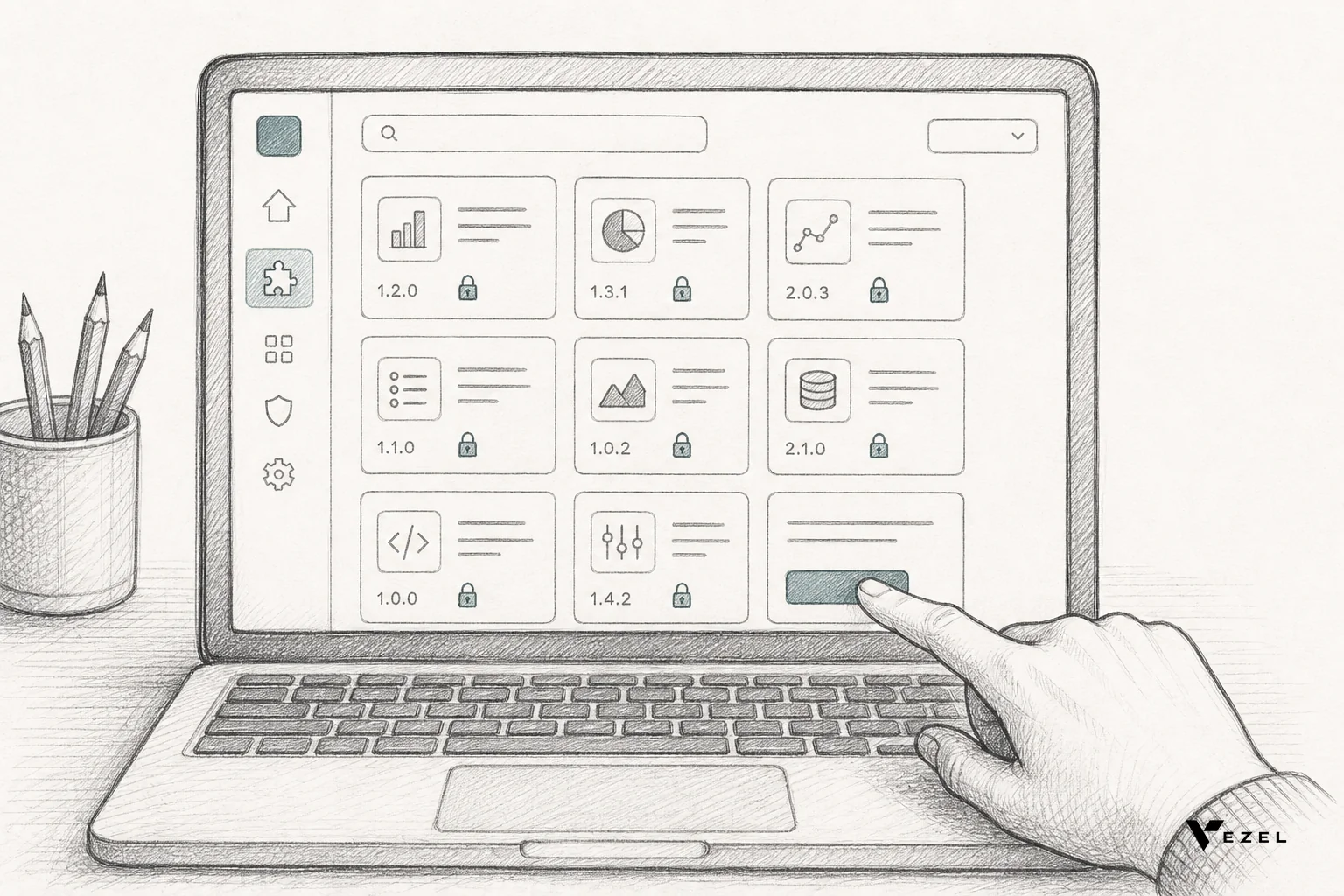
Publishing permissions should be configurable at multiple levels: a user can build an app for their own use, publish it to their organization, or (with explicit vendor permission) share it across customer organizations. That last option is where the marketplace becomes a genuine competitive moat, a library of community-built workflows that makes the platform more valuable the more customers use it.
Version history allows changes to be rolled back if something breaks. This matters more than it sounds: when a customer modifies an app that 50 of their colleagues depend on, the ability to revert in seconds is the difference between a minor incident and a support escalation.
The governance layer is also what prevents the irony of solving shadow IT by creating a new form of it. Without versioning, audit logs, and publishing controls, an extension builder can produce exactly the ungoverned sprawl it was supposed to replace, just inside the product instead of outside it.
Enterprise SaaS customization without engineering is not about removing accountability. It's about moving accountability to the right place: the customer who understands their own workflow, operating within guardrails that the vendor controls. That's a fundamentally different model from the one that's been breaking sprint boards for the past decade, and it's available now.
Ready to remove engineering from the customization loop without removing governance from the equation? Vezel's embedded AI extension platform lets your customers build dashboards, approval workflows, and AI agents in plain English, inside your product, on your data, within your security model. Book a demo to see it working on your API surface, or start your free trial and have your first customer-built microapp live before your next sprint planning meeting. If you'd prefer to talk through your specific architecture first, talk to an expert on the Vezel team.