


A VP of Engineering at a mid-market vertical SaaS company sits through her third vendor demo of the month. The sales rep clicks through a slick builder interface, drags a chart onto a canvas, and says the magic words: "Your customers will love this." She asks one question: "When my healthcare customer builds a dashboard, can it ever surface data from a different tenant's account?" The rep pauses. That pause is the whole story. Most extensibility demos look identical from the outside. What separates them shows up the moment you ask about security, data isolation, or what happens six months after the pilot ends.
This is the position a lot of B2B SaaS leaders find themselves in right now. Enterprise customers keep asking for custom dashboards, approval flows, and reports that don't exist in the core product. Engineering can't ship fast enough to keep up. So the market has responded with a new category of tool: the embedded extension builder, sometimes called an embedded extensibility platform, that lives inside your product and lets customers build their own microapps in plain English. The category is new enough that evaluation criteria haven't been standardized, and the wrong choice is expensive to reverse once customers start depending on what you built.
This guide walks through how to choose an embedded extensibility platform using seven concrete criteria, not a generic feature checklist. If you're comparing options for the first time, or you inherited a half-finished evaluation from a predecessor, this is the framework to run it against.

1. Start With Who Will Actually Be Building the Apps
Before you evaluate a single feature, answer one question honestly: who is going to sit down and describe the workflow they need? If the answer is "our engineers," you're looking at an internal tool builder, not an extensibility platform, and that's a fundamentally different buying decision. If the answer is "our customer success team, our implementation specialists, or the customer's own ops lead," you need a tool designed for people who have never written a line of code and never will.
This distinction matters more than it sounds. Tools like Retool and Superblocks were built for engineers who understand data models, conditional logic, and API contracts. That's a legitimate use case, but it's the wrong one if your goal is letting a hospital's biomedical engineering director or a roofing company's ops manager build their own morning prioritization dashboard without ever opening a ticket. Our breakdown of Retool vs embedded extensibility for SaaS products goes deeper on where that line sits.
A useful way to sort vendors here is a three-level maturity model. Level 1 tools do single-shot AI tasks like photo-to-form conversion or summarization. Level 2 tools are conversational, chat-based copilots that read and write data but produce answers that disappear when the session ends. Level 3 tools generate durable, installable applications that become a permanent part of a customer's daily toolkit. If you're solving the usage-gap problem, you want a platform operating at Level 3, one where a non-technical implementation specialist can type "show me overdue jobs grouped by site with a reassign button" and get a working app the same day, not a one-time answer.
2. Demand API-First Integration, Not a Parallel Database
Here's a trap that catches a surprising number of evaluation teams: standalone AI app generators, the kind built for rapid prototyping, look impressive in a demo because they can spin up a full interface in minutes. The problem shows up after the demo ends. These tools generate applications that live on their own infrastructure, with their own database, their own authentication, and their own URL. That's a parallel system, not an extension of the product your customer already trusts.
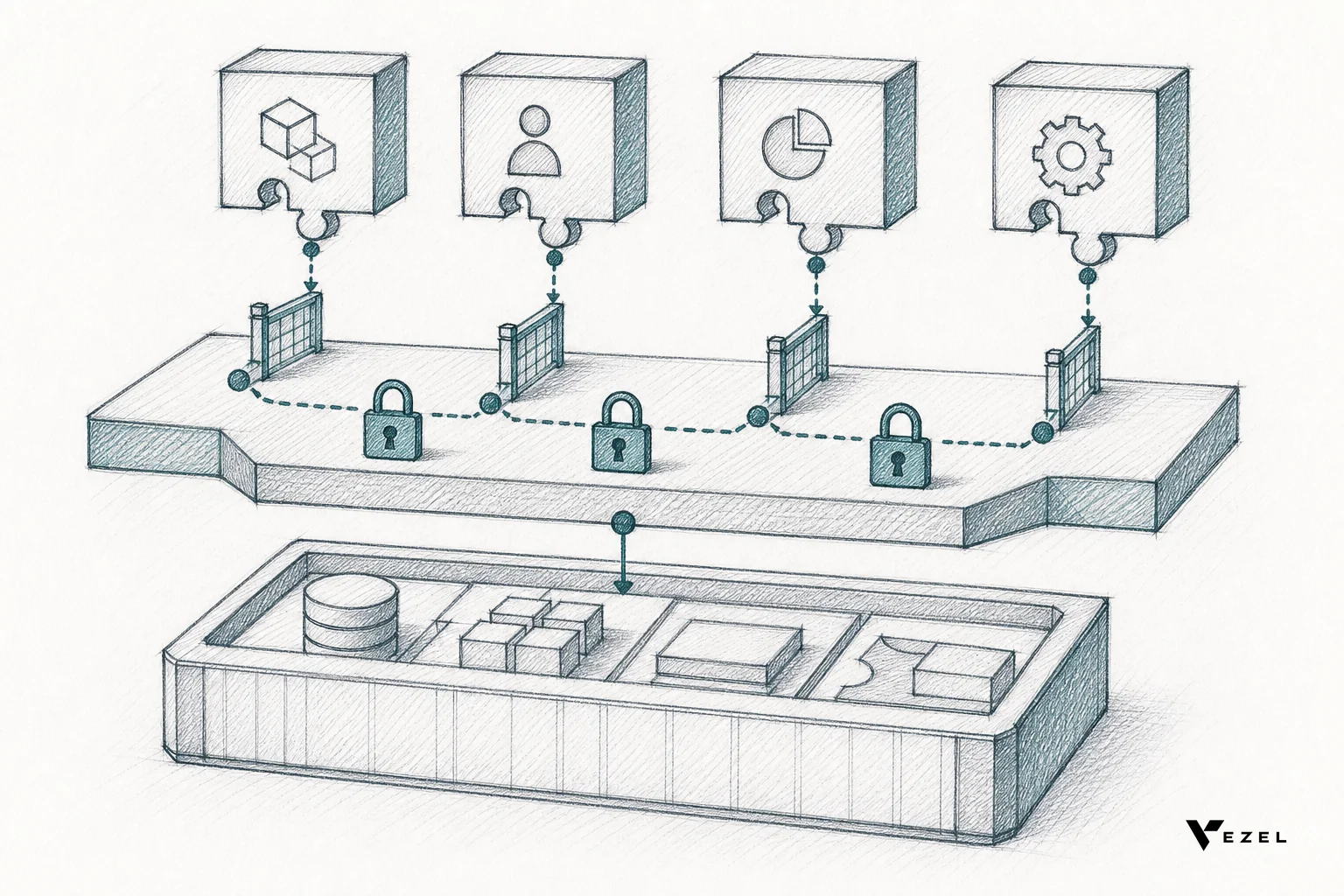
An embedded extensibility platform has to be API-first by design. Ask every vendor the same blunt question: does the generated app read and write real, live data through our existing API, or does it copy data into a separate store? The right answer inherits your data model directly. Look for platforms that can ingest an OpenAPI specification and auto-discover your endpoints, infer data shapes, and map plain-English requests to the correct calls without a developer manually wiring every connection. This is what "zero-footprint integration" actually means in practice, and it's the difference between a tool that extends your product and one that quietly forks it.
If you're weighing this against building the integration layer yourself, it's worth reading how other teams have approached embedding integrations into a SaaS product without writing custom connector code for every enterprise request.
3. Interrogate the Security and Governance Model Before You Sign Anything
This is the single most important category on this list, and it's the one most demos gloss over. A generated app is only as safe as the permissions it inherits. If your platform doesn't enforce the same authentication, authorization, and row-level access rules your core product already uses, you've just created a new, ungoverned attack surface for every customer who builds something.

Push every vendor on these specifics during evaluation:
- Does every API call a generated app makes pass through our existing auth and role-based permissions? If a user can't see certain records in the core product, the app they build should never be able to surface them either.
- Is tenant isolation enforced at the infrastructure level? Not just in application code, which can be bypassed, but at the runtime layer, so Customer A's apps structurally cannot reach Customer B's data even on shared infrastructure.
- Is every generation and deployment event logged? You'll need an audit trail if a compliance team or enterprise security reviewer ever asks what was built, by whom, and what data it touched.
- Who approves what gets published? Look for lifecycle management: draft, review, publish, and rollback states, not just a "generate and ship" button.
This is exactly the gap that undermines low-code internal tool builders and generic AI chatbots when they're stretched into customer-facing use cases. They weren't built to replicate your governance model per customer, and retrofitting that later is an enterprise compliance burden nobody wants to inherit. If you're selling into regulated verticals, our guide on how healthcare SaaS platforms can offer extensibility covers what heightened scrutiny looks like in practice, and it's a useful stress test even outside healthcare.
4. Check Whether It Actually Looks Like Your Product
White-labeling sounds like a cosmetic requirement until you watch what happens without it. If a customer has to leave your product, log into a second environment with a different visual language, and manage a separate URL just to build a workflow, you haven't extended your platform. You've handed your customer a second vendor relationship to maintain, and you've handed your own trust signal to someone else's interface. The generated apps need to inherit your typography, your color tokens, your component styles, and your navigation patterns automatically. A customer building a compliance checklist or a margin calculator should never wonder whether they've wandered into a different product. This single detail is a strong proxy for how seriously a vendor has thought through the "embedded" part of embedded extensibility, versus treating it as a rebranded version of a generic app builder.
5. Look for a Marketplace, Not Just a Builder
A generation tool that produces a one-off app and then forgets about it solves maybe a third of the problem. The apps your customers build need a second life: versioned, discoverable, and reusable by other users at the same account or across accounts facing the same workflow gap. This is what separates a governed marketplace from a generation sandbox. When a property manager builds a tenant-facing maintenance tracker, or a distributor builds a territory planner weighted by margin, that microapp shouldn't die the moment its creator moves on. It should be installable by the next team that hits the same wall, cutting down the repeat requests that otherwise pile back into your backlog. If backlog pressure from enterprise requests is what triggered this evaluation in the first place, this is the feature that actually moves the needle. Our post on reducing SaaS engineering backlog from enterprise requests walks through the mechanics in more detail.
6. Compare the Real Alternatives Side by Side
Most evaluations get muddled because teams compare an embedded extensibility platform against the wrong category of tool. Here's how the real alternatives stack up against each other on the dimensions that actually matter.

| Approach | Who builds it | Integration model | Security inheritance | Distribution | Best fit |
|---|---|---|---|---|---|
| Custom engineering | Your engineers | Native, hand-built | Full, but manually maintained per build | None; single-account, one-off | A handful of strategic whale accounts only |
| Internal low-code tool (Retool, Superblocks) | Your engineers or technical staff | Manual API wiring | Not inherited; rebuilt per tool | Internal only, not customer-facing | Internal ops dashboards, support tooling |
| Standalone AI app generator (Lovable, Bolt-style tools) | Anyone, non-technical | Separate database, own auth, own URL | None; isolated security island per app | Single link, no marketplace | Rapid prototyping of new standalone products |
| Generic AI chatbot / copilot | End users via chat | Read/write via product APIs, ephemeral output | Inherits session-level auth | None; answer disappears on session close | Quick lookups, one-time questions |
| Embedded extensibility platform (e.g. Vezel) | End customers, CSMs, implementation teams | API-first, zero-footprint, live data | Full inheritance: auth, roles, row-level access, audit logs | Governed, versioned, in-product marketplace | Recurring per-customer workflow gaps at scale |
The pattern in that table is worth sitting with. Custom engineering and internal low-code tools solve narrow problems well but don't scale past a few accounts. Standalone AI generators are genuinely useful for prototyping, but they were never architected to become a governed, permanent part of a multi-tenant product. If you want the full cost comparison, we've laid it out in our retention playbook for vertical SaaS extensibility, and if Glide is on your shortlist specifically, see the guide to embedding a workflow builder in your SaaS for a closer look at where standalone no-code tools fall short of an embedded model.
7. Ask for the Numbers That Actually Predict ROI
Every vendor will show you a feature list. Fewer will show you production numbers, and those numbers are where the real signal lives. Ask specifically for adoption rate, 30-day retention among users who built or used a custom app, and how many microapps get generated per active user. Deployments that are actually working tend to cluster around a consistent range: 85 to 95 percent of users activate at least one custom app, versus the 20 to 40 percent adoption rate typical of a standard feature release. Day-30 retention for those users often lands in the high 80s, compared with industry-average one-month retention figures frequently cited around 35 to 40 percent. Support tickets in the "how do I..." and feature-request categories tend to drop by roughly 30 to 35 percent, because customers are solving their own problems instead of waiting in a queue. And accounts that build custom workflows tend to expand to higher tiers, which shows up in net revenue retention, sometimes by 20 or more percentage points in reported deployments.
If a vendor can't produce numbers in these ranges, or can't explain why their deployment differs, treat that as a signal, not a formality. The whole point of choosing an extensibility platform over the status quo is measurable adoption, not another feature nobody opens.
Putting the Criteria Into a Buying Checklist
Strip away the vendor decks and the framework comes down to seven questions worth printing out before your next demo:
- Is it built for non-technical end users to describe workflows in plain English, or does it still require engineering skill?
- Does it integrate API-first against your live data, or does it fork a separate database?
- Does every generated app inherit your existing authentication, permissions, and row-level access, with a full audit trail?
- Does the output look and feel like a native part of your product, not a bolted-on second tool?
- Is there a governed marketplace for versioning, publishing, and reusing apps across users and accounts?
- Can the vendor show adoption, retention, and support-deflection numbers from real deployments, not just a demo?
- How long does integration realistically take, and what does your engineering team need to prepare?
Get honest answers to those seven and you'll know within a single evaluation cycle whether you're looking at an embedded extensibility platform or a repackaged version of a tool that was never meant to carry this job. For a deeper look at what the category as a whole should include, our companion piece on what to look for in a SaaS extensibility platform rounds out the picture alongside this buyer's checklist.
Frequently Asked Questions
What is an embedded extensibility platform?
It's a layer that a SaaS company integrates directly inside its own product, letting end customers, implementation teams, and customer success staff describe workflows in plain English and get working applications that run on the product's real data and inherit its security model, distributed through an in-app marketplace.
How is this different from a low-code tool like Retool or Glide?
Retool and Superblocks are built for engineers building internal tools, with their own login and interface, outside the customer-facing product. Glide is a standalone no-code app builder, not designed to be embedded as a white-labeled layer inside an existing SaaS platform. An embedded extensibility platform is purpose-built to live inside your product, be used by non-technical end customers, and inherit your existing data and permissions automatically.
Does embedded extensibility replace engineering?
No. It removes the one-off, non-generalizable requests that consume engineering capacity, commonly estimated at 30 to 40 percent of capacity at mid-market B2B SaaS companies, freeing your team to focus on core product innovation instead of bespoke dashboards and approval flows for individual accounts.
How long does integration typically take?
Most production integrations, including connecting the API surface, configuring security mapping, applying your design system, and seeding the marketplace with example apps, run around two weeks, not months. That timeline is one reason the category has become attractive to teams under pressure to shorten enterprise sales cycles.
Choosing the wrong tool here doesn't just waste a quarter. It teaches your enterprise customers, again, that "custom" means "eventually," and it leaves your engineering roadmap exactly as bloated as it was before you started evaluating anything. The right embedded extensibility platform does the opposite: it turns a recurring source of churn risk and backlog pressure into a governed, white-labeled part of your product that customers build themselves, the same day they ask for it.
If you want to see how this looks against your own API and data model rather than a generic demo, book a demo with Vezel and walk through your actual use case. Curious about the mechanics first? see how it works before you talk to anyone. And if your team prefers to test drive it directly, you can start your free trial or talk to an expert about what integration would look like for your specific product.