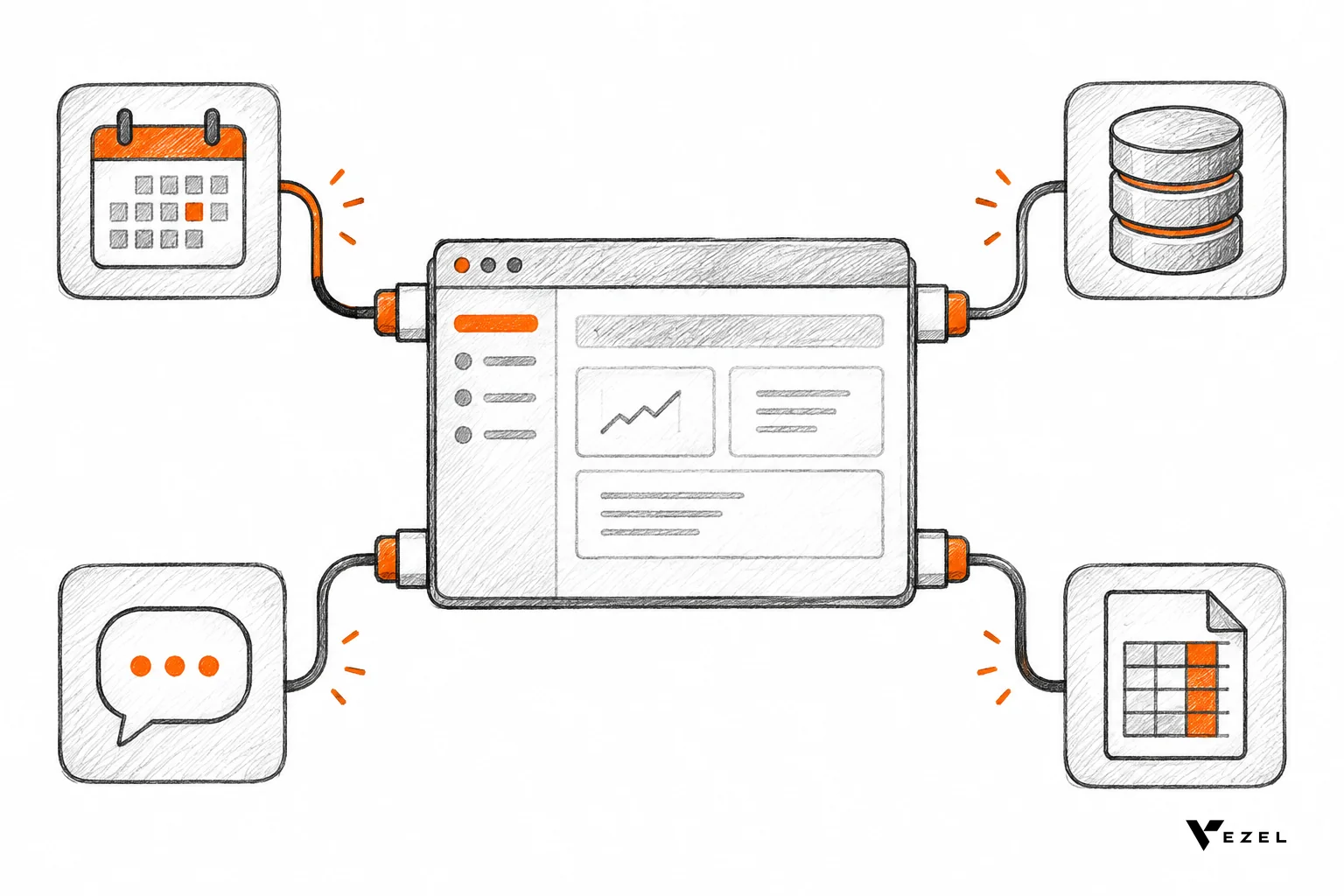


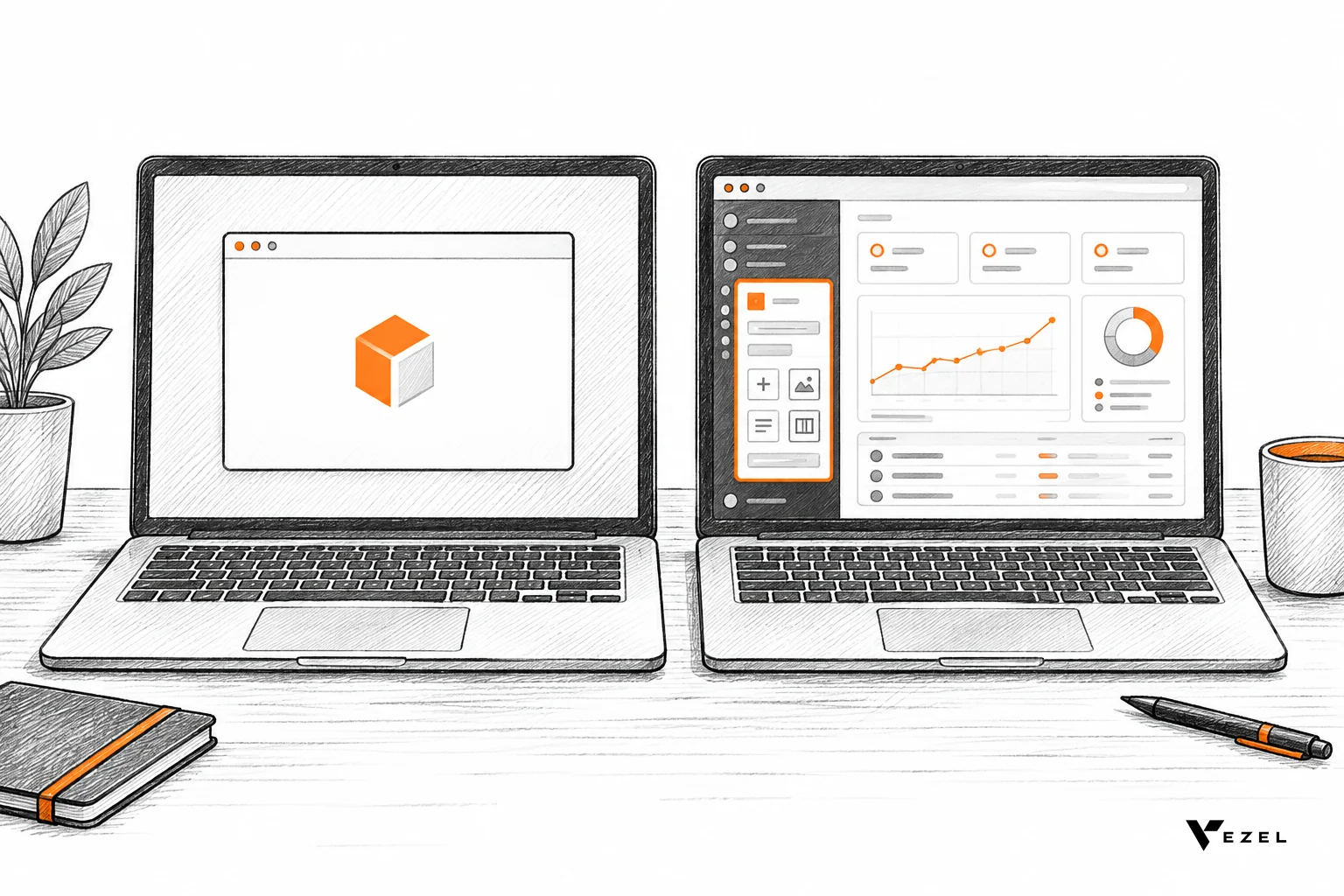
A white label app builder lets you launch a separate, branded app on its own platform. An embedded builder lives inside your existing SaaS product and works on your live data. For US SaaS vendors whose customers need tools tied to product data and permissions, embedded usually fits better. For standalone apps, white label wins.
Key takeaways
- Different jobs: A white label app builder ships a new branded app. An embedded builder lets customers extend the product they already log in to.
- Data and auth decide it: If the new tool must read and write your product's live data under each user's existing permissions, embedded removes a second login and a sync layer.
- Upkeep differs: A white-labeled app is a second product with its own releases. An embedded builder is maintained against your API and permission model.
- Not either/or: Many vendors use white label for standalone mobile or partner apps and embedded for in-product work.
- Vezel's place: Vezel is an embedded AI extension platform; most SaaS platforms can integrate it in a few days.
White label vs embedded builders at a glance
| Factor | White label app builder | Embedded builder |
|---|---|---|
| What it produces | A separate app under your brand | Dashboards, workflows, forms and agents inside your product |
| Branding | Your logo, domain and theme on a distinct app | Theming that matches your design system, so it feels native |
| Data access | Usually through connectors, exports or a synced copy | Direct through your existing APIs, live |
| Authentication | Often its own user store or a single sign-on bridge | Inherits your authentication, permissions and access controls |
| Upkeep | A second product, release cycle and support surface | Maintained against your API and governance rules |
| Customer experience | Leaves your product to use it | Stays in the product they already use |
What is a white label app builder?
A white label app builder is a platform that lets a company create apps and publish them under its own brand, logo and domain. The platform vendor owns the underlying technology. The brand owner presents the result as its own, often to clients, resellers or end customers.
These builders sell to agencies, resellers and software companies that want an app without building one from scratch. Some are drag-and-drop mobile app makers. Others are low-code platforms that publish portals and internal tools. A newer group generates a full application from a prompt and lets you resell that experience.
The common thread is separation. The app sits outside your core product, with its own screens, hosting and often its own database. That is a strength when you want a new product line. It is a cost when the app only makes sense next to your existing product.
What white label builders typically offer
Feature lists differ by vendor, so treat the following as the categories to look for rather than a promise from any one product.
- Mobile publishing: Some builders package the app for app stores under your developer account and name. Ask who holds the store listing and who handles updates.
- Custom domains and branding: Your logo, colors and domain on the finished app or portal.
- Reseller licensing: The right to sell the builder's output to your own clients, often with separate client workspaces. Ask whether each client counts as a separate license.
- Pricing models: Vendors commonly charge a flat rate with unlimited apps, a per-app or per-client fee, or a platform fee plus usage. You keep the margin between your cost and what you invoice the client. Compare the model against how many apps or clients you expect to run.
- Security and support: Look for encrypted data and responsive provider support, which matter more once customers depend on the app.
Published ranges for building an app give context. One build-or-buy guide lists MVP cost of $500–$5,000 for the lowest-effort route, $10,000–$50,000 for the middle route and $50,000–$500,000+ for custom builds. Treat that as a general app-creation range, not a quote for any builder named here.
If you are weighing the broader model, our guide to white label SaaS and when to offer white-labeled features covers reseller and OEM structures in more detail.
What is an embedded builder inside a SaaS product?
An embedded builder is a tool that runs inside your SaaS application and lets customers create their own dashboards, workflows, forms or agents without leaving it. It connects to your product's APIs, so what customers build uses your live data and respects your existing permissions.
The word "embedded" is about where the user is, not just where the code runs. A customer's operations manager opens your product, describes what they need, and gets a working tool in the same navigation, theme and login.
Vezel is one example. It describes itself as an embedded AI extension platform. According to Vezel, the flow has four steps: connect to your APIs, generate extensions from plain English, run them ready to use in a secure container, then scale and govern them. Customers can build dashboards, workflows, reports, forms, automations and AI assistants inside the SaaS product.
On security, Vezel states that extensions inherit your existing authentication, permissions and access controls. Most SaaS platforms can integrate it in a few days, per Vezel. Vezel has not given us a published pricing model, a security certification list or data residency options, so ask for those directly. If you want the full setup picture, see our walkthrough on how to embed a workflow builder in your SaaS.
How do the two compare on branding, data, auth, upkeep and customer experience?
A white label app builder gives you a separate branded app with its own login, data connection and upkeep. An embedded builder gives you a feature inside your product that reuses your branding, APIs, authentication and release process. The difference comes down to whether the new tool is a product or a capability.

Branding: a themed app vs a native-feeling feature
White label branding is cosmetic control over a separate thing. You set the logo, colors and often a custom domain. Customers can tell they have moved to a different surface, even if it carries your name.
Embedded builders aim for the opposite. Vezel offers white-label theming so extensions match the host product's design system. A customer-built dashboard then sits in your navigation and looks like it shipped with the product. We have no further detail on theming options or limits, so test your own design tokens in a pilot.
The catch: native feel depends on how closely your design system can be mapped. A heavily custom UI takes more theming work. A white-labeled app can ignore that problem because nobody expects it to match pixel for pixel.
Data access and authentication
This is where the two diverge most. A separate app needs a way to get your data. That usually means a connector, an export, a synced copy or a second set of credentials. Each of those is a place where data goes stale or permissions drift.
An embedded builder starts from your APIs. Vezel connects to existing APIs and, per its own description, auto-discovers data models and endpoints from OpenAPI-based definitions. Extensions then inherit authentication, role-based access and row-level access controls from the host, so a user sees only what they already could.
Here is a hypothetical example, not a real client. A field-service vendor has 400 customer accounts. Say 25 of them ask for a custom job-approval workflow. Suppose each account has 10 staff who would use it, and the workflow needs two data sets: jobs and technicians.
| Integration step | Separate white-labeled app | Embedded builder |
|---|---|---|
| Users to map | 25 accounts × 10 staff = 250 users, each with a role | 0 new mappings; the product's existing users and roles are reused |
| Sync jobs | 2 data sets × 25 accounts = 50 jobs to build and monitor | 0; reads live through existing APIs |
| Logins | 250 second logins, or one single sign-on bridge to maintain | 0 new; users stay signed in to the product |
The numbers are assumptions chosen to show the arithmetic. Replace them with your own account, staff and data-set counts. The decision rule: if the separate route leaves you with more than a handful of mappings, sync jobs or logins to own, the embedded route is likely cheaper to run. Staff turnover adds to the white label side, because every change must be mirrored.
For a deeper technical look at the API side, read how to connect AI extensions to your SaaS APIs.
Upkeep: who maintains what
A white-labeled app is a second product. It has its own release schedule, its own uptime, its own support tickets and its own security review. When you change an API, you must check whether the app still works.
Embedded builders shift the work. You maintain the API and permission model you already maintain. The platform handles generation and the container the extensions run in. Governance matters here, because customers will create many extensions. Vezel lists a control plane for permissions, publishing and lifecycle management, plus a governed in-product marketplace for versioning and discovery.
Neither route is maintenance-free. Embedded does not remove review; it moves review to a place you already own. Whether that trade is cheaper depends on how many separate surfaces you would otherwise run.
End-customer experience
Customers rarely care how a tool is built. They notice friction. A second login, a different layout or a lag between product data and app data all read as "this is bolted on."
Embedded keeps the work in one place. Someone reviewing approvals opens the same product they open for everything else. A white-labeled app can still feel good, especially on mobile or in a partner portal, but it asks customers to adopt another destination.
When does a white label app builder win?
A white label app builder wins when you want a standalone app that does not depend on live access to your core product. Typical cases are a branded mobile app in an app store, a partner or client portal, or a new product line sold by resellers and agencies.
It also wins when your product has no public API or the data is simple. In that case, there is little to inherit. The builder's own database and user store are an advantage, because you control everything in one place.
Choose white label when:
- The app must be distributed through an app store or a separate domain.
- The audience is mostly people who do not log in to your product.
- You want to resell the builder's output as its own offering.
- The app needs little or no live data from your core system.
When does an embedded builder win?
An embedded builder wins when the thing customers want is tightly tied to your product's live data, permissions and screens. Dashboards, approval workflows, onboarding flows, forms and AI assistants that act on product records are the typical cases, because they only work well beside that data.

It also wins on trust. Enterprise buyers ask where data goes and who can see it. If extensions inherit existing access controls and run in a secure container, the answer is shorter. Our list of enterprise buyer questions about SaaS extension security shows what those conversations look like.
Choose embedded when:
- Users already live in your product for the task.
- Permissions differ by user, team or record, and must carry through.
- The request is a dashboard, report, form or workflow rather than a new product.
- You would rather not run another app with its own login and release cycle.
A decision checklist for SaaS vendors
Ask five questions in order. Where does the user work? Where does the data live? Who owns the login? Who maintains it in a year? Is this a product or a capability? Your answers usually point clearly to one side or to a split.
- Where does the user work? In your product all day points to embedded. Outside it, on a phone or a partner site, points to white label.
- Does the tool need live product data? If yes, count the connectors and sync jobs a separate app would need.
- Do permissions vary by record? If yes, a second permission layer is a risk you must own.
- Who maintains it? Name the team. If nobody can own a second product, do not create one.
- Is it a product or a capability? A product gets its own brand and pricing. A capability makes the existing product more useful.
Our rule of thumb: if three or more answers point to the product itself, go embedded. If most point outward, go white label. A split is normal. A vendor can run a white-labeled mobile app for field staff and an embedded builder for the back-office workflows those staff trigger.
Worked scoring example
Suppose a vendor is evaluating a reseller-style white label builder for a customer approval tool. Here is how five answers map to a decision.
| Question | Answer | Points to |
|---|---|---|
| Where does the user work? | Inside the product all day | Embedded |
| Needs live product data? | Yes, jobs and technicians | Embedded |
| Permissions vary by record? | Yes, by team | Embedded |
| Who maintains it? | No team can own a second product | Embedded |
| Product or capability? | Capability | Embedded |
Five of five point to embedded, so the decision is embedded. Now change two answers: the audience is outside contractors who never log in, and the tool is sold as its own offering. That gives three answers pointing outward and two inward, so the rule favors white label for that tool, with embedded kept for the in-product work.
What to ask a white label vendor about connectors and SSO
- Which data connectors are prebuilt, and which need custom work? Are they read-only or read-write?
- How often does data sync, and what happens when a sync job fails?
- Does the builder support single sign-on with your identity provider, and does it pass roles and teams through or only identity?
- When a user is removed in your product, how fast is access removed in the app?
- Can row-level permissions be enforced, or only app-level roles?
- Where is the data copy stored, and how is it encrypted?
One thing is not settled. Generated tools raise a governance question that no category has fully answered: who reviews what customers create, and how often? Plan for it either way. Our guide on how to choose an embedded extensibility platform lists the governance features to ask about.
What is the best embeddable workflow builder for SaaS products?
The best embeddable workflow builder is the one that uses your APIs and permissions, matches your design system, lets non-developers create workflows, and gives you publishing and lifecycle control. No single tool is best for every product, so test each against your own data model and security rules.
Use these criteria when you evaluate options:
- Native look: Can it use your design system, so customers never feel a seam?
- Auth inheritance: Does it reuse your authentication and row-level controls instead of creating new ones?
- Data connection: Can it map your OpenAPI definitions without custom integration code?
- Who builds: Can an operations manager describe a workflow in plain English, or does it require a developer?
- Governance: Are there controls for publishing, versioning and retiring what customers create?
- Setup time: Can you test it against real endpoints in days, not quarters?
Vezel is built around these points as an embedded AI extension platform, and we would be glad to show you against your own product. Judge any vendor, including us, on a working pilot with your data.
FAQ
Is a white label app builder the same as white label SaaS?
No. A white label app builder is a tool for creating and rebranding apps. White label SaaS is a finished software product that one company runs and another sells under its own name. A builder can produce a white-labeled product, but the two terms describe different things.
Can I use both a white label builder and an embedded builder?
Yes. Many vendors split the work. A white label builder handles standalone apps, such as a mobile app or partner portal. An embedded builder handles dashboards, workflows and forms that live in the main product. The split follows where the user works and where the data lives.
Does an embedded builder need a developer to set up?
Setup needs engineering time, mainly to connect your APIs and confirm the permission model. Vezel says most SaaS platforms can integrate it in a few days. After that, customers create extensions in plain English, so day-to-day building does not need your developers.
Which option is better for data security?
The safer option is the one that adds the fewest new permission layers. An embedded builder that inherits your authentication and access controls adds none. A separate app can be secure too, but you must keep its user store and data copy in step with your product.
Next step
Choosing between a white label app builder and an embedded builder comes down to where your customers work and who will own the upkeep. If the work belongs inside your product, Book a Demo and we will show Vezel running against your API and permission model. Vezel responds to inquiries within 1-2 business days. Prefer to look first? See How It Works to follow the four steps from connection to governance.