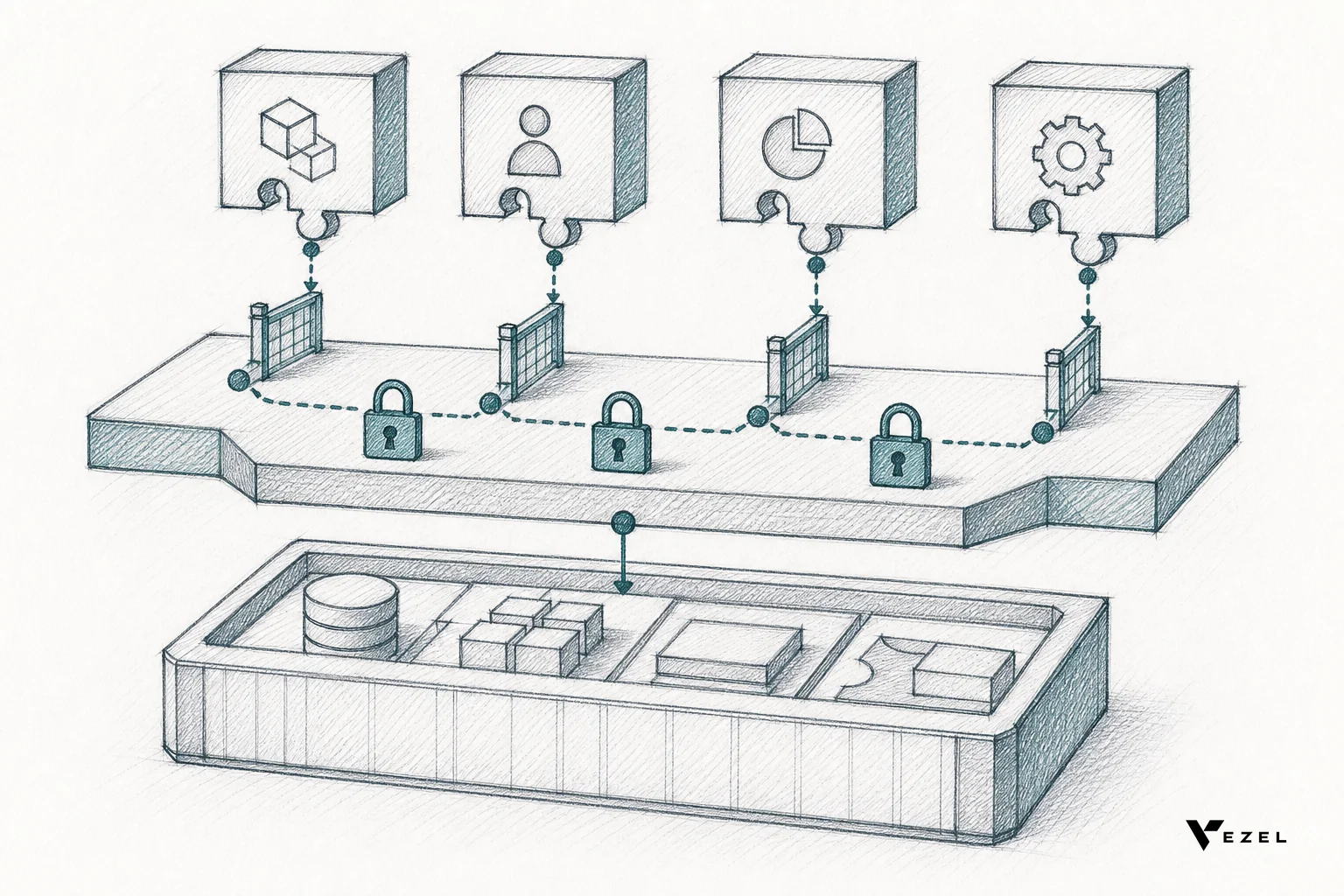



A Retool alternative for customer facing extensibility is a platform that lets your end customers build dashboards, workflows, and reports inside your product. It uses your existing authentication and permissions instead of a separate login.
Retool and similar tools were built for internal teams. They were not built for the hundreds or thousands of customers who never had an internal account in the first place.
Key Takeaways
- Retool wasn't built for your customers: it's an internal tool builder with a separate "external users" seat type. That seat type doesn't inherit your product's authentication or row-level permissions automatically.
- Embedding is not the same as governing: an iframe-based embed puts a builder's UI inside your product visually. The logic still runs on someone else's infrastructure, outside your permission model.
- Roadmap pressure has a number attached: teams commonly lose around 40% of engineering capacity to bespoke, single-customer requests, according to a 2026 industry breakdown of custom dashboard and workflow work.
- Five real options exist today: Retool, Superblocks, and Mendix target internal or full-stack development. Glide targets general no-code apps, while embedded extensibility platforms are the only category purpose-built to sit inside a customer-facing SaaS product.
- The decision rule is about who logs in: if the builder is for your own team, an internal tool builder works fine. If it's for your customers, you need a platform that inherits your auth model natively.
At a Glance: Retool vs. Embedded Extensibility Platforms
| Factor | Retool / Superblocks (internal builders) | Embedded Extensibility Platform |
|---|---|---|
| Primary user | Your own engineers and ops staff | Your end customers, non-technical |
| Authentication | Separate login or external user seat | Inherits host product's existing session |
| Permissions | Rebuilt manually per app | Inherits RBAC and row-level access automatically |
| Look and feel | Runs on the vendor's own UI shell | White-labeled to match your product's design |
| Build method | Drag-and-drop components, some code | Plain English prompts, no code |
| Governance at scale | Manual app-by-app management | Governed in-product marketplace for versioning and publishing |
| Best fit | Internal dashboards, ops tooling | Customer-facing dashboards, workflows, AI agents |
Why Internal Tool Builders Struggle With Customer-Facing Use
Internal tool builders struggle with customer-facing use because they were designed around a different user. That user already has an internal login and full trust.
Customers are neither. They need access that follows the permissions already enforced by your product.
Retool's pricing structure shows this clearly. Its external users are a separate seat type from internal builders and users. That seat type is only available on the Business and Enterprise plans.
Retool prices external users in tiers, starting with a free allotment and stepping down per-seat cost as volume grows. That structure is documented on Gigacatalyst's build-vs-buy comparison.
That math works for a handful of customer accounts. It gets uncomfortable fast once a vertical SaaS company has 300 or 3,000 logins to cover.
Pricing tiers are a symptom, not the real issue. The real issue is that these external users don't automatically inherit the row-level permissions your core product already enforces.
Someone has to rebuild that logic, app by app. They must also keep it in sync every time your data model changes.

Superblocks and Mendix sit in a related but slightly different lane. Superblocks positions itself around letting security and IT teams govern integrations, permissions, and auditing for internally built apps in a private cloud, per its own platform description.
Mendix goes further into full-stack, agentic enterprise application development with its own governance layer.
Both are strong at what they're built for: production-grade internal or enterprise applications built by developers. Neither markets itself as a layer that hands app-building directly to your end customers inside your existing product session.
How Do You Tell Whether a Platform's Extensibility Model Is Actually Governed Versus Just Technically Open?
You tell the difference by checking where extensions run their permission checks. Do they run at query time inside your existing permission model, or connect through a separate credential that someone must manage by hand?
Governed means every extension a customer builds is automatically scoped to what that customer's role can already see. Technically open means the platform lets you connect anything but leaves access control for you to build and maintain.
Ask a vendor one direct question: what happens to a dashboard's row-level filters when a customer's role changes in your core product tomorrow?
If the answer involves someone manually updating a config, that's technically open. If the extension automatically reflects the new role because it's reading the same permission table your product uses, that's governed.
A second signal is publishing. A governed marketplace tracks who built what, which version is live, and who can see it.
Without that, extensions multiply quietly. Nobody can answer "what did customer X build, and is it still connected to a field we deprecated."
You can read more about what this looks like in practice in our guide to lifecycle management for customer-built SaaS extensions.
What Does "Retool Embed" Actually Mean?
"Retool embed" typically means placing a Retool app inside another product's interface, most often through an iframe.
The app's logic and rendering still run on Retool's own runtime. They are visually framed to look like part of your product, rather than running natively inside your product's authenticated session.
That distinction matters more than it sounds. An iframe seam works fine for internal tools where the audience already trusts your infrastructure.
It becomes a harder sell for a customer-facing product. Security teams during procurement will ask exactly where the data travels and which session actually authenticates the request.
Platforms built as white-label, API-first embeds avoid this seam entirely. They render inside your own application shell and reuse your session token, rather than framing a separate app inside a border.
Retool Alternatives Compared: Retool, Superblocks, Mendix, Glide, and Embedded Extensibility
Each of these five tools solves a real problem. They just don't solve the same problem.
- Retool is a developer-first, pro-code and low-code hybrid platform. It is positioned for mission-critical internal applications that connect to real business data.
- Superblocks lets business teams build production-grade apps in a private cloud. IT and security control integrations and auditing centrally.
- Mendix is a full low-code, AI-powered application development platform aimed at connecting enterprise context across systems for what it calls the "agentic enterprise."
- Glide is an AI software development platform for building custom business apps, often starting from a spreadsheet. It is aimed at operations teams rather than a specific host product's customers.
- Embedded extensibility platforms (like Vezel's adaptive SaaS approach) are purpose-built to live inside an existing SaaS product. They inherit its authentication and let non-technical end customers build dashboards, workflows, and AI agents in plain English.
None of these four alternatives to embedded extensibility markets itself as software your customers use inside your login.
That's the gap this whole category of "Retool alternative" search traffic is circling.
A Worked Example: 500 Customers, One Extension Layer
Consider a hypothetical vertical SaaS company selling to logistics operators, with 500 customer accounts.
Each customer wants a slightly different dashboard: fuel cost by route for one, dwell time by facility for another, and driver compliance status for a third.
Building each one as a custom feature means 500 one-off engineering tickets. At minimum, it means 500 support escalations that eventually reach engineering anyway.
Routing that demand through Retool-style external user seats means paying per-seat costs at volume. It also means rebuilding permission logic for every dashboard by hand.
An embedded extension layer flips the math: one integration to the product's existing API and permission model. Every one of those 500 customers then builds their own version inside their own session.
Each version is automatically scoped to what that customer is already allowed to see. The engineering team ships the layer once. The customers do the rest.

What to Check Before You Commit Budget
Before signing a contract with any Retool alternative for customer-facing extensibility, run through this checklist:
- Authentication inheritance: does the extension run inside your existing login session, or does it require a separate credential?
- Row-level permissions: do dashboards and workflows automatically respect the same access rules your core product already enforces?
- White-label theming: does the output match your product's design system, or does it look like a bolted-on third-party tool?
- API auto-discovery: can the platform map to your existing data model without a custom integration project per customer?
- Marketplace governance: is there a way to version, publish, and audit what customers build over time?
- Pricing at your real scale: what does the cost look like at 100 customer accounts, and again at 1,000?
If you want a longer walkthrough of this evaluation process, our guide to choosing an embedded extensibility platform covers each of these in more depth.

Decision Rule: When to Pick an Embedded Extension Layer Over Retool
Pick an embedded extension layer when the people building dashboards, workflows, or reports are your customers, not your own staff.
It also fits when the number of those customers is large enough that per-seat external user pricing and manual permission rebuilding stop making sense.
Keep Retool, Superblocks, or Mendix in play when the builders are internal engineers or ops teams who already have accounts inside your company's own systems.
The line isn't about which tool is "better." It's about who's logging in.
Internal tool builders assume the person building the app already has organizational trust. Customer-facing extensibility platforms assume they don't.
They inherit that trust automatically from your product instead of asking someone to configure it by hand.
For a deeper side-by-side on this exact question, see our comparison of internal tool builders versus customer-facing extensibility.
Getting Started
Roadmap pressure from one-off customer requests doesn't go away by hiring faster.
It goes away when customers can build the dashboard, workflow, or report themselves, inside your product, without a ticket.
If you're weighing Retool, Superblocks, or Mendix against a platform built specifically for customer-facing extensibility, book a demo and see what a plain-English extension layer looks like connected to your own APIs.
You can also see how it works before you talk to anyone.