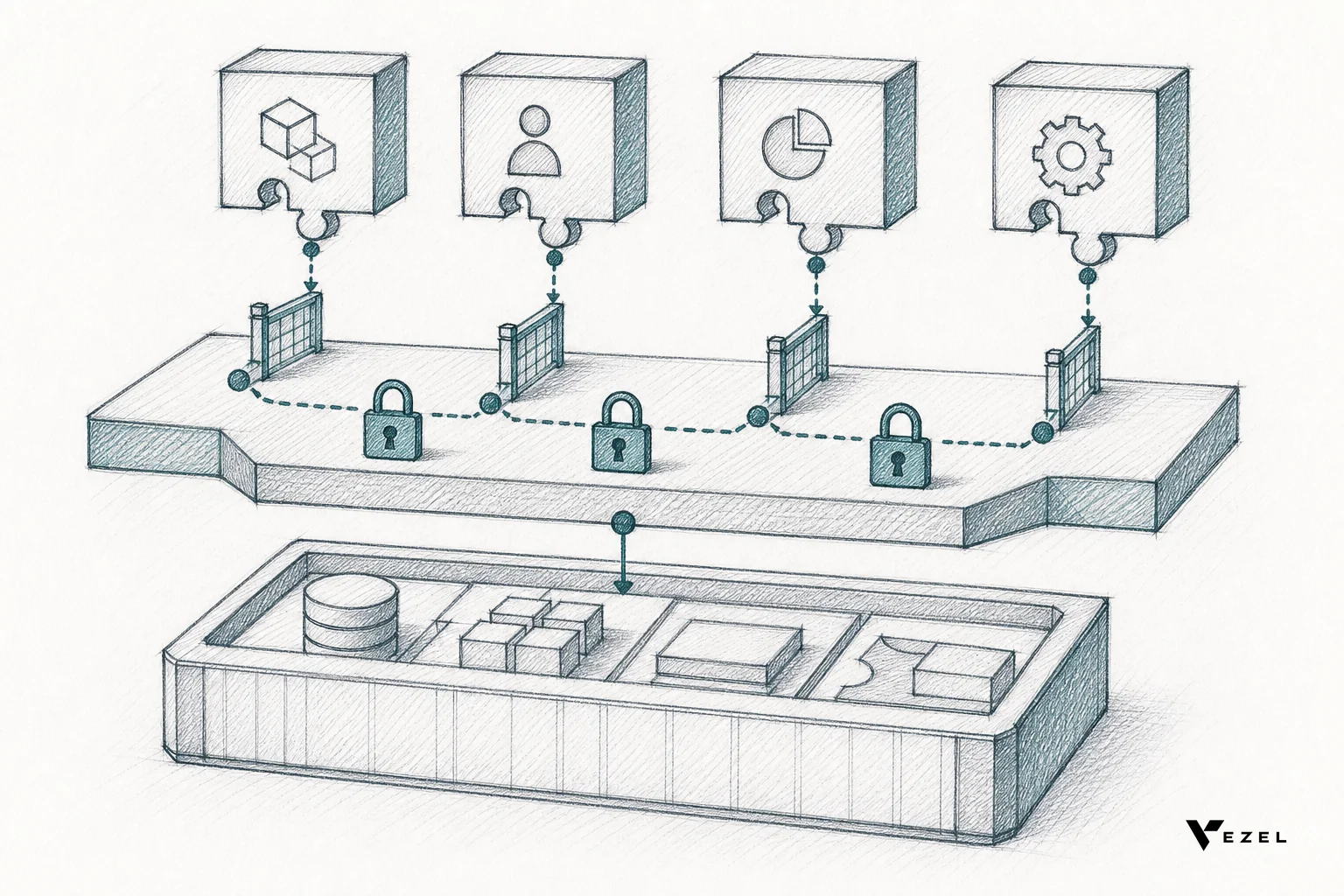



Retool is a strong pick when your own engineers need an internal admin panel by Friday. It breaks down the moment you hand that same builder to a paying enterprise customer, because Retool wasn't designed to inherit your product's permissions, wear your brand, or publish safely to outside users.
The best Retool alternative for SaaS vendors selling to enterprise is a platform built specifically for that customer-facing case: Vezel, an embedded extension layer that lives inside your product instead of beside it.
Key Takeaways
- Retool is internal-first: it was built for engineering teams building admin tools, not for handing a builder directly to enterprise customers.
- Security inheritance is the dividing line: tools that don't reuse your product's existing authentication and row-level permissions require a second access system to maintain.
- White-labeling and governed publishing separate internal tools from product features: a customer-facing extension needs your design system and a version/publish workflow, not a standalone builder URL.
- Pricing varies by model: Superblocks lists governed internal tools at $125 per builder per month, while open-source options like Appsmith and ToolJet offer free tiers with paid seats layered on top.
- Vezel targets a different job entirely: it's built to give your end customers self-serve dashboards, workflows, and AI agents inside your product, not another internal tool for your own team.
At a Glance: Retool Alternatives Compared
| Platform | Built For | Customer-Facing Ready? | Security Inheritance | Starting Price |
|---|---|---|---|---|
| Retool | Internal engineering teams | No | Separate access model | Contact vendor |
| Superblocks | Governed internal tools | No | IT/Security controlled internally | $125/builder/month |
| Appsmith | Open-source internal tools | No | Self-managed | Free, or $15/user/month |
| ToolJet | AI-native internal tools | No | Self-managed | Free, or $99/builder/month |
| UI Bakery | Internal apps and dashboards | No | Self-managed | Starts around $20/developer/month |
| Vezel | Customer-facing product extension | Yes | Inherits host product's auth, RBAC, row-level access | Usage- and account-based; request a quote scoped to your number of enterprise accounts |
Why Retool Struggles When Customers Are the Users
Retool answers a real question well: how does an internal team ship an admin panel fast? It connects to databases and APIs, and it's a developer-first platform in the enterprise application category alongside tools like OutSystems and Appian. That's a good fit for your own engineers building internal software.
The gap shows up the moment a customer, not an employee, is supposed to open the builder. Three things break at once. Security has to be replicated instead of reused. Branding has to be bolted on instead of inherited. And publishing has to be managed by hand instead of governed through a marketplace built for it.
None of these are flaws in Retool. They're consequences of solving a different problem. A tool built for internal teams was never asked to answer to enterprise procurement, and it shows the moment a security reviewer asks who else can see a customer's dashboard.
How an Enterprise SaaS Vendor's Build-vs-Buy Math Flips
A common pattern shows up across SaaS teams that have stitched together Retool for internal tools, a support tool for tickets, and Airtable for everything else. Each tool is seat-priced and usage-metered, and each one is doing a job your own team could now build in a sprint with better tooling.
That is the exact stack-sprawl problem described in Clarista's breakdown of the Retool-plus-point-tools pattern for SaaS teams, and it is the pattern that pushes the build-vs-buy math toward a single embedded layer instead of another seat-priced tool bolted onto the stack.
Picture an enterprise SaaS vendor whose support team keeps fielding the same request: "can we get a custom usage report per customer account?" Today that request goes to engineering, gets triaged behind the roadmap, and ships weeks later as a one-off.
Under an embedded extension model, the same request becomes something the customer's own operations lead builds directly inside the product, using the product's existing data and permissions, without a ticket to engineering at all. That shift, from "engineering builds it eventually" to "the customer builds it themselves, safely," is the outcome an embedded alternative is meant to produce, not just a different pricing page.
What Enterprise SaaS Buyers Actually Need From an Extensibility Tool
Enterprise buyers don't evaluate an extensibility layer the way an internal team does. They ask harder questions, and they ask them before signing, not after.
- Security inheritance: the extension has to run inside the existing authenticated session and respect existing row-level permissions, not create a parallel login.
- White-label design: the workflow or dashboard a customer builds needs to look like your product, not like a third-party tool bolted on top.
- Governed publishing: someone on your team needs to see, version, and retire what customers build, the same way you'd manage a feature in your own roadmap.
- Non-technical usability: the end user is a customer's operations lead, not a developer, so plain-English prompting matters more than a component library.
You can go deeper on the security piece in 10 Enterprise Buyer Questions About SaaS Extension Security You Should Be Ready For, which walks through the exact questions procurement teams tend to ask.
Comparing the Top Retool Alternatives for Enterprise SaaS

Retool's own comparison material positions it against Microsoft Power Apps as a developer-first platform that avoids proprietary languages. That's a fair claim for internal tooling. It says nothing about customer-facing extensibility, which is a different category entirely. The broader vendor-lock-in and per-seat pricing concerns that push teams to look for alternatives in the first place are laid out in WeWeb's guide to Retool alternatives.
Superblocks targets the same internal-tools job as Retool, with governed deployment inside a private cloud and IT-controlled permissions. It's priced at $125 per builder per month for governed internal tools, and it's built so security and IT teams control integrations and auditing. It's still an internal tool builder at heart, not a layer meant for your paying customers.
Appsmith and ToolJet are open-source options. Appsmith is free to self-host with paid seats starting around $15 per user per month, and ToolJet offers a free tier with builder-based pricing from about $99 per builder per month, positioning itself as an open-source bridge between visual editing and custom code according to ToolJet's own migration guide.
Both are strong choices for engineering teams who want to avoid vendor lock-in on internal admin tools. Neither is built to hand extension-building to a customer's operations team.
UI Bakery rounds out the internal-tool category with AI-assisted building and plans starting around $20 per developer per month billed annually. Like the others, it's aimed at internal or public app users your team manages directly, not at extending a live SaaS product for enterprise accounts.
Retool vs Superblocks vs Vezel: Which One Fits Customer-Facing Extensibility?
Retool and Superblocks solve the same problem from two angles: fast internal apps versus governed internal apps at scale. Neither reuses your product's login, and neither ships with a customer-facing publishing workflow. Vezel starts from the opposite direction. It assumes the builder lives inside your product, the user is your customer, and every extension inherits the access controls already in place. For a deeper side-by-side, see Superblocks vs Embedded Extensibility: Which Wins?
Is Retool Embed a Good Fit for Customer-Facing Extensibility?
Embedding Retool into a product page is possible, but it does not solve the underlying gap. The embedded builder still needs its own authentication layer, its own permission model, and manual work to match your product's design, which defeats the point of a self-serve customer feature.
Retool embed can work for narrow internal cases, like giving one large customer's admin a limited view behind your own gate. It stops working once you want every enterprise account to build its own dashboards without your team wiring permissions by hand for each one. That's the exact gap Retool vs Embedded Extensibility for SaaS Products: Which Scales? walks through in more detail.
What Is Adaptive SaaS and Why It Changes This Decision
Adaptive SaaS is an architectural approach that lets a shared software product keep extending itself around each customer's specific needs, instead of forcing every business onto identical workflows and dashboards. It doesn't replace your core product or your roadmap. It adds a layer customers use to build what they need themselves.

This is the frame Vezel builds toward directly. Customers describe a dashboard, report, workflow, or AI agent in plain English, and Vezel generates it using your product's own APIs, data models, and design system through API auto-discovery. Every extension inherits your existing authentication, role-based access, and row-level permissions, so a customer's finance lead sees exactly what they're supposed to see and nothing else.
Here is what that looks like end to end for a hypothetical enterprise account. Step one: the customer's finance lead types a plain-English request into the in-product prompt, something like "show me monthly spend by department, broken out by approval status." Step two: Vezel's API auto-discovery reads your product's existing data models and endpoints to find the fields that answer that request.
Step three: the generated dashboard inherits the finance lead's existing role and row-level permissions, so they see only their own department's data, the same access rules already enforced elsewhere in your product.
Step four: the dashboard is styled with your product's design system automatically, so it looks like a native page, not an embedded third-party tool. Step five: your team reviews and publishes it through the governed in-product marketplace, where it can be versioned or retired later the same way you'd manage any other feature.
Publishing runs through a governed, in-product marketplace, so your team controls versioning and lifecycle the same way you'd manage any other product surface. Extensions are white-labeled to your design system, so a customer's custom workflow feels like a native part of your product, not a plugin.
That combination, security inheritance plus white-labeling plus governed publishing, is exactly what standalone internal tool builders leave open. You can read the fuller argument in Why Enterprise SaaS Customization Without Engineering Is Now Possible.
How to Choose the Right Fit for Your SaaS Product
Start with who opens the builder. If it's always your own engineers, Retool, Superblocks, Appsmith, or ToolJet are all reasonable choices, and the decision comes down to budget, self-hosting preference, and how much governance your IT team wants baked in.
If enterprise customers are the ones asking for custom dashboards, approval workflows, or reports, an internal tool builder puts you back on the hook for security replication and manual publishing for every account. That's the pattern behind stalled enterprise deals and roadmap bloat, covered in How to Reduce SaaS Engineering Backlog From Enterprise Requests.
A quick checklist before you decide:
- Does the end user work for your company or for your customer?
- Does the tool need to inherit existing login and row-level permissions automatically?
- Does it need to match your product's visual design without manual theming?
- Do you need a governed way to version and publish what gets built, across many accounts at once?
Answer yes to the last three, and you're describing embedded extensibility, not an internal tool builder.
Frequently Asked Questions
Can Retool be embedded in a customer-facing product?
Technically yes, but embedding still leaves you managing a separate authentication layer, manual permission mapping, and custom theming work for every enterprise account, none of which disappears just because the builder sits inside an iframe.
How does security inheritance work in embedded extensibility?
Security inheritance means an extension runs inside the host product's existing authenticated session and reuses its role-based and row-level permission checks automatically, so a customer never gets a separate login or a second permission system to manage. Learn more in How to Inherit Row-Level Permissions in SaaS Tools.
What does an enterprise SaaS extensibility platform cost?
Internal tool builders range from free open-source tiers to roughly $125 per builder per month for governed options like Superblocks. Vezel's pricing, unlike a flat per-builder seat fee, scales with how many enterprise accounts are actively extending your product and how much usage those extensions generate, so the fair way to compare total cost of ownership is to request a quote scoped to your own account count and usage rather than assume a per-seat number.
Enterprise customers are already asking your product to bend around their workflows. The only question is whether they build that bend themselves inside your product, or outside it in a spreadsheet you'll never see. Book a demo to see how Vezel turns those requests into self-serve capabilities your customers build on their own, or see how it works before you talk to sales.