


Customers ask for features engineering can't ship because the request underneath is almost never "build this exact feature." It's "solve my problem now," filtered through whatever screen they were staring at when they hit a wall. Engineering hears a spec. The customer meant a symptom. That mismatch, repeated across thousands of accounts, is why the backlog never actually shrinks.
Key Takeaways
- Requests are reactive, not designed: most feature requests are a customer's immediate fix for friction, not a considered product decision, which is why the literal ask rarely matches the underlying need.
- Rejection is the norm, not the exception: B2B SaaS companies reject an estimated 70-80% of enterprise feature requests because each one serves a single account's workflow, not the shared product.
- Saying no repeatedly costs more than engineering time: it erodes trust, pushes customers toward spreadsheets and shadow tools, and shows up later as renewal risk.
- A self-serve extension layer changes the math: letting customers build their own dashboards, workflows, and reports inside the product turns a backlog problem into a capability the customer solves themselves.
- The goal isn't more roadmap capacity, it's fewer requests that need the roadmap at all.
At a Glance: Feature Requests vs. Self-Serve Extensions
| Factor | Traditional Feature Request Path | Self-Serve Extension Layer |
|---|---|---|
| Who builds it | Engineering, after prioritization | The customer, in plain English |
| Typical turnaround | Weeks to months, if it ships at all | Minutes to hours |
| Roadmap impact | Competes with core product work | None — lives outside the shared backlog |
| Security model | Rebuilt per feature | Inherited from existing auth and RBAC |
| Approval rate | Roughly 20-30% of requests get built | Effectively 100% of reasonable requests are attempted |
| Where the "no" goes | To the customer, repeatedly | Rarely needed — customer self-serves instead |
| Maintenance burden | Falls on the vendor forever | Owned by the customer, governed by the vendor |
What's Actually Behind the Request
Most feature requests are reactions, not proposals. A customer hits friction, something slowed them down or fell short of what they expected, and the request that follows is their fastest available fix, not a thought-out solution to the root cause.
That's why two customers who ask for "a custom report" often want completely different things once you dig in. One wants a weekly rollup for their board. The other wants an alert the moment a number crosses a threshold. Both typed the same ticket title.
Product teams that treat every request as a literal spec end up building the wrong thing with full confidence. Feature requests aren't feedback, they're a customer's guess at a solution to a problem they haven't fully described yet, a distinction worth sitting with before any ticket gets scoped.
Why Engineering Can't Just Build It
Even when the request is well understood, most of them still don't belong on a shared roadmap. B2B SaaS companies reject an estimated 70-80% of enterprise feature requests, according to founder-reported data compiled by Gigacatalyst, not because the requests are unreasonable, but because each one serves a single customer's workflow while engineering can only build for the whole base.
That rejection rate isn't a failure of process. It's the economics of a shared product. A feature that helps one account and confuses the other 500 doesn't clear the bar, no matter how loudly that one account asks.
The trap most product teams fall into is blurring the line between hearing a request and implicitly committing to it. Once a customer hears "we'll look into it," they hear a promise, and ProductPlan's guidance on handling feature requests points to exactly this gap between what teams intend to communicate and what customers actually walk away believing.
Why "No" Alone Doesn't Work
A clear no, explained well, can actually protect a relationship. A vague no, or a maybe that quietly becomes a no six months later, does the opposite. The customer stops trusting the roadmap and starts building around it.
The Real Cost of Saying No Repeatedly
Every unshipped request has a shelf life. At first, the customer waits. Then they build a spreadsheet. Then that spreadsheet becomes the actual system of record for their team, and your product becomes the place they log in to export data from.

This pattern shows up in renewal conversations more often than product teams realize. A customer who has been told "not yet" three times doesn't wait for a fourth answer, they start evaluating alternatives. You can read the mechanics of that specific failure mode in why customers churn when roadmap features never ship, and the shadow IT symptoms that precede it are covered in 7 signs your customers are building shadow IT workarounds.
There's also a quieter cost: engineering capacity itself. For most B2B SaaS companies, custom, single-customer requests, dashboards, approval flows, one-off reports, consume around 40% of development bandwidth, according to recent capacity benchmarking cited by Vezel. That's nearly half of engineering time spent on work that helps exactly one account and nobody else.
Customers Still Adapt to Products More Than Products Adapt to Customers
This is the pattern underneath all of it. Every business measures success differently, organizes teams differently, and reports up differently, even within the same industry. A shared product can't anticipate every one of those variations, and it was never designed to.
That gap between the software every customer receives and the software each one actually needs keeps widening as products mature and customer bases diversify. It's not a sign the product is broken. It's the predictable result of building one thing for thousands of different businesses.
The greatest challenge facing SaaS today isn't building more features. It's helping every customer feel like the product was built specifically for them.
AI assistants and chatbots made this gap more visible rather than closing it. They answer questions well, but an assistant that summarizes feedback doesn't build the team's morning dashboard, and a search bar that retrieves data instantly doesn't create the approval chain finance actually runs on. Once customers see software understand their intent, they expect it to act on that intent permanently, not just answer once and reset.
How to Say Yes Without Adding to the Backlog
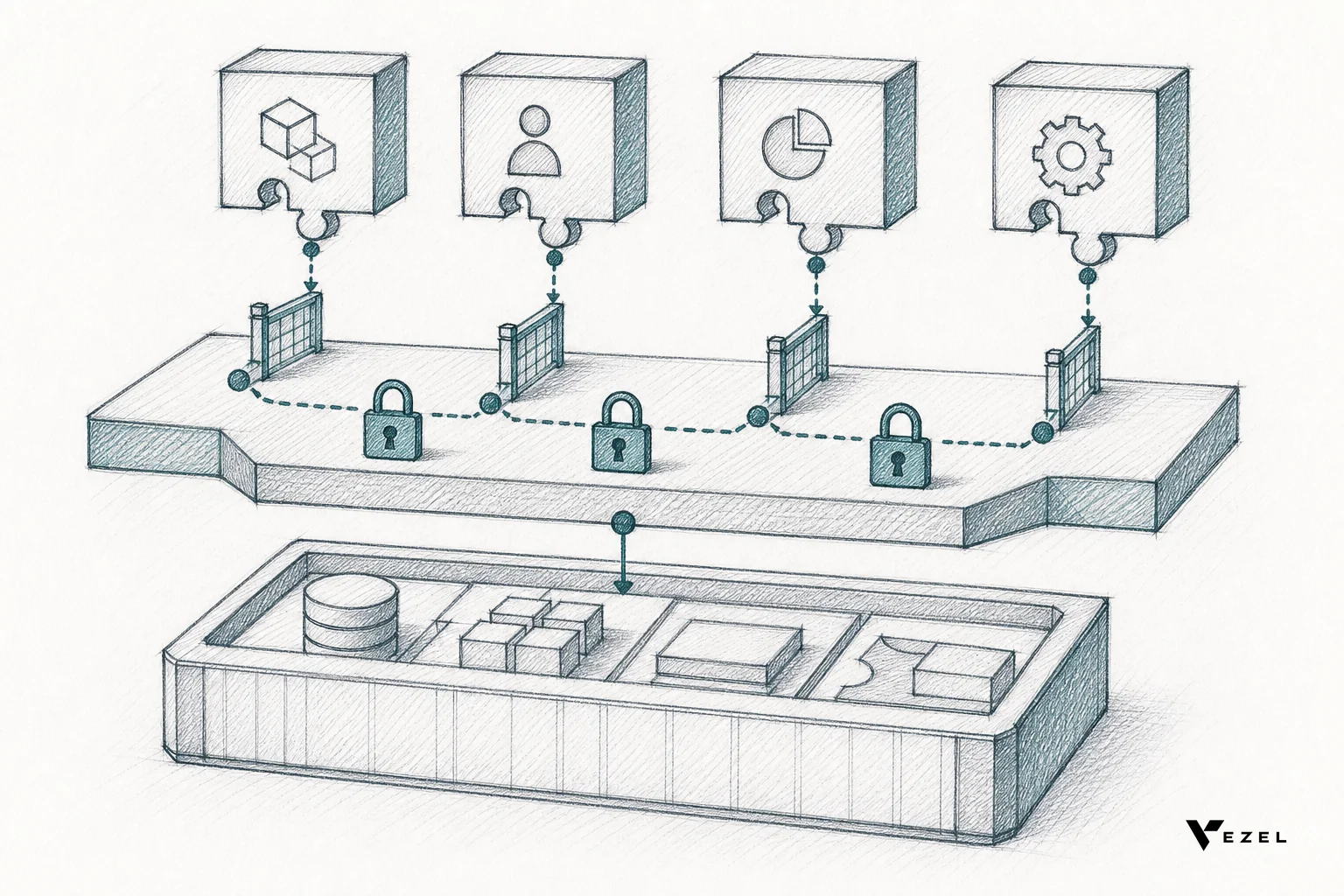
The fix isn't a bigger engineering team or a faster triage process. It's giving customers a way to build the dashboard, workflow, report, or agent themselves, inside the product they already use, without opening a ticket.

That's the shift Vezel is built around: an embedded extension layer where customers describe what they need in plain English and the platform generates it using the product's own data, permissions, and design system. Extensions inherit existing authentication and row-level access controls automatically, so security teams aren't reviewing a new system every time a customer builds something. Everything gets published through a governed, in-product marketplace instead of accumulating as unmanaged one-off code.
Companies exploring this path for the first time can start with how to give SaaS customers self-serve customization, which walks through the rollout mechanics in more detail.
What This Looks Like in Practice
Consider a hypothetical mid-market field service SaaS company. Three of its largest accounts each ask for a different version of the same thing: a dashboard showing technician utilization by region. None of the three define "utilization" the same way, so no single shared feature satisfies all three without extra configuration nobody wants to build and maintain.
Instead of scoping three variants, the product team gives each customer's admin the ability to describe their own utilization dashboard using the metrics and grouping that match their business. Each version pulls from the same underlying API, respects the same permissions, and never touches the engineering backlog. The roadmap stays focused on features that genuinely serve the whole customer base.
Vertical SaaS platforms in field ops, healthcare, and supply chain face this same pattern constantly, and the reporting variations tend to cluster by industry. See how field ops SaaS can offer custom reporting fast for an industry-specific breakdown.
A Simple Decision Rule for Product Teams
Not every request should go to engineering, and not every request should go to a self-serve layer either. A quick filter helps:
- Does it benefit more than a small slice of the customer base? If yes, it's a roadmap candidate.
- Is it core to the product's main workflow? Core logic, pricing engines, and primary navigation stay with engineering, not self-serve tools.
- Is it specific to one customer's metrics, layout, or process? That's a strong signal for self-serve extensibility instead of a backlog ticket.
- Would building it in-house take weeks for a single account's benefit? If so, it's exactly the kind of request that keeps roadmap bloat compounding. More on that pattern in why engineering roadmap bloat from enterprise customers keeps getting worse.
What's genuinely unresolved is where the line sits for AI agents and automations that touch write actions, not just dashboards. Read access is a much easier call than letting a customer-built extension trigger a workflow that changes production data, and most teams are still working out their own governance rules for that case.
FAQ
Should every feature request go to engineering for review?
No. Requests that serve one customer's specific metrics, layout, or process are better solved through self-serve extensibility than through a roadmap ticket, since building them in-house rarely benefits anyone beyond that single account.
Does self-serve extensibility replace the product roadmap?
No, it reduces pressure on it. The roadmap still owns core workflows and features that benefit the broad customer base; self-serve extensibility absorbs the long tail of one-off, customer-specific requests instead.
Is customer-built extensibility safe for enterprise security reviews?
It can be, when extensions inherit the host product's existing authentication, RBAC, and row-level permissions rather than creating a separate access model that security teams have to evaluate from scratch.
If your team is still fielding the same custom dashboard or workflow request every quarter, that's the signal to stop routing it through engineering entirely. Book a demo to see how Vezel lets your customers build their own extensions in plain English, or explore how it works to understand what gets generated inside your product on day one.