

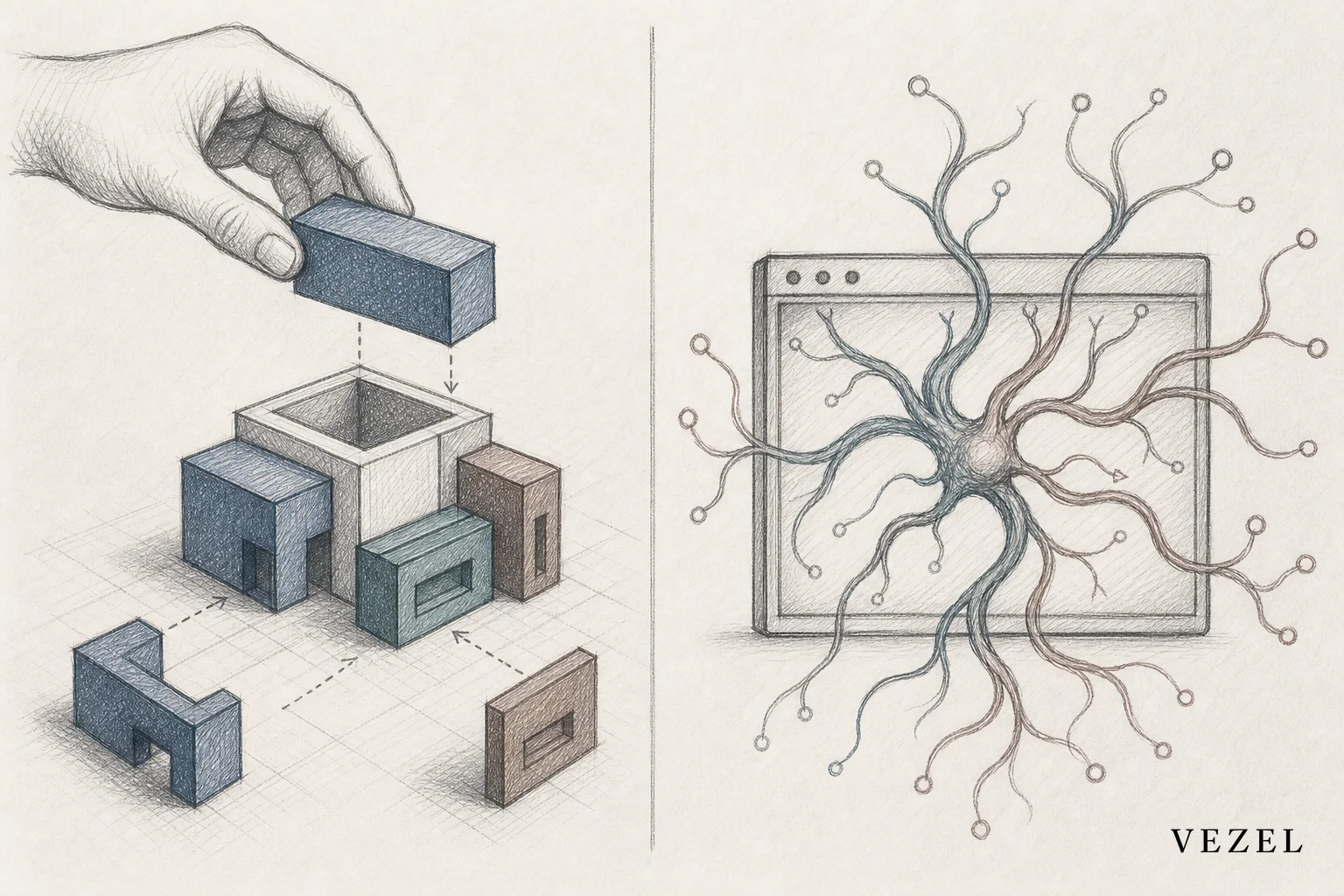
Composable software and Adaptive SaaS both promise flexibility, but they solve different problems for different people. Composable software lets your engineering team assemble a product faster from modular, API-first pieces. Adaptive SaaS lets your end customers build their own dashboards, workflows, and reports inside a product you've already shipped, without touching your backlog.
Key Takeaways
- Different unit of work: Composable software gives engineers building blocks; Adaptive SaaS gives end customers plain-English generation, no engineering required.
- Composable doesn't fix the backlog: A MACH-based stack still routes every customer-specific request through your product team and your sprint cycle.
- Adaptive SaaS lives inside your existing product: It's not a rebuild. It's an embedded layer that inherits your permissions and design system.
- They aren't mutually exclusive: Some platform teams run a composable core and add an adaptive extensibility layer for the last mile of customer requests.
- The buyer confusion is real: Both categories use the words "API-first," "modular," and "flexible" in marketing, but they answer different questions.
At a Glance: Composable Software vs Adaptive SaaS
| Attribute | Composable Software | Adaptive SaaS |
|---|---|---|
| Who builds | Your engineers, architects | Your end customers, in plain English |
| Where it lives | Across separate best-of-breed services (MACH stack) | Embedded inside your existing product |
| Primary goal | Faster internal product assembly | Self-serve customer-specific capabilities |
| Security model | Rebuilt per service or integration | Inherits existing auth, RBAC, row-level permissions |
| Time to a working customer request | Weeks to months (still a dev task) | Minutes to hours (no dev sprint) |
| Backlog impact | Neutral to negative; adds integration surface | Removes one-off requests from the roadmap |
| Best fit | Greenfield builds, platform re-architecture | Existing SaaS products with enterprise customization demand |
What Is Composable Software, Exactly?
Composable software is an architectural philosophy, often described through the MACH acronym: Microservices, API-first, Cloud-native, Headless. Instead of one monolithic application, you assemble a product from independent, swappable services: a headless CMS here, a payments service there, a search engine somewhere else.
The pitch is real. Teams can replace a single component without ripping out the whole stack. A commerce platform can swap its search provider without touching checkout. That's genuinely useful when you're building or re-platforming a product from scratch.
But composability is a decision made by your engineering team, for your engineering team. It changes how you assemble the product. It does not give your end customer a way to build anything themselves. If a customer wants a dashboard scoped to their own KPIs, composable architecture doesn't hand them a tool for that. It just makes it slightly easier for your developers to build it eventually.
What Is Adaptive SaaS?
Adaptive SaaS is a different kind of answer to the same underlying pressure: every customer wants the software to work their way, and the standard product can't anticipate every workflow. Instead of asking engineering to assemble more building blocks, Adaptive SaaS lets the product generate customer-specific capabilities on demand.
Concretely, that means a customer types a plain-English request inside the product they already use, and gets back a dashboard, workflow, report, form, or AI agent connected to live data. No new login, no separate app, no procurement cycle for another tool.

This is the model Vezel builds toward: an embedded AI extension layer that plugs into a host SaaS product through API auto-discovery, inherits the product's existing authentication and row-level permissions, and renders extensions in the host's own design system so they feel native rather than bolted on. You can read more about the mechanics in how to build custom dashboards inside your SaaS.
Where the Vocabulary Overlaps (And Why Buyers Get Confused)
Both categories borrow the same words: "API-first," "modular," "flexible," "no-code." Both get pitched to the same product and engineering leaders who are drowning in customization requests. That overlap is exactly why the two get conflated in vendor decks and analyst reports.
The confusion clears up once you ask one question: who is doing the building? Composable software is built by your team, for your product. Adaptive SaaS is built by your customer, inside your product, without a ticket ever reaching your backlog.
Composable Software vs Adaptive SaaS: The Core Differences
The comparison table above covers the summary. Three differences matter most when you're evaluating either approach against a real customization backlog.
- Ownership of the request. Composable architecture still routes a customer's dashboard request to your product team. Adaptive SaaS lets the customer build it themselves, the same day they ask.
- Security replication. Every new composable service you bolt on needs its own auth handling, or careful federation. An embedded extensibility layer inherits your existing RBAC and row-level rules automatically, which is covered in depth in how to give SaaS customers self-serve customization.
- Where the effort lands. Composable work is a permanent line item on your engineering roadmap. Adaptive SaaS moves that effort to a self-serve layer your customers use directly, which is the difference explored in how to reduce SaaS engineering backlog from enterprise requests.

Does Composable Architecture Solve Your Customization Backlog?
No. Composable architecture makes your internal product assembly faster, but every customer-specific dashboard, workflow, or report still requires a developer to build it using those composable pieces. It reduces integration friction, not the volume of one-off requests hitting your team.
That's the trap. A team re-platforms onto a MACH stack expecting the customization backlog to shrink, and instead finds it's just easier to build each one-off request, which quietly encourages more of them.
How to Embed a Form Builder Into an Existing SaaS Product
You embed a form builder into an existing SaaS product by connecting it to your current API and data model through auto-discovery, then letting the form generation happen in plain English rather than a drag-and-drop canvas your team has to maintain. The form inherits your product's existing permissions instead of running on a separate login.
This is a good test case for the composable-versus-adaptive question. A composable approach means picking a headless form service, integrating its API, mapping its auth model to yours, and shipping updates every time a customer wants a new field type. An adaptive approach means the customer describes the form they want and it appears, scoped to their own data, without a release cycle. For teams weighing this decision alongside integrations more broadly, how to embed integrations in your SaaS without code covers the adjacent pattern.
Which Approach Actually Reduces Engineering Backlog?
Adaptive SaaS reduces engineering backlog because it moves the actual build step to the customer, not just the integration step to your team. Composable architecture can make each individual build cheaper, but every request still needs a developer, so the backlog keeps growing as your customer base grows.
Engineering leaders who've tried the composable route for this specific problem often end up rebuilding the same internal tool builder pattern that Retool vs embedded extensibility for SaaS products already covers: fast for internal use, but never designed to hand off to a paying customer with their own permissions.
When Composable Still Makes Sense
Composable architecture is the right call when you're building a new product from scratch, or replacing a monolith your team has outgrown. If you're a platform team deciding whether to own search, checkout, or content management as separate services, that's a genuine composability decision, and it has nothing to do with customer self-serve.
It also makes sense when your differentiation is the assembly itself: a data platform that lets other engineering teams swap pipelines, for example. That's a builder-to-builder problem, not a builder-to-customer one.
When Adaptive SaaS Is the Better Fit
If you already have a working SaaS product and your enterprise customers keep asking for dashboards, approval workflows, and reports scoped to their own operations, an adaptive extensibility layer solves the actual bottleneck. It doesn't touch your core architecture. It sits on top, connects through your existing APIs, and lets customers self-serve the last mile that used to sit in your backlog.
This is the pattern behind vertical SaaS teams handling compliance workflows, supply chain reporting, and HR tech customization without adding headcount. See how supply chain SaaS can offer custom reporting for a concrete example of the same mechanism applied to one vertical.
FAQ
Is composable software the same as low-code?
No. Composable software is an architecture pattern for assembling a product from modular services. Low-code is a development approach that speeds up building within any architecture, composable or otherwise.
Can you use both composable architecture and Adaptive SaaS together?
Yes. A composable, API-first core makes it easier for an embedded extensibility layer to auto-discover your data model and connect cleanly, since well-structured APIs are exactly what platforms like Vezel need to generate extensions against.
Does Adaptive SaaS require rebuilding my product?
No. Adaptive SaaS is designed to plug into your existing product through your current APIs, inheriting your authentication and permissions rather than replacing your architecture. That's the point of difference from a composable re-platform, which does require structural change.
According to Gartner's research on composable applications, the driver behind composability is business agility, not customer self-serve. And per the MACH Alliance, the entire movement is defined around technical architecture, not end-user extensibility. Neither definition claims to solve customer-specific customization at the point of use, which is exactly the gap Adaptive SaaS is built to close.
If your backlog is full of one-off customer dashboard, workflow, and report requests, a composable re-architecture won't clear it. Book a demo to see how an embedded extensibility layer lets your customers build what they need themselves, or see how it works inside a real SaaS product. If you're still comparing approaches for your specific stack, talk to an expert about what fits your architecture today.