



Custom reporting for insurance SaaS platforms means letting each carrier, MGA, or broker build their own loss ratio breakdowns, claims severity views, and commission statements in plain English, directly inside the claims, underwriting, or policy admin system they already use, without waiting on an engineering ticket. The report connects to live data and respects existing permissions, so a broker never sees another broker's book.
Key Takeaways
- Every carrier calculates differently: Loss ratio, combined ratio, and severity thresholds vary by carrier and even by line of business, making one shared report template nearly impossible to satisfy everyone.
- Engineering backlog is the real bottleneck: Insurance SaaS vendors often lose a large share of dev capacity to one-off carrier and broker report requests instead of core product work.
- Embedded AI extensions close the gap: Natural language prompts turn into live, data-connected reports without a single custom API endpoint being written.
- Permissions must inherit, not replicate: Row-level access and RBAC need to carry over automatically so a broker-built report can't leak another broker's claims data.
- Faster enterprise deals: Sales teams close carrier and MGA contracts faster when they can demo custom reporting live instead of promising a roadmap item.
At a Glance: Insurance SaaS Custom Reporting
| Factor | Traditional Dev Request | Embedded AI Extension |
|---|---|---|
| Time to first report | Weeks to months | Minutes to hours |
| Who builds it | Engineering team | Carrier admin or broker, self-serve |
| Data connection | Custom API endpoint per request | Auto-discovered from existing APIs |
| Permissions | Manually replicated, error-prone | Inherited from host platform RBAC |
| Ongoing maintenance | Owned by engineering indefinitely | Versioned and governed in-product |
| Look and feel | Often inconsistent with core product | White-labeled, native appearance |
| Typical requester | Enterprise carrier or large broker | Any customer segment, self-service |
Why Every Carrier and Broker Wants a Different Report
Ask three carrier ops teams to define "loss ratio" and you might get three different formulas. One nets out reinsurance recoveries. Another excludes catastrophe claims. A third tracks it by underwriting year instead of calendar year. None of them are wrong. They just run their books differently.
The same pattern shows up everywhere in insurance software. A claims platform serving multiple carriers gets requests for severity trending by adjuster, by peril, by state, by line of business, in combinations that no single dashboard can anticipate. An underwriting platform hears from one MGA that wants exception reports flagged by binding authority, while another wants them flagged by premium threshold. A policy admin system serving brokers gets asked for commission statements sliced by producer, by carrier appetite, by renewal date.
None of these requests are unreasonable. They're the normal consequence of insurance being a fragmented, highly regulated, relationship-driven business where every carrier and broker has built its own operating model over years, sometimes decades. Trying to build a single report template flexible enough for all of them is a losing battle for any product team.
The Hidden Cost of One-Off Report Requests
Here's where it gets expensive. Every carrier-specific report request that lands in the backlog competes with core product roadmap items. Engineering has to understand the carrier's data model, build a custom query or endpoint, test it against live claims or policy data, and then maintain it every time the underlying schema changes.
Multiply that across a dozen enterprise carriers and a few hundred brokers, and you get a slow bleed of engineering capacity spent on plumbing instead of product innovation. Sales teams feel this too. An enterprise deal with a regional carrier stalls because their compliance team wants to see a specific audit report before signing, and that report doesn't exist yet. If your platform has struggled with enterprise deals bloating the roadmap, insurance is one of the sharpest examples of the pattern.
Compliance and audit teams add another layer. Insurance is one of the most heavily regulated industries in the country, overseen state by state through bodies like the National Association of Insurance Commissioners. Auditors often need their own custom views into claims handling timelines, reserve adequacy, or underwriting exceptions, views that rarely match what a carrier or broker asked for.
Case Study: A Claims Platform Closes the Reporting Gap
Picture a mid-market claims administration SaaS vendor serving regional property and casualty carriers. Every quarter, at least two or three enterprise carriers submit a custom report request tied to renewal negotiations. One wants claims aging by adjuster tenure. Another wants catastrophe claims segmented by peril and zip code. A third wants a reserve development report that matches their actuarial team's exact formula.
Historically, each request took engineering four to six weeks: understand the carrier's schema, write the query, style the output, then maintain it as data models shifted. During that window, the carrier's renewal decision often sat waiting, and the CS team fielded escalation calls they couldn't resolve.
By embedding an AI extension layer directly inside the platform, the vendor let each carrier's ops team describe the report they needed in plain English. "Show me claims aging by adjuster, filtered to claims open more than 90 days, grouped by catastrophe event." The extension mapped that request to the platform's existing claims API, generated a live report tied to real data, and inherited the carrier's existing row-level permissions automatically. No engineering ticket, no custom endpoint, no waiting for the next sprint.

The result: report requests that used to sit in a backlog for weeks were resolved same-day by the carrier's own team. Renewal conversations moved faster because the exact report the actuarial team wanted existed before the call even happened. For teams evaluating similar approaches, the pattern mirrors what's covered in how CRM SaaS platforms offer custom reporting and how logistics SaaS platforms handle the same challenge, different verticals, identical underlying problem.
How Embedded AI Extensions Generate Insurance Reports in Plain English
The mechanics matter here, because insurance data is sensitive and heavily interconnected. An embedded extension layer like Vezel works by first running API auto-discovery against the host platform's existing claims, underwriting, or policy admin APIs. It maps out the data model, whether that's claim records, loss reserves, policy endorsements, or broker commission tables, without requiring a new integration to be built.
Once that map exists, a carrier admin or broker types a plain English description of the report they need. The extension translates that into a live query against real data, not a static export or a stale snapshot. If the underlying claims data updates tomorrow, the report updates with it.
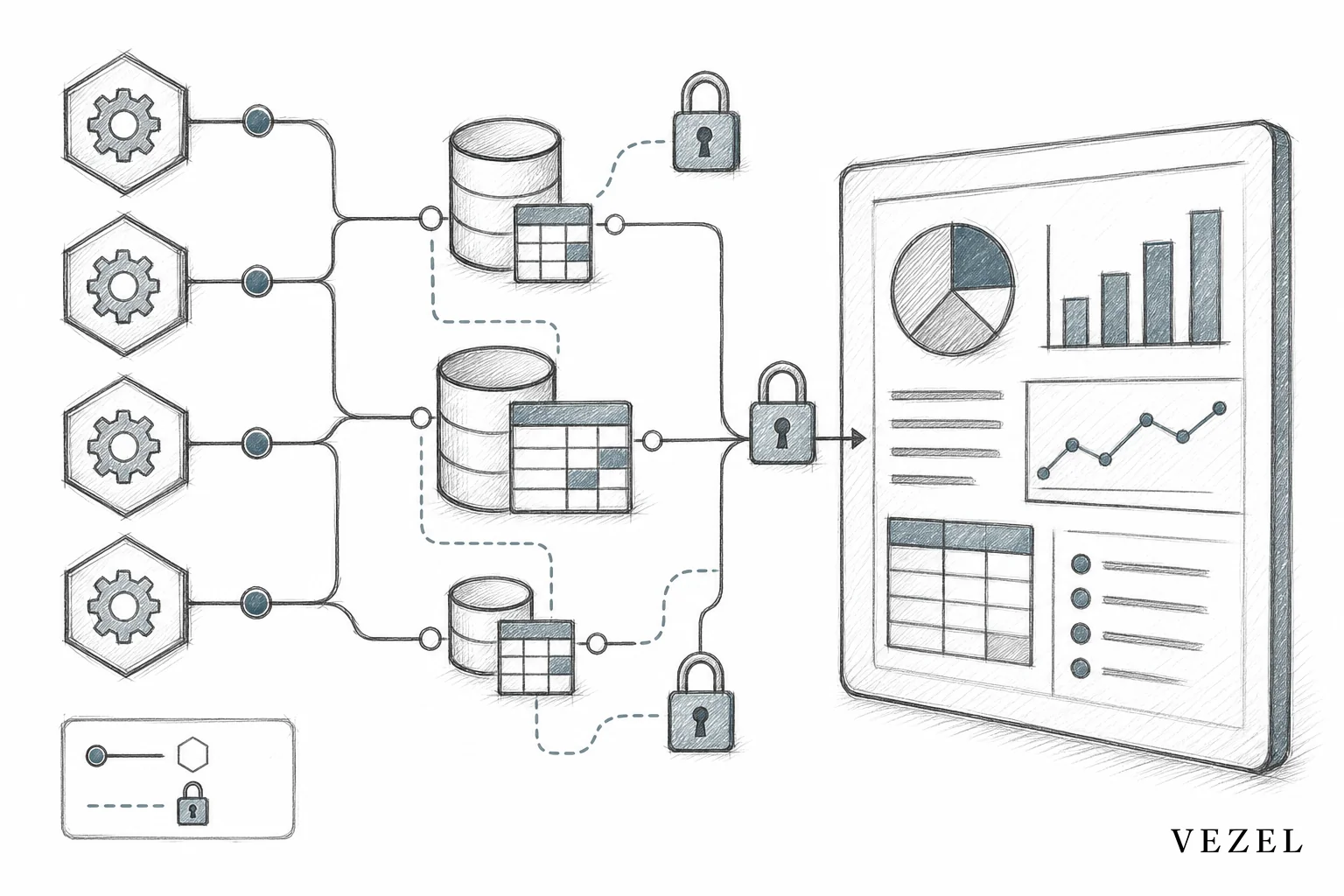
Security inheritance is the part that makes this workable for insurance specifically. The extension inherits the host platform's existing authentication, role-based access control, and row-level permissions. A broker building their own commission report only ever sees their own book of business, because the extension respects the same access rules the core platform already enforces. Nothing is copied into a separate system, and nothing bypasses the controls your compliance team already trusts. If you want the deeper mechanics of this, connecting AI extensions to legacy SaaS APIs walks through the discovery process step by step.
Everything is also white-labeled, so the report builder looks and feels like a native part of your claims or underwriting platform, not a bolted-on third-party tool. That consistency matters in insurance, where trust in the platform is closely tied to how polished and secure it appears.
Permission-Aware Reporting: Why It Matters in Insurance
Insurance data carries real regulatory weight. Claims records often include personally identifiable information, medical details in workers' comp and health-adjacent lines, and financial data tied to reserves and payouts. A custom reporting layer that doesn't respect existing access boundaries isn't a convenience, it's a liability.
This is why row-level access controls and RBAC inheritance aren't optional features for insurance SaaS, they're the baseline requirement. When a broker builds a report, it should automatically filter to only their book. When an adjuster builds a claims aging view, it should only surface claims they're assigned to or authorized to see. Getting this wrong replicates the exact problem covered in how to build custom dashboards inside your SaaS, where custom-built tools quietly break permission boundaries weeks after launch.
A governed, in-product marketplace adds the last piece: version control and publishing oversight, so a report a carrier built last quarter doesn't silently break when the underlying claims schema changes, and so your platform team retains visibility into what's been built and by whom.
Beyond Reporting: Workflows and Agents for Insurance SaaS
Custom reporting is usually the first request, but it's rarely the last. Once a carrier discovers they can build their own reports without engineering, they start asking for approval workflows for underwriting exceptions, automated escalation for claims above a reserve threshold, or an AI agent that can answer "what's the status of claim 48213" in plain language.
The same embedded extension approach that powers custom reporting extends naturally into these areas. You can learn more about building those pieces in how to embed a workflow builder in your SaaS and how to build AI support agents in your SaaS. The pattern insurance vendors are discovering mirrors what's already playing out across other verticals, whether that's CRM platforms serving sales teams or logistics platforms serving carriers and 3PLs.
Getting Started with Custom Reporting in Your Insurance Platform
If your engineering team is fielding repeated carrier and broker report requests every quarter, the fix isn't hiring more developers to keep pace. It's giving customers a governed way to build what they need themselves, without touching your codebase or your data model directly.
Start by auditing the last six months of one-off report requests from your largest carriers and brokers. Look for the pattern, most insurance SaaS vendors find that 70 to 80 percent of these requests are variations on the same underlying data, just sliced differently. That's exactly the kind of demand an embedded AI extension layer is built to absorb.
See how it works before deciding whether an embedded extension layer fits your platform, or if you're further along and ready to talk specifics about your claims, underwriting, or policy admin data model, talk to an expert about what deployment looks like for insurance SaaS specifically.
Custom reporting for insurance SaaS platforms doesn't have to mean another engineering sprint every time a carrier renews. Book a demo and see how carriers, brokers, and MGAs can build their own live, permission-aware reports inside the platform they already trust.