


Denise runs compliance for a regional healthcare network that depends on a mid-market maintenance management platform to track equipment inspections. Six months ago, she stopped using the platform's built-in reporting screen. Not because it was broken, but because it couldn't group overdue inspections by department the way her audits required. Today, her real system of record is an Airtable base she built herself, fed by manual exports and stitched together with a handful of automations nobody in IT signed off on. Her account still shows daily logins. Her actual work happens somewhere else entirely.
This is what shadow IT looks like in 2026: not a rogue developer spinning up unauthorized servers, but a competent, well-meaning customer quietly rebuilding the 20% of her job that the software doesn't cover. If you run product, engineering, or customer success at a B2B SaaS company, you've almost certainly got a dozen Denises on your books right now. Understanding how to prevent shadow IT in SaaS platforms starts with accepting an uncomfortable truth: shadow IT isn't a discipline problem. It's a signal.
What Shadow IT Actually Costs SaaS Vendors
Shadow IT is any tool, workflow, or system an employee builds or adopts outside of IT-approved, vendor-sanctioned channels. In the SaaS customer context, that means spreadsheets tracking data that should live in your platform, WhatsApp threads coordinating work your product was supposed to coordinate, Zapier chains stitching together gaps in your workflow logic, and increasingly, "shadow AI" — employees pasting company data into consumer chatbots or using AI coding tools to build personal dashboards that live entirely outside your security perimeter.
The scale is bigger than most vendors assume. Industry estimates commonly put the share of enterprise technology spend happening outside IT-approved channels somewhere in the 30-40% range. That's not a rounding error. That's roughly a third of the technology budget your customers control, routed around the product you sold them.
Here's the part that should worry a SaaS product leader more than the security exposure: shadow IT hides churn risk. An account with high login frequency and heavy shadow IT usage looks healthy in your dashboards. It isn't. The customer has quietly moved their real, mission-critical work to a system you can't see, can't secure, and can't bill for. Research on B2B SaaS retention consistently finds that roughly two-thirds of churn correlates with low product adoption, not bugs or dissatisfaction with quality. Customers rarely leave because your software is broken. They leave because it stopped being where the real work happens.
This connects directly to two other numbers worth knowing. Average feature adoption across B2B SaaS commonly lands in the 22-35% range, and founder communities consistently report that 70-80% of enterprise feature requests never ship. Do the math: if 100 enterprise accounts each file two or three requests a quarter, that's 200-300 requests against a team that can realistically ship 20-30 features in the same window. Every request that doesn't get built is a workflow a real customer needs today. When it doesn't materialize, the customer doesn't wait patiently. They build around you.
Why Customers Build Workarounds in the First Place
SaaS economics depend on building one product and selling it to many customers without proportional cost increases. That's the whole point of the model, and it's why gross margins in software look so different from services businesses. But it has a structural flaw: the customers buying that one product are rarely doing the same job the same way.
A maintenance platform might serve a hospital's compliance team, a roofing company's field crews, and a manufacturing plant's reliability engineers, all on the same core interface. A CRM might serve a real estate brokerage and a distributor with entirely different pricing logic. Each group has different vocabulary, different regulatory pressure, and a different answer to "what's the first thing I do every morning." When one interface tries to serve all of them, it ends up roughly 60-80% relevant to any single customer. The remaining slice doesn't vanish. It moves into a spreadsheet, a sticky note, or an unauthorized script.
That's the usage gap, and it's the actual root cause behind almost every shadow IT problem you'll find in a customer account review. Denise didn't build her Airtable base because she distrusts her vendor. She built it because the missing 20% of her job had to live somewhere, and the platform didn't offer her a governed way to build it herself.
Why the Usual Fixes Don't Stop Shadow IT
Most SaaS teams have already tried to solve this, and it's worth being honest about why those attempts stall out.
Shipping more features feels like the obvious answer, but every feature added to a shared core product adds complexity for every customer, not just the one who asked. The product becomes a Swiss Army knife: theoretically capable of anything, practically navigable by no one. Frontline users, the ones whose daily habits actually determine retention, are the most sensitive to that bloat.

Configuration panels — feature flags, custom fields, permission toggles, genuinely help when customer variance is narrow. They break down when it's wide, for a simple reason: configuration changes how existing features behave, but it cannot create functionality that doesn't exist yet. If a customer's workflow needs a calculation or a view your product has never had, no amount of toggling produces it.
Bespoke engineering for key accounts works for a handful of strategic customers, but some estimates put the share of engineering capacity consumed by one-off, single-customer requests as high as 30-40% at mid-market B2B SaaS companies. Most of that work never gets reused. It becomes permanent maintenance debt buried in the core codebase.
Standalone low-code tools like Retool, Glide, and Superblocks reduce build time from months to days, and they're genuinely excellent for internal ops tooling. But they live outside your product, require the builder to think like an engineer, and don't inherit your platform's row-level security. A customer has to leave the product they trust, log into a second environment, and manage a parallel system. That's not a fix for customer-facing shadow IT. In a lot of ways, it's just a sanctioned version of the same problem. Our breakdown of Retool vs. embedded extensibility for SaaS products goes deeper on where standalone builders hit a ceiling.
Generic AI chatbots, the "ask your data a question" sidebar that dominated 2024-2026 product launches, look good in a demo but tend to land at single-digit weekly active usage once the novelty wears off. A chatbot answer disappears when the tab closes. Nobody wants to retype the same prompt every morning; they want a button that already works. That's what product circles have started calling "checkbox AI": AI shipped to satisfy a board narrative, not a specific workflow, and it gets quietly sunsetted within 12-18 months.
The Real Fix: Governed Self-Serve Extensibility Inside the Platform
If shadow IT is a response to a usage gap, the only durable fix is closing the gap without opening a new security hole. That means giving customers a way to build the missing 20% of their workflow inside the product they already trust, using their real data, under the same permissions they already have.

This is the shift from AI-as-conversation to AI-as-application. There's a useful way to frame the maturity curve here. Level 1 is extraction: single-shot AI calls like photo-to-form or summarization, identical for every customer. Level 2 is conversation: a chatbot that can read and write data but forgets everything when the session ends. Level 3 is application generation: the AI produces a durable, installable, per-customer microapp that becomes part of someone's actual daily toolkit, because it was built around their specific description of their specific job.
Embedded AI extension builders, the category Vezel operates in, live at Level 3. A customer describes a workflow in plain English, "show me overdue inspections grouped by department, with a one-tap sign-off", and the system generates a focused application that reads and writes real data through the platform's own APIs, inherits its authentication and role-based permissions, and gets published into an in-product marketplace where other users can find and adapt it. No separate login. No parallel database. No shadow system waiting to be discovered during the next security audit.
The retention data behind this pattern is why the category has attracted attention from SaaS leadership teams. Production deployments of Level 3 application generation report adoption rates in the 85-95% range, against a typical 20-40% for a standard feature release, and day-30 retention in the high 80s, against industry-average one-month retention figures often cited around 35-40%. When customers can build the missing piece themselves, inside the platform, the incentive to build it outside disappears.
Governance Controls That Make Self-Serve Extensibility Safe
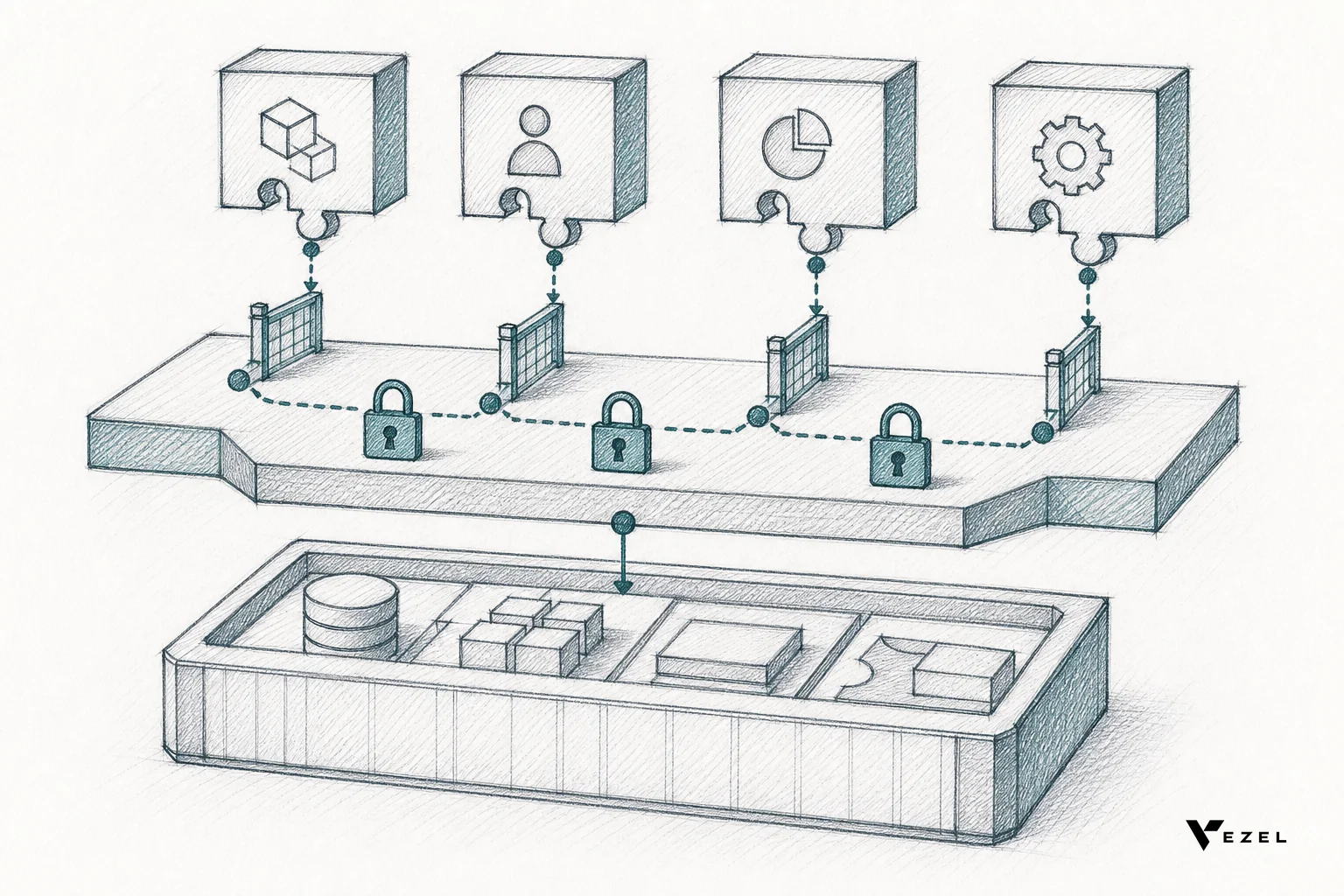
Giving customers the ability to build isn't useful if it just creates a faster, sanctioned version of shadow IT. The governance layer is what separates a real extensibility platform from a liability. Four controls matter most:
- Multi-tenant isolation. Every generated app runs in a sandbox scoped to one customer's tenant, enforced at the infrastructure level so Customer A's apps can never read Customer B's data.
- Permission and role inheritance. Every API call a generated app makes passes through the same authorization rules the rest of the platform already enforces. If a user can't see certain records today, an app they build can't surface those records either.
- Audit trails. Every generation and deployment event gets logged, so security and compliance teams can answer "who built what, and when" without digging through spreadsheets.
- Publishing and lifecycle management. Apps are versioned, can be reviewed before wider release, and roll back cleanly if something breaks, the opposite of an unmanaged script nobody remembers writing.
The table below lays out the practical difference between what customers do today when they hit a gap, and what governed extensibility replaces it with:
| Dimension | Shadow IT (spreadsheets, Zapier, personal chatbots) | Governed Embedded Extensibility |
|---|---|---|
| Data location | Exported, duplicated, often unencrypted | Stays in the host platform's live data model |
| Access control | None, anyone with the file can open it | Inherits existing roles and row-level permissions |
| Audit visibility | Invisible to IT and vendor | Every build and deploy event logged |
| Maintenance | Breaks silently when someone leaves or a format changes | Versioned, supported, rollback-capable |
| Vendor visibility into usage | Zero, looks like normal login activity | Full usage analytics per app and per user |
| Time to build | Hours to weeks of manual effort | Minutes, described in plain English |
For a deeper look at what to demand from a vendor before you commit to one of these platforms, see our guide on how to choose an embedded extensibility platform, and our companion piece on how to embed a workflow builder in your SaaS for the approval-flow side of this problem.
What This Looks Like Across SaaS Verticals
The pattern repeats everywhere customer diversity is wide. In maintenance management, a hospital's biomedical engineering team can build a real-time "critical equipment down" board instead of tracking it in a shared spreadsheet, an approach we cover in more depth in how healthcare SaaS platforms can offer extensibility. In CRM, a sales manager can build a renewal-risk dashboard that flags declining usage instead of maintaining a side tracker in a personal spreadsheet. In HR tech, a healthcare HR team can build a credential-expiration tracker grouped by department rather than emailing a manual list every month. In every case, the shadow system disappears not because someone banned it, but because the governed alternative is faster and safer than the workaround ever was.
How to Roll Out Self-Serve Extensibility Without Creating New Risk
Preventing shadow IT at the platform level is a rollout, not a switch you flip. A sensible sequence looks like this:
- Audit the workarounds that already exist. Talk to customer success about which accounts export data regularly, ask what spreadsheets or third-party tools show up in support tickets, and treat every answer as a roadmap item, not a compliance violation.
- Connect your API surface. Ideally via an OpenAPI specification, so the extension builder can discover your data model and endpoints without manual mapping.
- Map security before you map features. SSO, roles, and row-level access rules need to carry over exactly, so generated apps can never see more than the user already can.
- Apply your design system. Generated apps should look native to your product, not like a bolted-on tool with a different font and a different navigation pattern.
- Seed the marketplace. Publish a handful of first-party example apps covering the most common workarounds you found in step one, so customers see the art of the possible immediately.
- Start with your own team. Let customer success and solutions engineers build workflows live, on calls, before opening the builder to every end-user. It's the fastest way to prove governance holds up under real conditions.
Integration timelines for this kind of embedded builder typically run around two weeks, not the multi-quarter engineering projects that bespoke customization usually requires. Our guide on connecting SaaS to customer workflows without code walks through that setup in more detail, and if roadmap bloat from enterprise requests is part of what's driving your customers to shadow IT in the first place, reducing engineering backlog from enterprise requests is the natural next read. Start your free trial to see how quickly your own API surface maps into a working extension layer.
Frequently Asked Questions
Is shadow IT always a security risk?
Not automatically, but it's always an unmanaged one. The tool your customer built to solve a real problem might work fine for months. The risk shows up when it holds sensitive data with no access controls, no audit trail, and no one accountable for keeping it current. According to the Cybersecurity and Infrastructure Security Agency, unmanaged and unmonitored assets are consistently among the top vectors for data exposure in enterprise environments, precisely because nobody is watching them.
How is embedded extensibility different from just adding a chatbot?
A chatbot answers a question and forgets it. Embedded extensibility produces a durable, installable application that becomes part of a customer's daily routine. That distinction, roughly the gap between Level 2 and Level 3 AI maturity, is why chatbot adoption tends to fade after launch while application-generation adoption tends to climb.
Does this require engineering resources from my team?
Initial integration takes real but limited engineering time, mainly connecting your API surface and mapping your security model. After that, customers and customer success teams build workflows themselves in plain English, which is the entire point: it removes the ongoing engineering burden that bespoke customization creates.
How fast can a SaaS company roll this out?
Most integrations, including security mapping, design-system theming, and marketplace seeding, run around two weeks. Individual customer workflows can go from a plain-English description to a live, permissioned application the same day it's requested.
Denise shouldn't need an Airtable base to do her job. She needs a platform that closes the gap her vendor left open, without asking her to trust a second system with data the first one was supposed to protect. That's the actual definition of preventing shadow IT: not locking things down harder, but making the sanctioned path faster than the workaround. If you're ready to see what that looks like against your own product's API, book a demo, or talk to an expert about mapping your specific security model into a governed extension layer. You can also see how it works before committing to a rollout plan.