


Three days before a six-figure renewal decision, a solutions engineer named Marcus does something he's not supposed to do. Sitting in a follow-up call with an enterprise prospect's ops team, he pulls up Glide and builds a rough version of the dashboard they've been asking for: overdue jobs, ranked by site, color-coded by urgency. It takes him twenty minutes. The room goes quiet, then impressed. Someone says, "wait, can we just use this?"
Marcus doesn't have a good answer. The prototype runs on a spreadsheet he manually exported that morning. It has no connection to the platform's real database, no awareness of who's allowed to see which accounts, and no way to update itself when a job status changes in production. It's a demo, not a deliverable. That gap between "we can show you this" and "we can actually ship this, safely, inside your product" is exactly where the debate between Glide and an embedded SaaS extensibility platform gets decided.
This isn't a story about Glide being a bad product. It's a story about two categories of tool solving two different problems, and what happens when B2B SaaS leaders confuse one for the other.
What Glide Actually Is (and Who It's Built For)
Glide is a general-purpose no-code app builder. You connect a spreadsheet, an Airtable base, or a Google Sheet, and Glide turns it into a mobile-friendly or web app with forms, lists, and basic logic. For a small business owner who needs an inventory tracker, or a team lead who wants a simple internal scheduling tool, it's genuinely useful. Thousands of people use it to go from "I have a spreadsheet" to "I have an app" in an afternoon.
The design center of Glide is the standalone app. You build it once, it lives on Glide's own infrastructure, with its own authentication and its own URL. That's fine when the app is the product. It becomes a structural mismatch the moment the app is supposed to be a feature inside a much bigger product that already has its own users, its own data model, and its own security rules.
That mismatch is the same one covered in our breakdown of Retool vs embedded extensibility for SaaS products: a general-purpose builder — whether it's aimed at developers like Retool or at business users like Glide — is architected to produce an independent app, not a governed extension of an existing platform.
What "Embedded SaaS Extensibility Platform" Actually Means
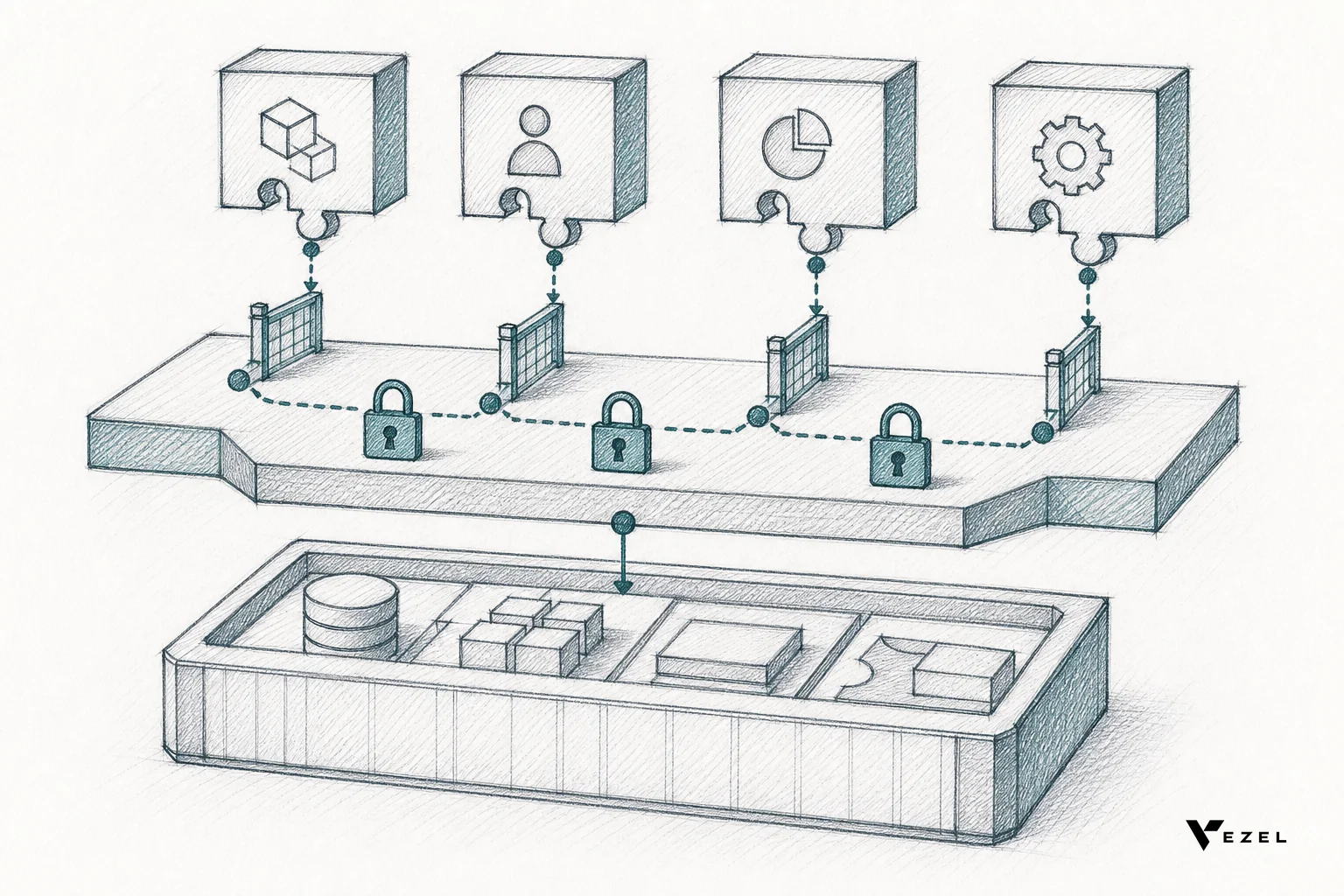
An embedded extensibility platform is a different animal entirely. Instead of living outside your SaaS product, it lives inside it. Vezel, for example, plugs into a host platform's API surface so that a customer success manager, an implementation specialist, or an end-customer can describe a workflow in plain English, "show me overdue jobs grouped by site, with a button to reassign to the nearest technician", and get a working microapp that runs on the platform's real, live data.
Five things distinguish a production-grade embedded extension builder from a general no-code tool:
- Multi-tenant runtime. Every generated app runs in a sandbox scoped to one customer's tenant, so Customer A's app can never touch Customer B's data, even on a shared instance.
- API auto-discovery. Rather than someone manually wiring up every endpoint, the platform ingests the host product's OpenAPI spec and maps plain-English requests to the right data calls automatically.
- Security inheritance. Every call a generated app makes passes through the same authentication and row-level permissions the core product already enforces. If a user can't see a record today, an app they build won't show it to them either.
- White-label theming. Generated apps pick up the host product's fonts, colors, and navigation patterns, so they feel native instead of bolted on.
- Governed marketplace. Apps don't vanish after one use. They're versioned, published for other users to discover, and tracked with usage analytics.
This is what's sometimes called the Application-Driven Model: instead of shipping one interface built for a hypothetical average customer, the platform lets every customer generate small, single-purpose "microapps" scoped to their exact job. You can see this pattern applied across industries in how healthcare SaaS platforms offer extensibility and in how to build custom dashboards inside your SaaS.
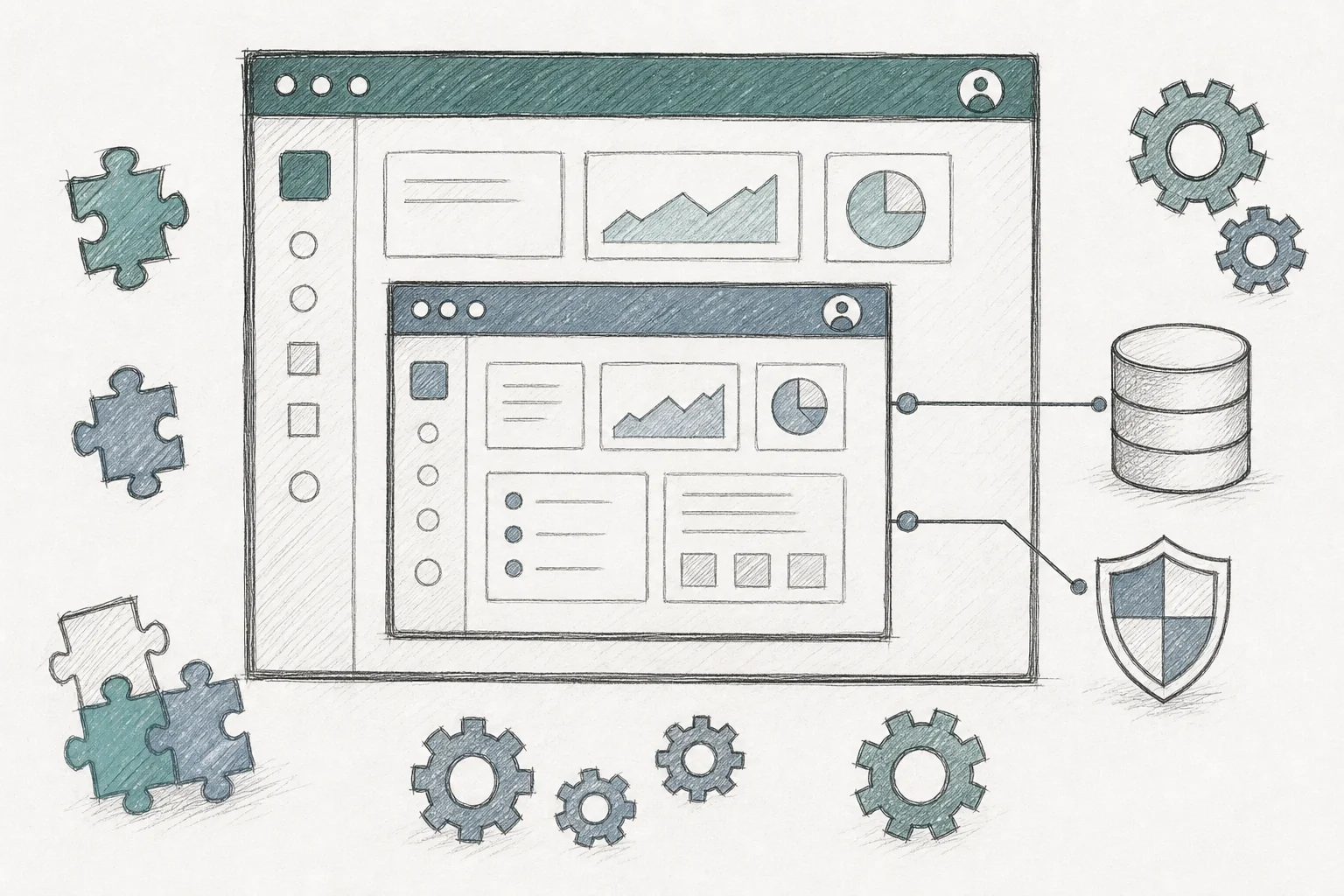
Glide vs Embedded Extensibility: Side-by-Side
The clearest way to see the difference is to line the two approaches up against the questions an enterprise SaaS product leader actually has to answer: where does this app live, who can access what, and what happens when a hundred customers all want their own version?
| Dimension | Glide (Standalone No-Code Builder) | Embedded Extensibility Platform (e.g. Vezel) |
|---|---|---|
| Where the app lives | On Glide's own infrastructure, separate URL and login | Inside the host SaaS product, no separate login |
| Data source | Spreadsheets, Airtable, Google Sheets (manual sync or basic connectors) | Live connection to the host product's real API and database |
| Security model | Its own auth system, built and maintained independently per app | Inherits the host platform's existing authentication and row-level permissions |
| Multi-tenancy | Not natively enterprise multi-tenant; each app is its own island | Sandboxed per customer tenant by design |
| Branding | Glide's look and feel, with limited customization | White-labeled to match the host product's design system |
| Distribution | Shared as a standalone link | Published into an in-product, governed marketplace |
| Who builds it | Anyone comfortable structuring data and app logic themselves | Any end-user or CS team member describing a workflow in plain English |
| Best fit | Small business tools, internal utilities, standalone prototypes | Enterprise SaaS customization at scale, governed and auditable |
| Typical adoption pattern | Varies widely; not measured against host-product retention | Production deployments report 85-95% activation vs. 20-40% for a typical feature release |
Notice what's missing from the Glide column: nothing about row-level access, nothing about tenant isolation, nothing about inheriting the host product's permission model. That's not an oversight in Glide's design. It's simply not the problem Glide was built to solve.
Where Glide Genuinely Wins
Credit where it's due. If you're a small operations team that needs a standalone inventory tracker, a field checklist app with no dependency on an existing enterprise platform, or a quick prototype to test an idea before committing engineering time, Glide is a fast, low-friction way to get there. It's also a reasonable way for a non-technical founder to validate a brand-new product idea that has no existing "host" to embed into.
The trouble starts when a B2B SaaS company tries to stretch that same tool to solve a fundamentally different problem: giving enterprise customers governed, secure, native customization inside a product that already has thousands of users, sensitive data, and a security team asking hard questions during procurement. That's not a scale issue Glide can grow into. It's an architectural mismatch, the same one we cover in our comparison of Mendix against embedded extensibility: general-purpose builders optimize for building apps fast, not for disappearing into someone else's platform.
Why the Gap Matters for Enterprise SaaS Deals
Here's the part product leaders feel in their roadmap. Founder communities consistently report that 70-80% of enterprise feature requests never ship, not from a lack of effort, but from simple arithmetic. A hundred enterprise accounts filing two or three requests a quarter adds up to hundreds of asks against an engineering team that can realistically ship a few dozen features in the same window. Each unbuilt request is a real workflow a real customer needs, and if it doesn't get built, the customer builds a workaround instead.
That workaround is where standalone no-code tools like Glide quietly become a liability rather than a fix. An enterprise customer who can't get a dashboard from your product will happily wire one up themselves, connected to an exported spreadsheet, sitting entirely outside your security perimeter. Multiply that across dozens of accounts and you've recreated the exact shadow IT problem your platform was supposed to prevent, just with a nicer interface than a rogue Zapier flow.

Enterprise procurement teams know to ask about this. Security questionnaires increasingly include questions about where customer data lives, who can access it, and whether a vendor's "customization" story involves data leaving the platform at all. A standalone app builder struggles here by design: the app is not part of the host platform's tenant model, so there's no clean answer to "does this inherit our existing row-level permissions?" The honest answer is no, and that answer can stall or kill a deal. This is exactly the friction explored in how to shorten your enterprise SaaS sales cyclehow to reduce saas engineering backlog from enterprise requests", sales cycles stretch when security review surfaces gaps that a bolt-on tool simply can't close.
Embedded extensibility platforms answer that question differently, because the architecture is built around it from day one. Every generated microapp inherits the host product's existing authentication and access controls, which means the security review answer is "yes, it uses the same permission model as everything else you've already audited." That single difference is why production deployments of embedded extension builders report meaningful reductions in support tickets, and net revenue retention gains often cited in the 20-point range as accounts expand to support the workflows they've built for themselves. It's also why solutions engineers who can build a requested workflow live on a sales call, on the real platform, report materially higher win rates than teams stuck promising "it's on the roadmap."
The question isn't whether your enterprise customers need customization. They already do, and they're already building it somewhere, the only open question is whether it happens inside your platform's security model or outside it.
How to Decide Between a Standalone No-Code Builder and an Embedded Extensibility Platform
Before your team reaches for any no-code tool to solve a customer's workflow gap, run the request through a short checklist:
- Does the app need to read or write real customer data? If yes, a standalone builder connected to an exported spreadsheet is a security downgrade, not a solution.
- Does it need to respect existing permissions? If different roles should see different records, the app must inherit access control, not reinvent it.
- Will more than one customer eventually want a version of this? If so, you need a governed way to publish, adapt, and reuse it, not a one-off link.
- Will this need to survive a security review? Enterprise procurement will ask where the data lives and who can see it. Standalone tools rarely have a clean answer.
- Do you want your CS team, not your engineers, building it? Plain-English generation only pays off if it's connected to real data and real permissions from the start.
If you answered yes to two or more of those, you're not looking for a general app builder. You're looking for an embedded extensibility layer. This maps to a broader maturity model worth knowing: Level 1 is single-shot AI extraction (photo-to-form, simple classification), Level 2 is conversational AI that reads and writes data but disappears when the chat ends, and Level 3 is durable, installable application generation, which is where platforms like Vezel operate and where the retention numbers actually show up. For a deeper walkthrough of evaluation criteria, see how to choose an embedded extensibility platform and how to embed a workflow builder in your SaaS.
FAQ: Glide, Embedded Extensibility, and SaaS Customization
Can Glide apps connect to my SaaS product's live data?
Not natively in the way an embedded extension does. Glide is built around spreadsheet and Airtable-style data sources. Connecting it to a production SaaS database usually requires custom integration work, and even then the app lives outside your platform's tenant and permission model, not inside it.
Is Glide secure enough for enterprise customers?
Glide has its own security practices for the apps it hosts, but that's a different question from whether a Glide app can inherit your platform's authentication, row-level permissions, and audit logging. For enterprise deals where procurement asks about data residency and access control, a standalone app built outside your security perimeter is a hard conversation to win.
What's the real difference between a no-code app builder and an embedded extension platform?
A no-code app builder like Glide creates independent applications with their own infrastructure. An embedded extensibility platform generates extensions that live inside an existing SaaS product, using its real APIs, its real data, and its real permission model, and distributes them through an in-product marketplace instead of a standalone link.
How fast can an embedded extensibility platform go live inside my product?
Integration timelines vary by platform complexity, but a typical rollout connects the host product's API surface, maps security and roles, applies branding, and seeds a first set of example apps within a matter of weeks, not the months a comparable custom-engineering effort would take. You can see the process in more detail in how to deploy AI agents inside your SaaS platform.
The Real Choice Isn't Glide vs Vezel. It's Standalone vs Native.
Marcus's twenty-minute Glide prototype wasn't wrong to build. It proved the workflow mattered enough that the customer wanted it live inside their sales call. The mistake would have been shipping that prototype as the answer, leaving a governance gap that procurement finds three weeks later. The workflow the customer wants doesn't disappear if you don't build it, it just moves outside your platform, into a spreadsheet, a Glide link, or a shadow tool nobody on your security team has reviewed.
If your enterprise customers keep asking for custom dashboards, approval flows, or reports that don't exist yet in your product, the fix isn't a faster prototyping tool bolted onto the outside. It's an extension layer that lives natively inside your platform, connected to real data, inheriting real permissions, and distributed through a marketplace your own customers can find. Book a demo to see how Vezel turns a plain-English request into a governed, white-labeled extension of your product, or start your free trial to try it against your own API today. If you'd rather talk through your specific architecture first, talk to an expert and bring your hardest enterprise customization request. There's a good chance you can build it live, on the call, the same way Marcus almost did.