


A VP of Engineering at a mid-market logistics SaaS company gets a Slack message from her sales lead on a Tuesday afternoon. An enterprise prospect, worth six figures in annual contract value, wants a custom dispatch dashboard before they'll sign. Her first instinct is to open a tab and start researching Mendix. It's the platform every analyst report mentions, the one with the Gartner Magic Quadrant placement, the one that promises "build anything." Two hours later she closes the tab, more confused than when she opened it.
That confusion is the point of this post. The question isn't whether Mendix is a good platform. It is. The question is whether Mendix is the right tool for the specific problem she has: an existing SaaS product that needs to bend around dozens of different enterprise workflows without her engineering team building and maintaining a separate application for each one. That's a fundamentally different problem than "we need to build a new enterprise app," and the comparison between Mendix vs embedded SaaS extensibility platform approaches hinges entirely on which problem you actually have.
Get this decision wrong and you either overspend on a platform that requires a dedicated development team to operate, or underspend on a tool that can't inherit your product's security model and data. Get it right, and you turn a recurring source of engineering pain into a competitive advantage.
What Mendix Actually Is (and Who It's Built For)
Mendix is a full low-code application development platform, owned by Siemens. It's designed to let professional developers and trained citizen developers build complete enterprise applications: think supply chain management systems, custom ERP modules, or internal operations tools built from the ground up. It ships with a visual modeling environment, its own deployment pipeline, its own data model design tools, and its own application lifecycle management.
That's a serious amount of capability, and it's exactly what you want if your job is building an entirely new application that didn't exist before. Mendix gives you visual workflow modeling, integration connectors, and enterprise-grade governance for the apps you build inside it. Manufacturing companies use it to build plant-floor applications. Insurance companies use it to build claims-processing tools. It's a legitimate, mature category leader in the enterprise low-code application platform space, per Gartner's own coverage of the category.
Here's the catch: Mendix assumes you're starting from a blank canvas. Someone still has to understand the platform's modeling language, design the data structures, wire up integrations by hand, and manage a deployment pipeline. It's built for developers, not for the end-customer sitting inside your product who just needs a dashboard that ranks overdue jobs by site. Mendix doesn't know your SaaS product's data model, doesn't inherit your authentication system out of the box, and doesn't publish generated apps back into your product's interface. It produces a separate application, with its own login, its own hosting footprint, and its own maintenance burden.
If your actual goal is to stop your enterprise customers from asking engineering to build one-off dashboards and workflows inside the product they already use, Mendix doesn't close that gap. It just moves the gap onto a different, more powerful, still-separate platform.
What an Embedded SaaS Extensibility Platform Is Instead
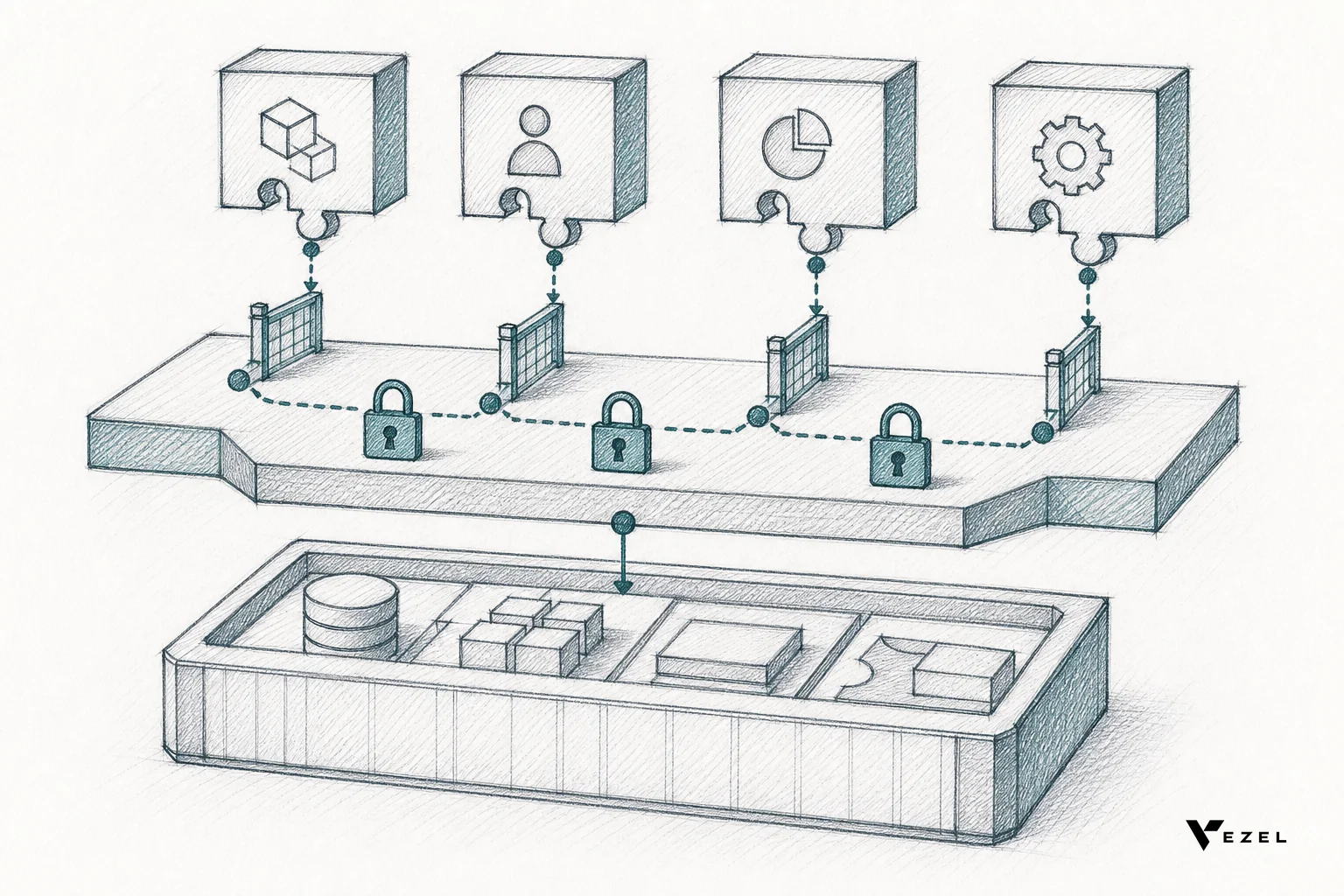
An embedded AI extension platform takes a different starting assumption. It isn't trying to be a place where developers build new software from scratch. It's a layer you integrate directly inside your existing SaaS product, so your own end-customers, your customer success team, or your implementation specialists can describe a workflow in plain English and get a working microapp back, connected to real data, the same day.
This is the core distinction covered in why enterprise SaaS customization without engineering is now possible: the builder discovers your product's API surface automatically, maps natural-language requests to the right endpoints, and generates an app that inherits your existing authentication and row-level permissions. No separate login. No new attack surface. No standalone app sitting outside your governance model.

This is what's often called the Application-Driven Model. Instead of trying to build one interface flexible enough to serve every customer, you let each customer generate small, single-purpose microapps: a morning prioritization dashboard, a compliance checklist with photo capture, a margin calculator scoped to their own pricing logic. None of these are "platform features" in the traditional roadmap sense. Each is narrow, specific, and tailored to one customer's version of a common job, which is exactly what drives daily use.
The generated app also picks up your product's design system automatically, so it looks native rather than bolted on. And it doesn't disappear after one use. It gets versioned, published into an in-product marketplace, and made discoverable to other users solving a similar problem, a pattern explored further in how to embed a workflow builder in your SaaS.
Mendix vs Embedded Extensibility: The Direct Comparison
Laid side by side, the practical differences show up in four places: how long it takes to get running, who actually builds the workflow, how deeply it integrates with your existing product, and what it costs your team over time.

Setup Complexity
Mendix requires meaningful ramp-up time. Your team needs to learn its modeling language, design a data structure, configure a deployment environment, and set up integrations by hand, one connector at a time. Even experienced Mendix developers describe a real learning curve before they're shipping production apps independently. An embedded extensibility platform, by contrast, connects to your API surface once, typically via an OpenAPI spec, and the integration itself is usually measured in weeks, not months. After that one-time setup, every future workflow request doesn't require new engineering, because it's generated on demand.
Target User
This is the sharpest dividing line. Mendix is built for developers, whether professional engineers or trained citizen developers who've learned the platform's tooling. An embedded extensibility layer is built for the person who actually has the problem: your end-customer's operations lead, your customer success manager, your implementation specialist. They describe what they need in plain English. Nobody on that side of the table needs to understand data models or API schemas.
Integration Depth
A Mendix application is, functionally, a new application. It has its own authentication, its own hosting, and its own security perimeter that your team has to independently secure and audit. An embedded extensibility platform inherits your existing authentication and role-based permissions natively. If a user can't see certain records in your core product, an app they generate can't see those records either, because every API call passes through the same authorization rules your platform already enforces. This single distinction is why embedded extensibility is considered a governance upgrade rather than a governance liability, a theme covered in more depth in how to govern enterprise extensions in your SaaS if you're evaluating this from a security-first lens. Related reading, if you're managing multiple in-flight integration efforts, is how to embed integrations in your SaaS without code.
Distribution
A Mendix build lives at its own URL, discoverable only to whoever knows it exists. An embedded extensibility layer publishes generated microapps into an in-product marketplace, where other users at the same company, or other customers facing a similar workflow, can find, install, and adapt what's already been built. That reuse is a meaningful part of why adoption rates for this model run dramatically higher than typical feature rollouts.
Total Cost
Mendix carries licensing costs plus the ongoing cost of developer time to build and maintain each app. Industry estimates suggest one-off, single-customer engineering requests can consume as much as 30-40% of engineering capacity at mid-market B2B SaaS companies, and most of that work is never reused by another customer. It becomes permanent maintenance debt sitting in a codebase that nobody outside the original request cares about. An embedded extensibility platform is priced and architected around avoiding exactly that outcome: a lightweight one-time integration replaces an ongoing, compounding cost of custom engineering per customer, a dynamic broken down further in how to reduce SaaS engineering backlog from enterprise requests.
Why This Distinction Matters for the Usage Gap
Here's the uncomfortable industry number that neither platform can wave away: average feature adoption across B2B SaaS commonly sits somewhere in the 22-35% range. Most of what a vendor builds goes unused, not because it's bad, but because it was designed for a hypothetical average customer who doesn't actually exist. Founder communities also report that 70-80% of enterprise feature requests never ship at all, simply because the math doesn't work. A hundred enterprise accounts filing two or three requests a quarter adds up to far more than any engineering team can realistically build.
Mendix can technically build almost anything. But "technically possible" isn't the constraint. The constraint is that someone still has to build it, and once built, it still lives outside your product, requiring separate maintenance. That doesn't close the usage gap. It just gives you a more capable tool to keep closing it manually, one request at a time.
An embedded extensibility layer closes the gap differently: by letting the end-customer solve their own version of the problem, inside the product they already trust, without a ticket ever reaching your backlog. That's the difference between adding a more powerful hammer and removing the need to swing one at all, a pattern explored in is missing workflows causing your SaaS churn.
When Mendix Is the Right Call (and When It Isn't)
Mendix earns its place when you're building a genuinely new, standalone enterprise application, and you have a dedicated development team who will own it long-term. If a manufacturing company needs a net-new plant-floor operations system that doesn't need to live inside an existing SaaS product, Mendix's modeling tools and governance features are a legitimate fit.
Mendix is the wrong call when your real goal is extending an existing SaaS product to serve many different customer workflows without spinning up a separate application, a separate login, and a separate security model for each one. In that scenario, you're not trying to build one new app. You're trying to give hundreds of different customers the ability to shape the product they already use, without your engineering team touching each request individually.
Choosing neither option carries its own risk. When customers can't get the workflow they need inside your product and don't have a self-serve path to build it, they build it themselves, outside your platform. That's the shadow IT and "shadow AI" pattern: employees pasting company data into consumer chatbots or wiring together their own scripts and spreadsheets that live entirely outside your security model, a risk covered directly in how to prevent shadow IT in your SaaS platform. Estimates for enterprise technology spend happening outside IT-approved channels commonly run in the 30-40% range, according to industry research tracked by groups like Gartner's shadow IT research.
How to Decide: A Practical Framework
Before you commit budget and engineering time to either path, run through these four questions honestly.
- Are we building a new product, or extending one that already exists? If it's net-new and standalone, a full low-code platform like Mendix is worth evaluating. If it's meant to live inside a product you already sell, you need something built for embedding, not standalone development.
- Who will actually build the workflow? If the answer is "our developers, because it requires real engineering skill," you're in low-code platform territory. If the answer needs to be "the customer's ops lead, in plain English, without engineering," you need an embedded layer.
- Does the output need to inherit our existing security model? If every generated app needs to respect the exact role-based permissions and row-level access already enforced in your product, a standalone platform with its own auth system creates a parallel governance burden you'll have to manage forever.
- Do we need one large application, or many small, per-customer microapps? A single new enterprise system favors a full development platform. Dozens of narrow, customer-specific dashboards, forms, and workflows favor an embedded, API-first extension layer.
If your honest answers point toward "extending an existing product for many different customers, built by non-developers, inheriting our security model, as small focused microapps," you don't have a Mendix problem. You have an embedded extensibility problem, and it's worth reading what to look for in a SaaS extensibility platform before you evaluate vendors.
FAQ: Mendix, Low-Code, and Embedded Extensibility
Can Mendix be embedded inside another SaaS product?
Mendix applications can be integrated with other systems through APIs, but the resulting app is still a separate application with its own hosting, authentication, and interface. It doesn't natively become part of your product's interface or inherit its permissions the way a purpose-built embedded extensibility layer does.
Is Mendix cheaper than building an embedded extensibility layer?
It depends entirely on what you're comparing. For one standalone application built once, Mendix licensing plus developer time might be reasonable. For dozens or hundreds of ongoing per-customer workflow requests, the compounding cost of developer time to build and maintain each Mendix app typically outpaces the cost of a one-time embedded integration that lets customers self-serve.
What's the difference between Mendix and Glide for SaaS extensibility?
Glide is a no-code app builder aimed at building standalone business apps quickly, similar in spirit to Mendix but lighter weight. Neither is purpose-built to live inside an existing SaaS product's interface or inherit its security model natively, which is the core requirement for closing the enterprise customization gap without creating a parallel system to govern.
Does an embedded extensibility platform replace engineering entirely?
No. It removes engineering from the loop for the long tail of one-off, per-customer requests, so your team can stay focused on core product innovation instead of custom dashboards and approval flows. Complex, product-wide features still belong on your engineering roadmap.
The decision between Mendix and an embedded SaaS extensibility platform isn't about which tool is more powerful in the abstract. It's about which problem you're actually trying to solve. If enterprise prospects keep asking for custom dashboards, workflows, and approval flows before they'll sign, and your engineering team keeps absorbing that cost one ticket at a time, you don't need a bigger development platform. You need your product to become extensible on its own. Book a demo to see how Vezel turns those requests into self-serve microapps inside your existing SaaS product, or see how it works before you talk to anyone. If you'd rather explore hands-on first, you can start your free trial, and if you have a specific enterprise deal on the line right now, talk to an expert about what it would take to close it this quarter instead of next year.