


Renata has run customer success at a mid-market vertical SaaS company for six years. She can tell within the first week whether an enterprise account is going to be a smooth ramp or a slow bleed. The signal isn't the contract size. It's whether the new admin logs back in after day two.
Last quarter, a seven-figure logistics customer signed, got a 40-minute kickoff call, a shared onboarding doc, and a Slack channel with her team. Three weeks later, half their users still hadn't connected their integrations. Renata's team spent 26 hours that month answering the same setup questions one account manager at a time. That's the real cost of enterprise onboarding today: not the software, but the manual, human-powered scaffolding every SaaS company builds around it.
This guide walks through how to set up an AI agent for SaaS customer onboarding using plain English prompts, no engineering ticket required, so the guidance your best CS rep gives by hand becomes something your product does natively for every account, every time.
Why Traditional Onboarding Workflows Break at Scale
Most SaaS onboarding starts the same way: a generic checklist, a drip email sequence, maybe a product tour built by a growth team two years ago. It works fine for a self-serve SMB user. It falls apart the moment an enterprise account shows up with its own org structure, its own approval chain, and its own definition of "done."
Every business onboards differently. One customer needs finance to approve billing setup before anyone touches the product. Another needs a compliance officer to sign off on data access first. A generic onboarding flow can't account for either, so someone on your team fills the gap manually, one email at a time.
Engineering-built onboarding automation helps, until the tenth enterprise customer asks for a version that matches their workflow instead. That's when onboarding starts eating roadmap capacity meant for the core product. Teams end up building bespoke onboarding scripts customer by customer, then maintaining all of them indefinitely. It's the same pattern covered in how to reduce SaaS engineering backlog from enterprise requests: one-off builds pile up faster than any team can maintain them.
When the product can't flex, customers build their own workaround. A spreadsheet tracking who's completed setup. A shared doc listing outstanding integrations. This is exactly the shadow IT risk described in how to prevent shadow IT in your SaaS platform, and it starts on day one of the customer relationship, not months later.
What an AI Onboarding Agent Actually Does Inside Your Product
An AI onboarding agent isn't a chatbot bolted onto the corner of your dashboard. It's a native part of the product that greets new users, checks their actual account status, and guides them through the setup steps that apply to them specifically, then knows when to hand things off to a human.
Picture it this way: instead of a static checklist that says "connect your billing integration," the agent checks whether billing is already connected. If it isn't, it prompts the user, links directly to the right settings page, and follows up if nothing happens within a few days. If the user gets stuck, the agent escalates to a real CS rep with full context already attached, instead of starting the conversation from zero.

Three agent patterns tend to cover most onboarding needs:
- Setup-guidance agents that walk new admins through configuration based on their actual account state.
- Data-validation agents that flag missing fields, unconnected integrations, or incomplete team invites before they become support tickets.
- Escalation agents that recognize when a user is stuck and route them to a human, with the full history attached.
Because the agent reads live account data instead of guessing, it can say something as specific as "your finance team hasn't approved the billing connection yet" instead of a generic "check your settings." That specificity is what separates an onboarding agent from a support widget.
1. Define Your Onboarding Triggers
Start by mapping the moments onboarding should actually begin. Account creation is the obvious one, but it's rarely the only one. A plan upgrade, a new admin invite, or first access to a specific module can all be valid trigger points.
Segment your triggers by customer type. An SMB self-serve account might trigger the agent the moment they sign up. An enterprise account, with a white-glove sales process, might trigger it only after the contract is signed and the first admin logs in. Write these as plain English rules: "When a new admin logs in for the first time on an enterprise plan, start the setup-guidance agent." No engineering ticket, no sprint planning, just a rule your product team writes directly.
2. Connect the Agent to Live Platform Data
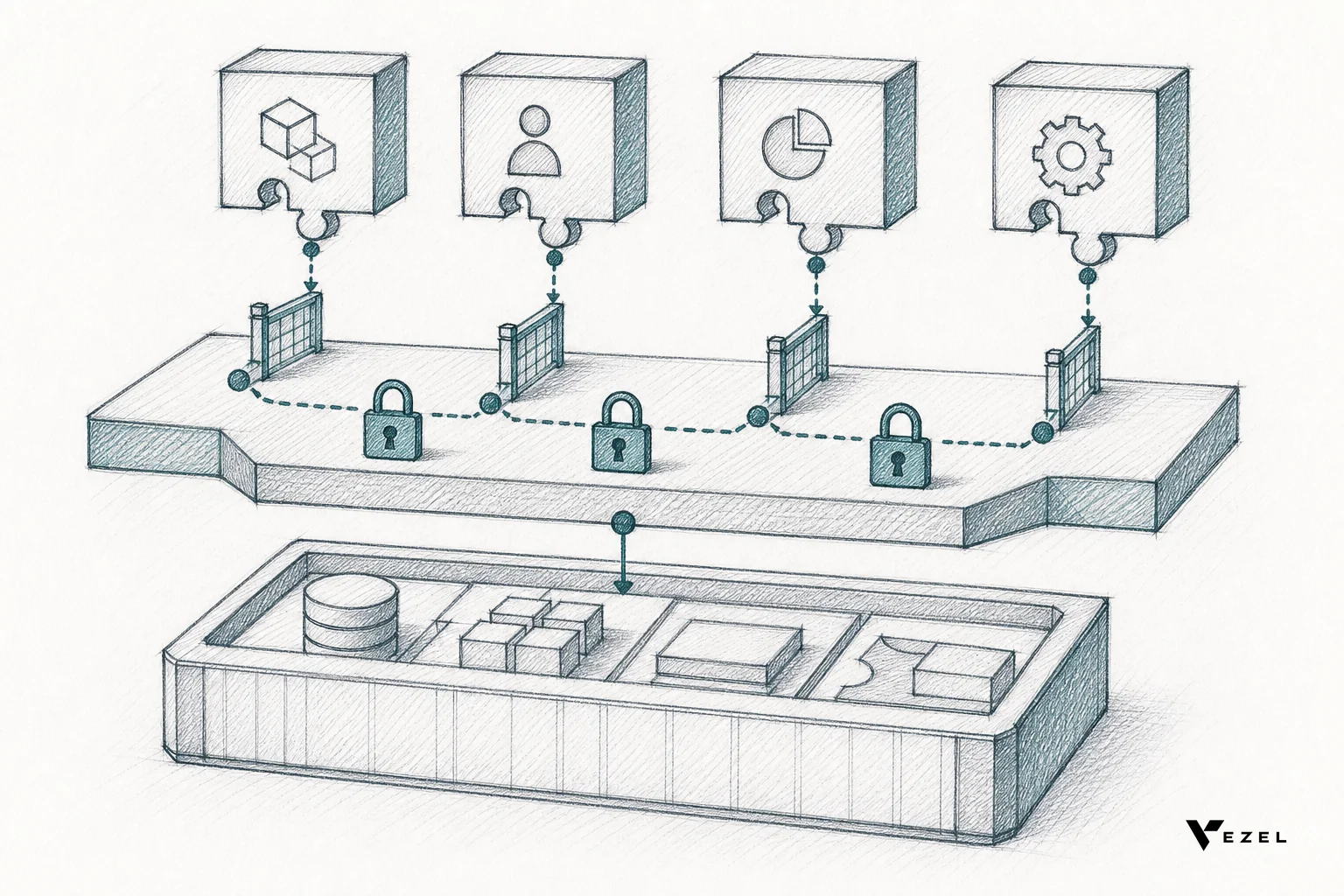
An onboarding agent is only as useful as the data it can see. This is where API auto-discovery matters: Vezel's extension layer maps directly to your existing OpenAPI-based data models and endpoints, so the agent can check real account state instead of relying on static help content.
That means the agent knows whether a customer's integrations are actually connected, whether their team roster is filled out, or whether a required approval step is still pending, all without anyone writing a custom integration for each customer. No duplicate data entry, no separate onboarding database to maintain. The agent reads the same data your product already runs on.
3. Set Permissions and Governance Before You Publish
Enterprise buyers scrutinize security during onboarding itself, often before they've finished setting up. An onboarding agent that can't respect existing access controls is a liability, not a convenience.
This is where security inheritance matters. The agent inherits your platform's existing authentication, role-based access control, and row-level permissions automatically. It never sees data a given user role shouldn't see, and it never bypasses your existing access model to "help." That's a meaningfully different posture than internal tool builders like Retool, which require separate permission setups that don't map cleanly to customer-facing use, a distinction covered in Retool vs embedded extensibility for SaaS products.

Before publishing, use the governance control plane to set who can edit the agent, which environments it runs in, and how versions get approved. This matters even more for regulated industries. Healthcare platforms, for instance, need governance that accounts for HIPAA-relevant data boundaries, a topic explored in how healthcare SaaS platforms can offer extensibility.
4. Write the Agent's Onboarding Prompts in Plain English
This is the step that used to require a developer and now doesn't. You write the agent's behavior the same way you'd brief a new CS hire.
An example prompt might read: "Welcome new admin users on enterprise accounts. Check if they've connected billing within their first 48 hours. If not, prompt them with a direct link and explain why it matters. If they haven't invited teammates after five days, remind them and offer to walk through it live." That's the entire build. No backlog ticket, no sprint, no waiting on a release cycle.
Tone matters here too. Decide how persistent the agent should be before escalating to a human, and what counts as "stuck." A good rule of thumb: if a user asks the same question twice, or if a required step goes untouched for more than a few days, hand it to a person. The agent's job is to close the small gaps quickly and flag the real ones early, not to replace your CS team.
Because it's plain English, iterating is fast. Notice enterprise customers keep getting stuck on the same SSO step? Rewrite that one instruction. No engineering involvement required, which is the same principle behind building custom dashboards inside your SaaS without a dev cycle.
5. Publish the Agent Directly Inside Your Product
Once the logic is set, publish the agent as a white-labeled experience that matches your product's existing design system. Customers shouldn't be able to tell it's a separate layer. It should look, feel, and behave like a feature you built in-house.
Publishing runs through a governed, in-product marketplace, so you can maintain different onboarding agents for different customer segments, an SMB version and an enterprise version, for example, without maintaining two separate codebases. Version control means you can update the agent's behavior post-launch without a redeploy, and roll back instantly if something isn't working. For teams that also want to extend this pattern into ongoing operations, not just onboarding, how to deploy AI agents inside your SaaS platform covers the broader agent lifecycle.
Build In-House vs Embed an Agent Layer: What It Actually Costs
Before committing engineering time, it's worth comparing what each path actually costs in hours, maintenance, and risk. Here's how the three most common approaches stack up.
| Approach | Time to Launch | Per-Customer Customization | Security Inheritance | Ongoing Maintenance |
|---|---|---|---|---|
| In-house custom onboarding bot | Weeks to months per build | Requires new engineering work per segment | Must be built and audited manually | High — separate codebase to maintain |
| Generic chatbot / help-widget tool | Days, but limited scope | Minimal; mostly static scripts | Often disconnected from live account permissions | Low effort, but low value over time |
| Embedded AI agent (Vezel) | Hours, plain English setup | Edit prompts per segment, no code | Inherits existing auth, RBAC, row-level access | Low — versioned and governed centrally |
The tradeoff is straightforward. Building in-house gives full control but consumes engineering capacity that could go toward core product work. A generic chatbot is fast but shallow, it can't see real account data or enforce your permission model. An embedded agent layer gets the speed of a no-code tool with the data access and governance of a real product feature. For a deeper cost breakdown, see extensibility platform vs custom dev: what's cheaper.
What Changes Once the Agent Is Live
The first thing that changes is time-to-value. Instead of waiting for a CS rep to notice a stalled account, the agent catches it in real time and acts immediately. Renata's team, in the scenario above, wouldn't need 26 hours of manual follow-up. The agent would have flagged the unconnected integrations on day three and nudged the right admin directly.
Second, fewer enterprise deals stall waiting on custom onboarding builds. Sales teams can point to an onboarding experience that already adapts to different org structures, instead of promising a custom build during the sales cycle, a dynamic covered in how to stop enterprise deals from bloating your roadmap.
Third, shadow IT drops. When customers get real, adaptive guidance inside the product, they stop building their own spreadsheets to track onboarding progress. And engineering gets its time back. Instead of writing one-off onboarding scripts per enterprise logo, they maintain a platform that product and CS teams can adjust themselves.
Frequently Asked Questions
Does setting up an AI onboarding agent require engineering resources?
No. Vezel's extension layer is built for plain English prompting. Product and CS teams define triggers, connect to existing data through API auto-discovery, and publish the agent without writing code or filing an engineering ticket.
How is this different from a support chatbot?
A support chatbot typically answers questions reactively and often can't see live account data. An onboarding agent proactively checks account status against real data, guides users through setup based on what's actually incomplete, and escalates to a human when needed, all while inheriting your platform's existing permissions.
Can different customer segments get different onboarding agents?
Yes. You can publish multiple agent versions through the governed marketplace, one tuned for self-serve SMB accounts and another for enterprise accounts with more complex approval chains, without maintaining separate codebases.
How does the agent handle sensitive account data securely?
The agent inherits your platform's existing authentication, role-based access control, and row-level permissions. It only ever sees what the logged-in user is already permitted to see, which keeps it aligned with your security posture during a stage when enterprise buyers are watching closely.
Onboarding shouldn't be the part of your product that still runs on spreadsheets and tribal knowledge. It should be the first proof that your software adapts to how each customer actually works.
If prolonged onboarding cycles are costing your CS team hours and your sales team momentum, it's worth seeing the setup process firsthand. Book a demo to walk through how an AI onboarding agent gets configured inside your own product, or see how it works in detail. Teams ready to move faster can start a free trial and publish their first onboarding agent this week, and if you want a second opinion on your current onboarding flow, talk to an expert before your next enterprise kickoff call.