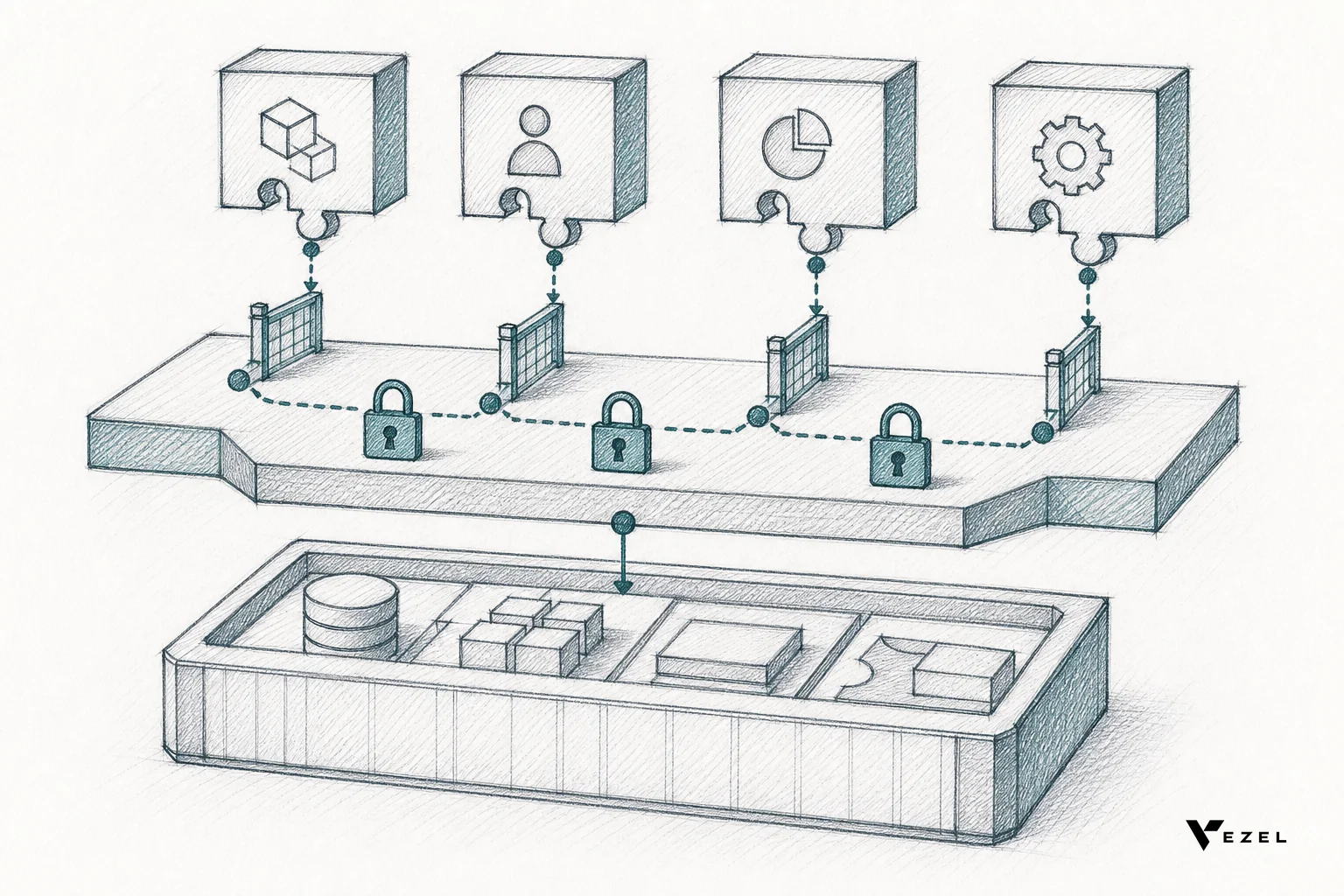



Salesforce AppExchange and an embedded AI extension builder solve extensibility with two opposite assumptions about who does the building. AppExchange assumes a developer writes Apex code and ships a packaged app through Salesforce's review process. An embedded AI extension builder assumes your own end customer types a plain-English sentence and gets a working dashboard, workflow, or agent inside your product in minutes, no code and no separate app store required.
Key Takeaways
- Different builders entirely: AppExchange extensibility is built by Salesforce developers or ISVs; embedded AI extension builders are built by the non-technical business users who actually need the dashboard or workflow.
- Speed gap is measured in weeks vs minutes: A packaged AppExchange app can take weeks to months through development, sandbox testing, and Salesforce's security review. A plain-English extension can be generated live, often during a sales call.
- Security model differs structurally: AppExchange apps must be built and reviewed to respect Salesforce's permission model. Embedded extensions inherit your product's existing authentication, RBAC, and row-level access controls automatically.
- AppExchange only helps if you're on Salesforce: It's an ecosystem built around one CRM. An embedded AI extension builder plugs into any SaaS product's own APIs, regardless of whether Salesforce is involved at all.
- They solve different business problems: AppExchange is for selling packaged apps into thousands of Salesforce orgs. Embedded AI extensibility is for SaaS vendors who need to stop losing engineering capacity to one-off enterprise customization requests.
At a Glance: AppExchange vs Embedded AI Extension Builder
| Factor | Salesforce AppExchange | Embedded AI Extension Builder |
|---|---|---|
| Who builds it | Salesforce developers / ISVs | Non-technical end customers |
| Skill required | Apex, Lightning Web Components, Salesforce DX | Plain English, no coding |
| Typical time to ship | Weeks to months, plus review | Minutes to hours |
| Works outside Salesforce | No, Salesforce-only ecosystem | Yes, embeds in any SaaS product's APIs |
| Security model | Must be engineered to respect org permissions | Inherits host platform's auth, RBAC, row-level access |
| Branding | Feels like a Salesforce marketplace app | White-labeled, feels native to your product |
| Governance | Salesforce security review + AppExchange listing | In-product governed marketplace for publishing/versioning |
| Best fit | ISVs selling packaged apps across Salesforce orgs | SaaS vendors giving their own customers self-serve customization |
Two Very Different Bets on What "Extensible" Means
Ask a Salesforce ISV and a vertical SaaS founder what "extensibility" means, and you'll get two completely different answers. Salesforce built AppExchange on a bet that developers, not end users, should build the extensions. That bet made sense in 2005. It still makes sense if you're selling a packaged app to thousands of Salesforce customers.
But most B2B SaaS companies aren't ISVs. They're running their own product, with their own APIs, their own customers, and their own roadmap pressure. For them, the question isn't "how do we list an app in a marketplace." It's "how do we stop rebuilding the same custom dashboard for the fifth enterprise customer this quarter." That's a fundamentally different problem, and it needs a fundamentally different tool.
An embedded AI extension builder answers that second question directly. Instead of routing every customization request through engineering, or through a developer ecosystem you don't control, it lets the customer describe what they need in plain English and generates the dashboard, workflow, report, or agent right inside your product. No packaging. No separate marketplace. No developer required on either side.
How Salesforce AppExchange Extensibility Actually Works
Building on AppExchange means committing to Salesforce's development stack. That typically means Apex for backend logic, Lightning Web Components for the interface, and Salesforce DX for packaging and deployment. Teams provision developer sandboxes, write unit tests to meet Salesforce's code coverage requirements, and prepare metadata packages for release.
Then comes the part most teams underestimate: Salesforce's security review. Every app submitted to AppExchange goes through a formal review checking for vulnerabilities, proper permission handling, and compliance with Salesforce's technical requirements. According to Salesforce's own AppExchange documentation, this review process is mandatory before public listing and can take several weeks depending on app complexity and review queue volume.
None of this is a criticism of Salesforce's approach. It's appropriate for what AppExchange is designed to do: let independent software vendors build and monetize packaged applications distributed across a huge installed base of Salesforce orgs. The problem is that this entire workflow assumes you have Salesforce developer talent on staff, a multi-week runway, and a use case that justifies formal packaging.
Most enterprise customization requests don't meet that bar. A single customer wants a dashboard that groups deals by their internal territory structure. Another wants an approval workflow that matches their specific compliance chain. Building and reviewing a full AppExchange package for one customer's specific need rarely pencils out economically, which is exactly why so many of these requests pile up in engineering backlogs instead. We've covered this pattern in more depth in how to reduce SaaS engineering backlog from enterprise requests.
How an Embedded AI Extension Builder Works Inside Your Own Product
An embedded AI extension builder starts from a different premise entirely. Instead of assuming a developer will build the extension, it assumes the person who needs the dashboard, report, or workflow can describe it in plain English and get a working result immediately, inside the product they already use every day.
Here's the mechanical difference. Vezel's platform uses API auto-discovery, mapping to your existing OpenAPI-based data models and endpoints automatically, so there's no separate integration project every time a customer wants something new. When a customer types a request like "build me a dashboard showing overdue shipments grouped by region," the system generates a working dashboard connected to live data, not a mockup.
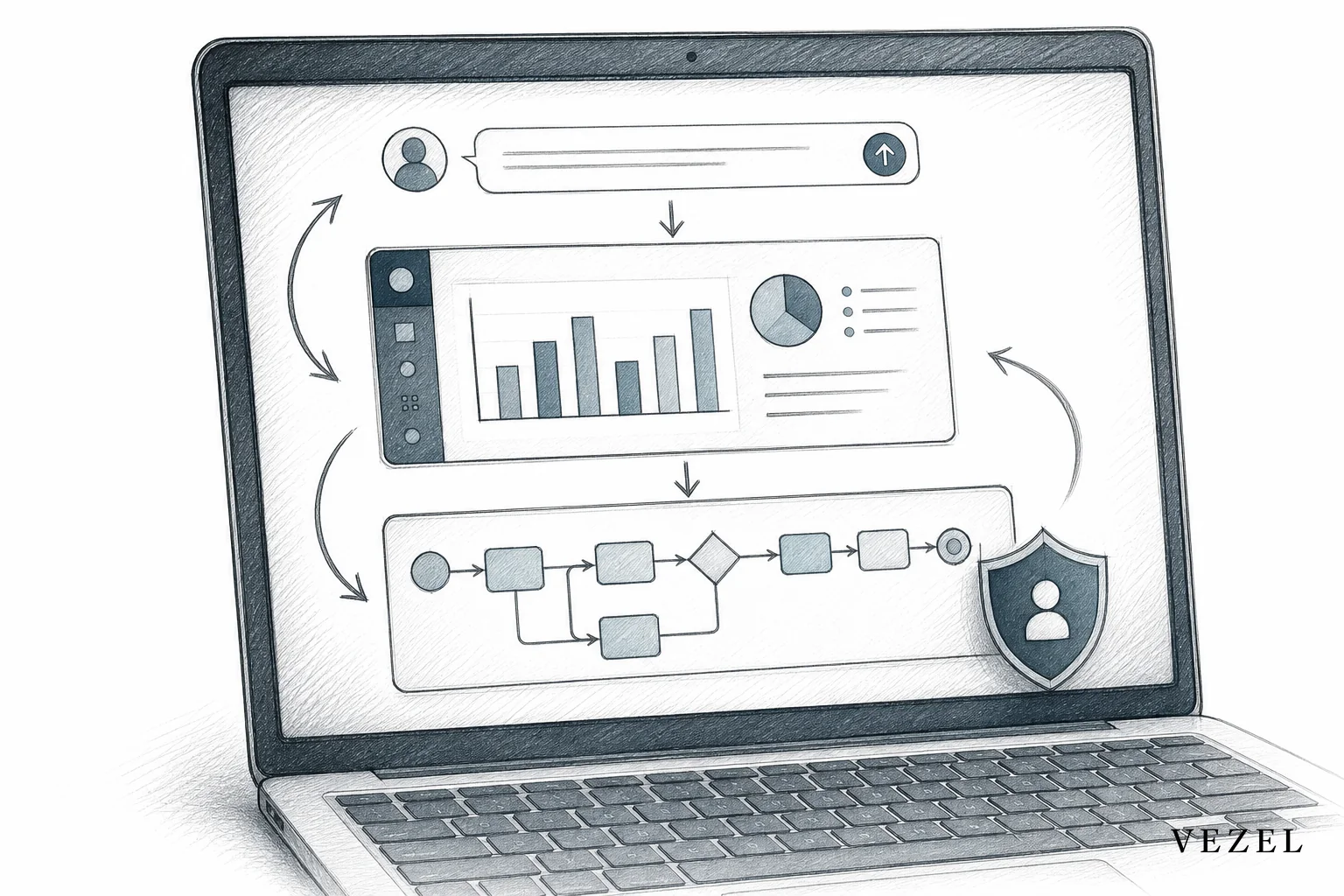
Security works differently too. Extensions inherit your product's existing authentication, role-based access controls, and row-level permissions automatically. A regional manager who can only see their own region's data in your core product sees the same restriction in any dashboard they generate. That's a meaningfully different security posture than building a permission model from scratch for every packaged app, and it's a topic we go deeper on in how to prevent shadow IT in your SaaS platform.
The extensions are also white-labeled, meaning they inherit your product's design system instead of feeling like a bolted-on marketplace app. Everything customers build gets published through a governed in-product marketplace, so your team retains control over versioning, publishing, and lifecycle management even though the customer did the building. That governance layer matters, and we walk through it in how to choose an embedded extensibility platform.
Salesforce AppExchange vs Embedded AI Extension Builder: Side-by-Side Comparison
Put the two models next to each other on the dimensions that actually matter to a product leader evaluating extensibility, and the split becomes obvious.
| Dimension | Salesforce AppExchange | Embedded AI Extension Builder |
|---|---|---|
| Target builder audience | ISVs and Salesforce-certified developers | Business users, ops teams, non-technical admins |
| Applicable products | Salesforce orgs only | Any SaaS product with an API |
| Approval process | Mandatory Salesforce security review | Internal governed marketplace, vendor-controlled |
| Coding required | Yes (Apex, LWC) | No (plain English prompts) |
| Typical build cycle | Weeks to months | Minutes to hours |
| Integration effort per new request | Custom development per app | API auto-discovery, no new integration project |
| Branding experience | Marketplace app look and feel | White-labeled, matches host product design |
| Distribution model | Public or private AppExchange listing | Native inside your own product for your own customers |
Where Salesforce AppExchange Still Wins
Give Salesforce its due. AppExchange has one of the most mature ISV ecosystems in software, with a massive installed base of Salesforce orgs and buyers already trained to browse a marketplace for add-ons. If you're building a packaged app meant to be resold across thousands of different Salesforce customers, and you have the developer talent to build and maintain it, AppExchange remains a legitimate and proven distribution channel. Deep platform capabilities support genuinely complex, reusable business logic that many customers will use in similar ways.
Where an Embedded AI Extension Builder Wins
The moment you're not a Salesforce ISV, and you're instead a SaaS vendor with your own product and your own customer base, the calculus flips. Your non-technical end customers can self-serve a dashboard or workflow instead of filing a ticket and waiting on your roadmap. Enterprise sales cycles shorten because a sales engineer can generate the exact custom workflow a prospect is asking about live in a demo, instead of promising it will ship "next quarter." We've documented that specific dynamic in how to shorten your enterprise SaaS sales cycle, though the more relevant read here is extensibility platform vs custom dev: what's cheaper, which breaks down the cost side of this decision.
What This Means for B2B SaaS Product Leaders
Product and engineering leaders evaluating extensibility approaches often frame this as a build-vs-buy question. It's really a question about who should be doing the building at all. Salesforce's model routes every extension through a developer, whether that's your team, a systems integrator, or an ISV. An embedded AI extension builder routes it through the customer directly, with your engineering team focused on the platform rather than the individual request.

This matters most acutely in industries where customization requests are constant and highly specific: healthcare tech platforms navigating compliance-driven reporting differences between hospital systems, supply chain platforms where every distributor wants a different scorecard, and HR tech products where every customer's approval hierarchy looks slightly different. We cover the healthcare case specifically in how healthcare SaaS platforms can offer extensibility. The pattern repeats across verticals: engineering backlog grows, sales cycles stall waiting on custom builds, and customers quietly build spreadsheet workarounds that create shadow IT risk.
Choosing between AppExchange-style developer-dependent extensibility and embedded AI extensibility isn't really about picking a "better" platform in the abstract. It's about matching the tool to who is doing the requesting. If your customers are asking your product to adapt to how they run their business, and they need that adaptation now rather than next quarter, a developer-gated marketplace built for a different CRM isn't the right tool for that job.
How to Decide Which Model Fits Your SaaS Platform
A few honest questions cut through most of the debate quickly:
- Is your product built on Salesforce at all? If not, AppExchange isn't relevant to your extensibility strategy no matter how mature its ecosystem is.
- Who is actually requesting the customization? If it's your own end customers asking for dashboards, workflows, and reports specific to their business, you need a tool they can use directly, not a developer marketplace.
- How fast do you need to respond? If enterprise deals stall waiting weeks or months for a custom build, a developer-dependent model will keep costing you deals no matter how good the eventual result is.
- Who owns the security and permissions model? A tool that inherits your existing RBAC and row-level access removes an entire category of risk compared to building permissions fresh for every packaged app.
- Do you want a marketplace of third-party apps, or a governed extension layer for your own customers? These are genuinely different goals, and conflating them leads to picking the wrong tool.
For a more complete framework covering vendor evaluation criteria, security requirements, and total cost comparisons, see how to choose an embedded extensibility platform.
Frequently Asked Questions
Is Salesforce AppExchange only for Salesforce-based products?
Yes. AppExchange apps run inside Salesforce orgs and are built using Salesforce's development stack. If your product isn't built on Salesforce, AppExchange doesn't apply to your extensibility strategy at all.
Can non-developers build on Salesforce AppExchange?
Salesforce offers configuration tools like Flow for certain automation tasks, but publishing an app to AppExchange, and meeting its security review requirements, generally requires Apex and Lightning Web Component development skills. It's not designed for a non-technical end customer to build their own extension from scratch.
Does an embedded AI extension builder replace Salesforce entirely?
No, and that's not the comparison being made here. An embedded AI extension builder is an architectural layer you add to your own SaaS product, letting your customers generate dashboards, workflows, reports, and AI agents natively. It solves a different problem than a CRM marketplace: giving your customers self-serve customization instead of routing every request through your engineering roadmap.
How does security work when customers build their own extensions?
Extensions inherit the host platform's existing authentication, role-based access controls, and row-level permissions automatically, rather than requiring a new permission model to be engineered for each build. That's a structurally different approach than reviewing each packaged app individually for security compliance, and it's covered in more depth in how to build custom dashboards inside your SaaS.
If your engineering team is stuck rebuilding the same custom dashboard, workflow, or approval chain for every enterprise customer, the developer-dependent AppExchange model was never going to solve that problem, because it was built for a different one. An embedded AI extension builder lets your own customers describe what they need in plain English and get it running inside your product today, with your existing security model intact. Book a demo to see how Vezel turns your product into one your enterprise customers can shape themselves, or see how it works before your next enterprise sales call stalls on a custom workflow request. If you want to talk through your specific extensibility needs first, talk to an expert and get a straight answer on what fits your product.