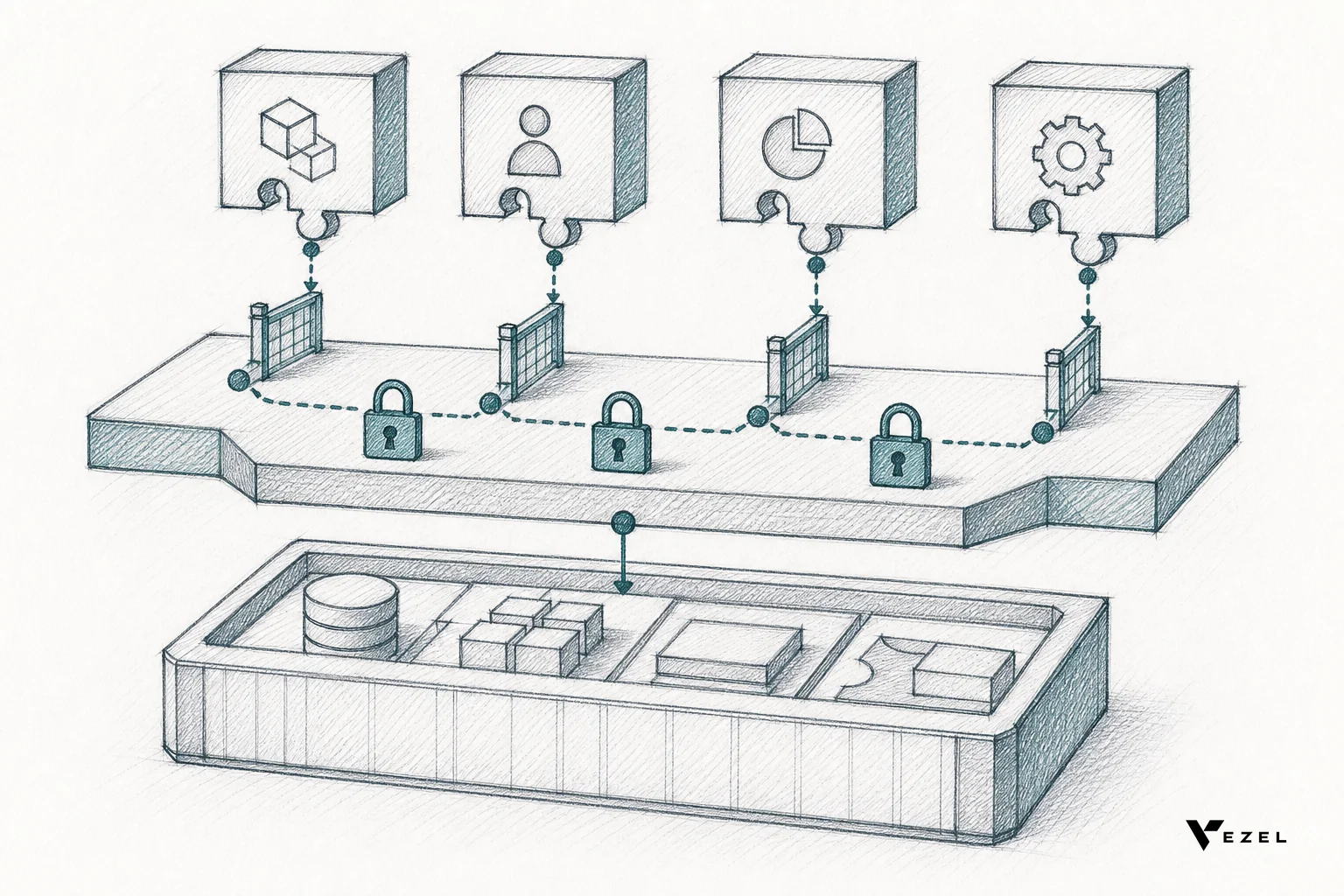


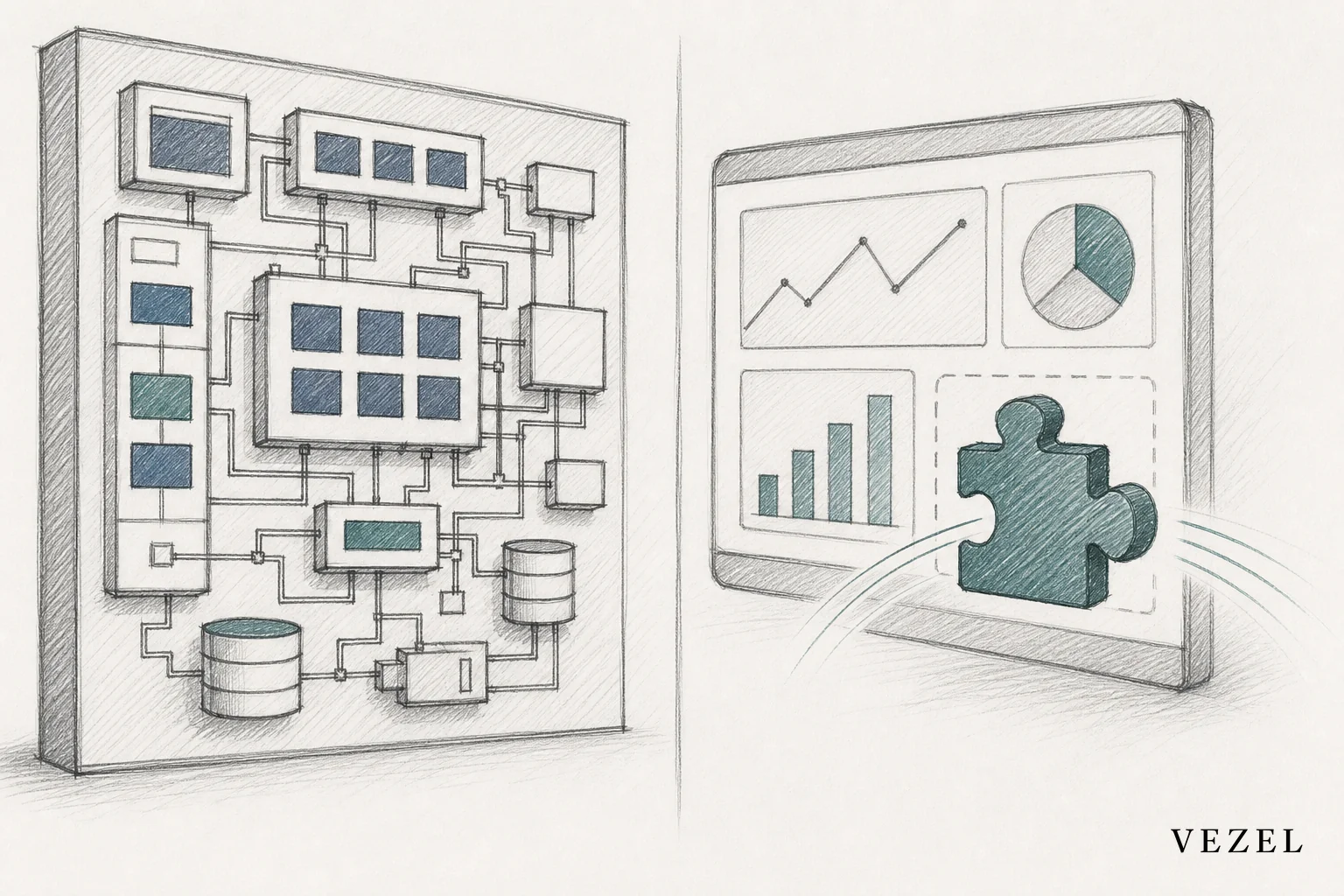
Low-code platform vs embedded AI extensibility comes down to one question: who is doing the building, and what are they touching? A low-code platform like Mendix or OutSystems hands your developers a faster way to build a full standalone application from scratch. Embedded AI extensibility hands your customers a way to generate dashboards, workflows, and reports inside the product they already log into, inheriting your existing security model instead of rebuilding it.
Key Takeaways
- Different builders, different jobs: Low-code platforms are built for your internal dev team to construct new applications; embedded extensibility is built for your end customers to self-serve inside your existing product.
- Setup effort diverges early: Low-code requires data modeling, environment provisioning, and a deployment pipeline before anyone builds anything useful. Embedded extensibility connects to your existing OpenAPI spec and starts working in days.
- Security inheritance is the dividing line: Low-code platforms generally require you to rebuild authentication, RBAC, and row-level permissions inside the new app. Embedded extensibility inherits your host product's existing access controls automatically.
- Time-to-value gap is measured in months, not days: A bespoke low-code build for one enterprise customer commonly takes 6-12 weeks; a self-serve embedded dashboard or workflow can go live the same week the request comes in.
- They solve different problems: Low-code is still the right call for building a genuinely new standalone application. It is the wrong tool for customer-facing, product-embedded customization at scale.
At a Glance: Low-Code Platform vs Embedded AI Extensibility
| Dimension | Traditional Low-Code Platform | Embedded AI Extensibility |
|---|---|---|
| Who builds | Your engineers or IT team | Your end customers, self-serve |
| Where it runs | Standalone app, separate deployment | Inside your existing product, white-labeled |
| Setup time | Weeks of data modeling and environment setup | Days, via API auto-discovery |
| Security model | Rebuilt manually per app | Inherited from host product (auth, RBAC, row-level) |
| Interface | Visual drag-and-drop app builder | Plain English prompts |
| Governance | IT-managed environments and approvals | In-product marketplace with publishing and versioning |
| Best fit | New standalone application from scratch | Customer-specific dashboards, workflows, reports, AI agents inside an existing SaaS product |
Why This Decision Keeps Landing on Product Leaders' Desks
An enterprise prospect asks for a custom approval workflow before they'll sign. A mid-market customer wants a dashboard that matches how their team actually tracks KPIs, not how your product was originally designed. Every one of these requests eventually lands on the same desk: yours. And every VP of Product eventually asks the same question. Should we build this internally with a low-code platform, or is there a faster way?
The confusion is understandable. Both categories get lumped under "no-code/low-code" in vendor comparisons, sales decks, and analyst reports. But they were built to solve completely different problems, for completely different people, and mixing them up leads to expensive mistakes.
What a Traditional Low-Code Platform Actually Is
Platforms like Mendix, OutSystems, and Microsoft Power Apps are full application development environments. They give your internal developers a visual canvas for building an entirely new piece of software: data models, business logic, UI screens, deployment pipelines, all of it.
They are genuinely good at that job. If you need a new standalone internal tool, or a brand-new product entirely, a low-code platform can shave real time off a from-scratch build. Our earlier breakdown of Mendix vs Embedded Extensibility covers that specific comparison in detail.
But low-code platforms were not designed to sit inside an existing SaaS product and let your customers build things themselves. They assume a developer is doing the modeling, and they assume the resulting app is a new, separate piece of software, not a native extension of the product your customer already uses every day.
What Embedded AI Extensibility Actually Is
Embedded AI extensibility is a different category entirely. Instead of building a new app, it plugs directly into your existing SaaS product as a white-labeled layer. A customer types a plain-English request, an auto-discovery layer maps that request against your existing API and data model, and the result is a dashboard, workflow, report, or AI agent that looks and behaves like it was part of your product all along.

This is the core idea behind what we call building custom dashboards inside your SaaS or embedding a workflow builder directly into your product. The customer never leaves your product, never touches a separate environment, and never needs a developer to translate their request into a spec.
Setup Effort: Weeks of Modeling vs Days of Integration
A low-code build for a single customer-specific requirement typically starts with a data modeling exercise. Someone has to define entities, relationships, and business rules before a single screen gets built. Then comes environment provisioning, testing, and deployment. Even experienced teams working in Mendix or OutSystems routinely spend several weeks getting a single custom app from idea to production.
Embedded extensibility skips almost all of that. Because it connects to your existing OpenAPI (Swagger) specification and auto-discovers your data model, most of the modeling work is already done. What's left is describing the desired outcome in plain English. That's the difference between a multi-week project and a same-week delivery.
Security Inheritance: The Question Nobody Asks Until It's Too Late
Here's where the two categories diverge hardest. Build a new app on a low-code platform, and you are also building a new security model. Authentication has to be wired up again. Role-based access control has to be redefined. Row-level permissions, the kind that keep one customer's regional manager from seeing another region's contract values, have to be manually replicated and tested.
Teams routinely underestimate this. We've seen the pattern play out enough times that it's worth its own detailed breakdown: why replicating RBAC in a custom-built tool is so hard to get right the first time, and even harder to keep right as roles change.
Embedded extensibility avoids this problem by design. Because the extension runs inside your existing product rather than beside it, it inherits your existing authentication, RBAC, and row-level permissions automatically. There's no second system to keep in sync, and no separate audit trail to maintain.
How Do You Tell Whether an Extensibility Model Is Actually Governed?
This is a question worth asking directly, because "technically open" and "actually governed" get confused constantly. A platform can expose an API and call itself extensible without offering any real control plane behind it. Here's what actually separates the two:
- Automatic permission inheritance: A governed model inherits your existing auth and RBAC without extra configuration. If a platform requires you to manually re-grant permissions for every extension, it's technically open, not governed.
- A publishing and versioning layer: Governed extensibility runs through an in-product marketplace where extensions get reviewed, versioned, and can be rolled back. Open access with no review step is a shadow IT risk waiting to happen.
- Auditability without code review: If your IT or security team has to read custom code to know what an extension can access, it isn't governed. A governed system exposes that information at the permissions layer, not buried in application logic.
This distinction matters enough that it shaped an entire earlier piece on how to choose an embedded extensibility platform, and it is exactly the gap that leads teams toward shadow IT inside SaaS platforms when the governed option isn't available.
Time-to-Value for Customer-Facing Customization
Time-to-value is where the categories separate most visibly. A bespoke low-code build for a single enterprise customer's dashboard or approval flow commonly runs six to twelve weeks once you account for modeling, security work, testing, and deployment. That timeline rarely fits inside an active enterprise sales cycle.

Embedded AI extensibility compresses that into days. A customer admin describes what they need in plain English, the extension is generated against live data, and it's available inside the product the same week. This is a big part of why teams evaluating how to shorten an enterprise SaaS sales cycle keep landing on embedded extensibility rather than a low-code build-out.
Low-Code Platform vs Embedded AI Extensibility: Full Comparison Table
| Factor | Low-Code (Mendix, OutSystems, Power Apps) | Embedded AI Extensibility (Vezel-style) |
|---|---|---|
| Primary user | Internal developer or IT admin | Customer's end user or admin |
| Output location | New, separate application | Inside the existing SaaS product |
| Typical build time per request | 6-12 weeks | Days |
| Security setup | Manual, rebuilt per app | Inherited automatically |
| Skill required | Visual modeling and some coding knowledge | Plain English description |
| Maintenance burden | Ongoing, per-app, per-customer | Centralized, versioned in a governed marketplace |
| Ideal use case | Building a new standalone application | Customer-specific dashboards, reports, workflows, agents |
When a Full Low-Code Platform Still Makes Sense
None of this makes low-code irrelevant. If you're building a genuinely new application, internal tooling with a dedicated dev team behind it, or a product that doesn't yet exist, a low-code platform is still a reasonable, often excellent choice. It just isn't built for the specific problem of letting your existing customers self-serve customization inside your existing product.
That's a narrower, sharper use case, and it's the one most B2B SaaS product leaders are actually facing when an enterprise customer sends over a custom workflow requirement mid-sales-cycle.
Making the Call: A Decision Framework
Three questions cut through most of the confusion:
- Who builds it? If the answer is "our engineers," a low-code platform can speed that up. If the answer needs to be "the customer, without filing a ticket," you need embedded extensibility.
- What does it touch? A brand-new standalone application points toward low-code. A dashboard, report, workflow, or agent living inside your existing product points toward embedded extensibility.
- How fast do you need it live? If the answer is measured in quarters, low-code can work. If it's measured in days, because a deal or renewal is on the line, embedded extensibility is the only realistic path.
Teams applying this framework to their own roadmap pressure often start with our guide on extensibility platform vs custom dev cost, which walks through the economics side by side.
FAQ
Is Mendix a low-code platform or embedded extensibility?
Mendix is a traditional low-code platform. It's built for developers to construct standalone applications, not for end customers to self-serve customization inside an existing SaaS product. See our dedicated Mendix vs Embedded Extensibility comparison for a deeper look.
Can embedded AI extensibility replace low-code entirely?
No, and it isn't trying to. If you need to build a new standalone application from scratch, low-code still has a role. Embedded extensibility solves a narrower problem: giving your existing customers a governed way to customize the product they already use.
Does embedded extensibility work for regulated industries like healthcare?
Yes, and security inheritance is exactly why. Because extensions inherit the host product's existing authentication and row-level permissions rather than rebuilding them, healthcare tech platforms can offer customization without opening a new compliance gap. Read more in our piece on custom reporting for regulated vertical SaaS platforms.
According to Gartner's research on low-code development technologies, low-code adoption continues to accelerate across enterprise IT, but that growth has largely been driven by internal application development, not customer-facing self-serve customization. The U.S. Bureau of Labor Statistics also tracks a widening software developer talent gap, which is precisely the constraint that makes engineering-dependent low-code builds hard to scale against a growing volume of enterprise customization requests.
If your team is choosing between building yet another bespoke low-code app for the next enterprise request or giving customers a governed way to build it themselves, it's worth seeing the difference firsthand. Book a demo to walk through how embedded AI extensibility inherits your existing security model and ships customer-specific dashboards, workflows, and reports in days instead of quarters. Want the technical mechanics first? See how it works, or talk to an expert about your specific roadmap pressure before your next enterprise deal stalls on a customization request.