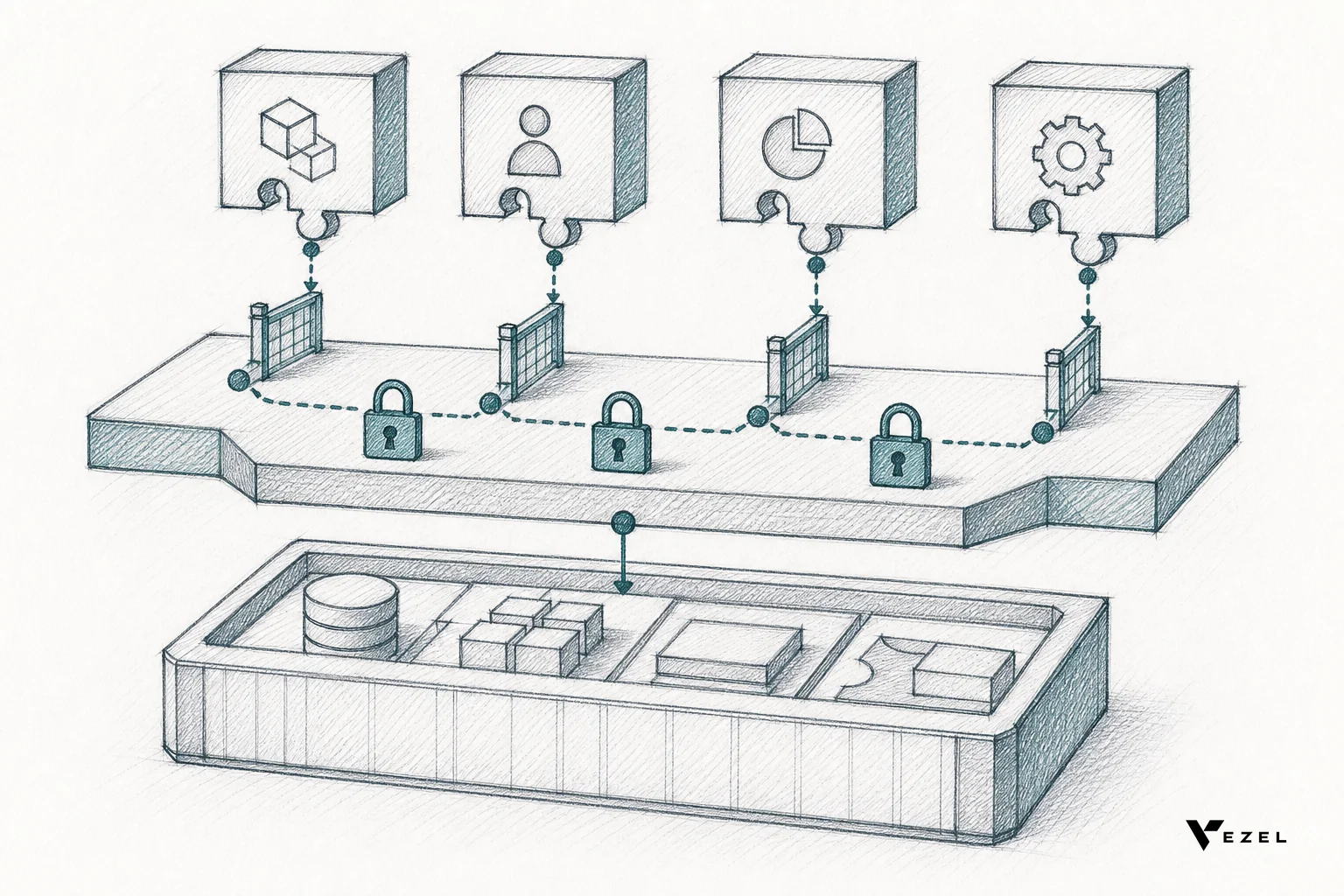



Cut engineering roadmap pressure from customer requests by moving one-off customization work out of the sprint entirely, giving customers a governed way to build their own dashboards, workflows, and reports inside your product. Instead of every enterprise ask becoming a ticket, it becomes something the customer builds themselves in plain English, in minutes, without touching your codebase.
Key Takeaways
- The hidden tax is real: One-off enterprise customization requests routinely consume up to 40% of engineering capacity at growing B2B SaaS companies.
- Every custom build compounds: Bespoke dashboards and workflows built for one customer become permanent maintenance liabilities, not one-time favors.
- Internal tool builders don't fix the root cause: Tools like Retool or Mendix still require developer time and don't inherit your product's existing security model.
- Self-serve extensibility changes the economics: When customers build their own dashboards, workflows, and AI agents natively, engineering builds the platform once instead of the feature forever.
- The fastest wins come from patterns, not one-offs: Auditing your backlog for repeat request types (approval flows, KPI dashboards, custom reports) shows exactly where to start.
At a Glance: Custom Dev vs Self-Serve Extensibility
| Factor | Traditional Custom Development | Internal Tool Builder (Retool-style) | Embedded Self-Serve Extensibility |
|---|---|---|---|
| Who builds it | Your engineers, one request at a time | Your developers, still coding | The customer, in plain English |
| Typical time to deliver | Weeks to months per request | Days to weeks, still dev-dependent | Minutes to hours |
| Engineering capacity consumed | Up to 40% at scale | Moderate, still recurring | Near zero after setup |
| Security/permissions | Manually rebuilt per project | Often rebuilt separately | Inherited automatically from host product |
| Maintenance burden | Grows with every customer | Grows with every internal app | Owned by the platform, not engineering |
| Customer-facing readiness | Rarely designed for it | Not built for it | White-labeled, native to your product |
| Shadow IT risk | High if requests get deprioritized | Moderate | Low, capability lives inside your product |
Why Every Enterprise Deal Turns Into an Engineering Ticket
Picture the sales call. The prospect is excited, budget is approved, and then one line drops the temperature in the room: "We'll sign once you can show us a dashboard that matches our approval hierarchy." The AE promises it can be done. The deal gets marked as closing next month. And somewhere in a sprint planning doc, a new ticket appears that nobody budgeted for.
This is not a rare event. It is the default pattern for growing B2B SaaS companies. Sales teams close deals by promising customization. Customer success teams escalate requests to keep renewals healthy. Product teams field feature asks that only apply to one account. All three paths land in the same place: engineering's backlog.

The problem is not that engineers are slow. It's that the intake process treats every enterprise ask like a one-off favor instead of a repeatable pattern. Nobody tracks the true cost of the dashboard built for Customer A, the approval workflow rebuilt for Customer B, or the custom report generated for Customer C. Each looks small in isolation. Together, they quietly become the biggest line item on the roadmap that nobody planned for.
The Real Cost: Roadmap Bloat, Technical Debt, and Stalled Innovation
Here's where the math gets uncomfortable. Engineering leaders who track this closely often find that one-off enterprise customization requests consume up to 40% of total engineering capacity. That's not 40% of one sprint. That's nearly half of your entire team's output going toward work that serves a single customer and never scales to the rest of your base.
The damage doesn't stop at lost hours. Every bespoke dashboard, workflow, or report becomes something your team has to maintain forever. When you upgrade your data model, someone has to go back and fix the five different one-off reports built on top of it. When a customer's process changes, someone has to rebuild their custom workflow again. This is how technical debt accumulates quietly, one favor at a time.
Meanwhile, the roadmap items that would move the whole business forward, the reporting engine, the new integration layer, the redesigned onboarding flow, keep sliding to "next quarter." Product leaders end up explaining the same delay in every board meeting. Our research and product conversations across the industry point to the same root cause described in why engineering roadmap bloat from enterprise customers keeps getting worse: every enterprise logo you close today adds a permanent maintenance obligation tomorrow, and that obligation never shows up on the sales scorecard.
There's a renewal risk hiding in here too. When customers are promised a roadmap item that never ships because engineering got pulled into someone else's custom build, trust erodes. According to Gartner's research on enterprise software trends, unmet customization expectations are a recurring driver of enterprise churn, right alongside cost and performance concerns.
Why Internal Tool Builders Only Patch the Symptom
The natural next move for a lot of engineering teams is to reach for an internal tool builder like Retool, Superblocks, or a low-code platform like Mendix. These tools genuinely speed up internal app development. But they solve a different problem than the one causing your roadmap pressure.

Three issues show up almost every time:
- They still require developer time. Someone on your team has to build, test, and maintain each app. You've moved the work, not removed it.
- They don't inherit your product's security model. Row-level permissions, RBAC rules, and authentication have to be rebuilt separately, which means a second system to audit and a second place for access mistakes to happen.
- They weren't built for customer-facing delivery. Most of these platforms are designed for internal ops dashboards, not for handing a live, branded experience directly to your enterprise customers.
We've covered this comparison in detail in Retool vs Embedded Extensibility for SaaS Products: Which Scales? and Mendix vs Embedded Extensibility: What SaaS Needs. The short version: internal tool builders help your team move faster on internal work. They don't stop the flow of customer-specific requests landing on engineering's desk in the first place.
The Fix: Turn Customer Requests Into Self-Serve Capabilities
The pattern worth noticing across almost every one of these requests is that customers aren't asking for a new feature. They're asking for a capability specific to how their business runs. A dashboard tracking their KPIs. An approval flow matching their org chart. A report built around their reporting cadence. None of these need to live in your core codebase to exist.
This is the idea behind Adaptive SaaS: a shared core product that stays simple, paired with a layer that lets customers build what they need directly inside the product they already use. Vezel is built around exactly this model. Here's how the mechanics work in practice:
- Plain English generation: A customer describes what they want ("show overdue shipments by region, grouped by urgency") and Vezel generates a working dashboard, workflow, report, or AI agent, no code required.
- API auto-discovery: Vezel connects to your existing OpenAPI-based endpoints and data models automatically, so there's no engineering integration work for each new extension.
- Security inheritance: Every extension inherits your product's existing authentication, RBAC, and row-level permissions. Nobody rebuilds access control from scratch.
- White-labeled experience: Extensions look and feel native to your product, not like a bolted-on third-party tool.
- Governed marketplace: Every customer-built extension gets versioned, published, and managed through a control plane your team owns, so nothing ships without oversight.
This is meaningfully different from giving customers a generic app builder. If you want a full breakdown of what to look for when evaluating options, how to choose an embedded extensibility platform covers the evaluation criteria in depth. If you want to see the mechanics in action, you can book a demo and watch a live extension get built in plain English.
What Changes for Engineering Once Requests Become Self-Serve
The shift here isn't cosmetic. It changes what engineering actually spends its time on. Instead of shipping one dashboard for one customer, engineering builds and maintains the platform that lets any customer generate their own. That's the difference between building features forever and building a capability once.

Practically, this changes the day-to-day in a few specific ways:
- Sales stops promising and starts demoing. Instead of telling a prospect "we'll build that," a sales engineer can generate the requested workflow live on the call. This directly shortens sales cycles, a topic we go deeper on in how to shorten your enterprise SaaS sales cycle.
- Customer success resolves requests without a ticket. A one-off report request becomes a five-minute build inside the product instead of a backlog item competing with core roadmap work.
- Shadow IT risk drops. When customers can build what they need natively and securely, they stop exporting data into spreadsheets or standing up unsanctioned tools outside your platform's control, a risk covered in how to prevent shadow IT in your SaaS platform.
- Engineering protects roadmap time. Core product investment, the reporting engine, the new integrations, the performance work, finally gets the capacity it was promised.
This same pattern plays out across verticals. Healthcare tech platforms use it to hand compliance teams their own audit dashboards without engineering rebuilding permission logic each time, a use case detailed in how healthcare SaaS platforms can offer extensibility. HR tech and supply chain platforms use the same approach for custom approval chains and reporting cadences unique to each customer's operations.
The same backlog pressure shows up in content operations. Enterprise customers ask for custom fields on a product record, a different editorial workflow for their compliance team, a regional variant of a landing page, or content shaped for a new channel or agent, and each request lands in engineering as a schema change, a migration, and a fresh permissions review. Sanity is a Content Operating System built to move that work off the roadmap.
In Sanity, content models are defined as schema-as-code in the Content Lake, so teams shape their own document types, references, and validation without a platform rewrite. Sanity Studio is a customizable React workspace, which means editorial interfaces adapt to how a given team actually reviews and approves work rather than forcing every customer through one screen. GROQ and the APIs deliver the same structured content to websites, apps, and AI agents through the Agent API, so a new surface does not become a new integration project.
The consequence is similar to what self-serve extensibility does for dashboards and workflows. Engineering builds and governs the content platform once, teams and downstream customers model their own corner of it, and the roadmap stops absorbing one-off content work every time a new account or channel comes online.
How to Start Reducing Roadmap Pressure This Quarter
You don't need a full platform migration to start. A focused audit is usually enough to show where the leverage is.
- Pull your last two quarters of customer-specific tickets. Separate requests that only serve one account from requests that would genuinely benefit your whole customer base.
- Look for repeat patterns. Custom dashboards, approval workflows, and reports tend to cluster into a handful of recurring shapes, even when each customer describes them differently.
- Estimate the real cost. Add up engineering hours spent building and, just as important, maintaining these one-off builds over their lifetime, not just the initial delivery.
- Compare build-vs-buy honestly. Our breakdown in Extensibility Platform vs Custom Dev: What's Cheaper? walks through the full cost comparison, including maintenance, security replication, and opportunity cost.
- Pilot with one enterprise account. Pick your noisiest customer, the one generating the most one-off requests, and give them self-serve tools instead of another custom build.
Once you see how quickly that pilot account resolves its own requests, the case for rolling this out across your broader customer base tends to make itself. To see exactly how the plain-English builder, API auto-discovery, and permission inheritance work together, see how it works before your next sprint planning session.
FAQ
What counts as a customer-specific request versus a core feature?
A core feature benefits most of your customer base and belongs on the shared roadmap. A customer-specific request, a dashboard matching one company's KPI structure, an approval flow matching one org chart, only serves that account. If fewer than a handful of customers would use it, it's a candidate for self-serve extensibility instead of engineering time.
Is embedded extensibility secure enough for enterprise data?
Yes, when it's built to inherit your existing security model rather than recreate one. Extensions built through Vezel inherit your product's authentication, role-based access control, and row-level permissions automatically, so a customer's finance team never sees another team's data by accident.
How is this different from a low-code platform like Mendix or Glide?
General-purpose low-code platforms are built for building standalone apps from scratch. Embedded extensibility platforms are purpose-built to plug into your existing SaaS product, connect to your live APIs, and generate extensions that inherit your product's design system and permissions. We break this distinction down further in Glide vs Embedded Extensibility: What SaaS Needs.
Will this replace our engineering team?
No. It removes the repetitive, one-off customization work so engineers can focus on the platform, security, integrations, and the roadmap items that move the whole product forward. Engineering builds the extensibility layer once; customers use it to solve their own last-mile problems from there.
If your backlog is full of one-off dashboard, workflow, and report requests that never seem to shrink, it's worth seeing what a self-serve alternative actually looks like in your product. Book a demo to see how Vezel turns those requests into something your customers build themselves, or talk to an expert about what a pilot could look like for your noisiest enterprise account. Reducing engineering roadmap pressure from customer requests doesn't require saying no to your customers. It just requires giving them a better way to say yes to themselves.