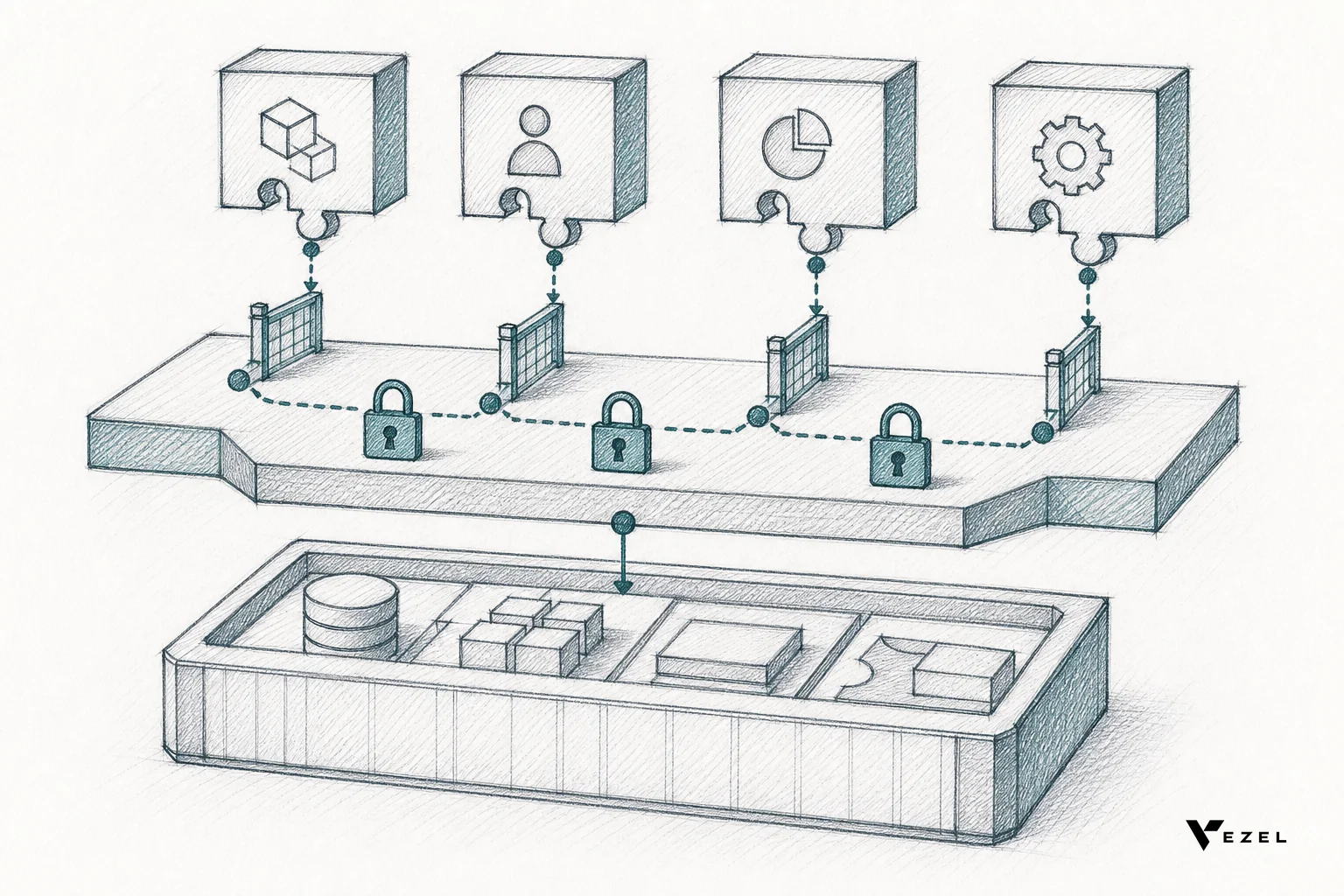



Professional services automation vs embedded AI extensibility is a choice between two ways of filling the same gap: your enterprise customer needs a dashboard, workflow, or report that your product doesn't ship out of the box. PSA software helps you staff, bill, and track a consultant who builds it by hand. Embedded AI extensibility lets the customer generate it themselves, inside your product, in plain English. One scales with headcount. The other scales with usage.
Key Takeaways
- Different jobs entirely: PSA tools (Kantata, Certinia, Mavenlink) manage services delivery, they don't build the deliverable. Embedded extensibility generates the deliverable itself.
- Cost curves diverge fast: PSA cost tracks billable hours and utilization targets. Extensibility cost is largely platform-based and doesn't grow linearly with each new request.
- Speed gap is real: A PSA-tracked implementation project commonly runs four to twelve weeks. A generated dashboard or workflow can go live the same session.
- Margin impact: services revenue typically carries thinner margin than subscription revenue, and every custom build adds to a maintenance backlog engineering inherits later.
- Not either/or: most SaaS companies keep a small services function for genuinely one-off work, and use embedded extensibility for the 80% of requests that repeat with small variations.
At a Glance: PSA Software vs Embedded AI Extensibility
| Factor | PSA Software + Consultants | Embedded AI Extensibility |
|---|---|---|
| What it produces | Time tracking, billing, resourcing around a human-built deliverable | The dashboard, workflow, report, or agent itself |
| Typical delivery time | 4-12 weeks per engagement | Same day to a few days |
| Cost driver | Billable headcount and utilization | Platform subscription, not per-hour |
| Margin profile | Services margin, generally lower than SaaS margin | Preserves core software margin |
| Who builds it | Implementation consultant or solutions engineer | The customer, in plain English, inside the host product |
| Security model | Rebuilt per engagement, risk of drift | Inherits existing auth, RBAC, and row-level permissions |
| Maintenance | Lives on after the project, often undocumented | Versioned and published through a governed marketplace |
| Scales with | Headcount you hire and manage | Usage across your existing customer base |
What PSA Software Actually Does
Professional services automation software is built to run a services business, not to build software. Tools like Kantata, Certinia, and Mavenlink track project timelines, log billable hours, allocate consultants across engagements, and report on utilization. They answer questions like "is this project on budget" and "which consultant has capacity next week."
None of that touches the actual deliverable. When an enterprise customer asks for a compliance dashboard scoped to their own hierarchy, or an approval workflow matching their internal sign-off chain, PSA software just tracks the hours a consultant spends building it. The dashboard still gets hand-coded or configured by a person, on a clock, against a statement of work.
That's fine for genuinely bespoke, one-time engagements. It becomes expensive when the "custom" request is really a variation on something ten other customers already asked for. Every one of those variations restarts the billing clock.
What Embedded AI Extensibility Does Instead
Embedded AI extensibility skips the consultant and generates the deliverable directly inside your product. A customer describes what they need in plain English, a dashboard, a workflow, a report, or an AI agent, and the extension is generated against your platform's own data model.
Vezel does this through API auto-discovery, mapping the request to existing endpoints and data models automatically, so nothing gets built against a stale schema or a manual export. Every extension inherits your host platform's existing authentication and RBAC, right down to row-level access, so there's no parallel permission system for anyone to maintain. The result is white-labeled, meaning it looks and feels like a native part of your product, not a bolted-on tool.
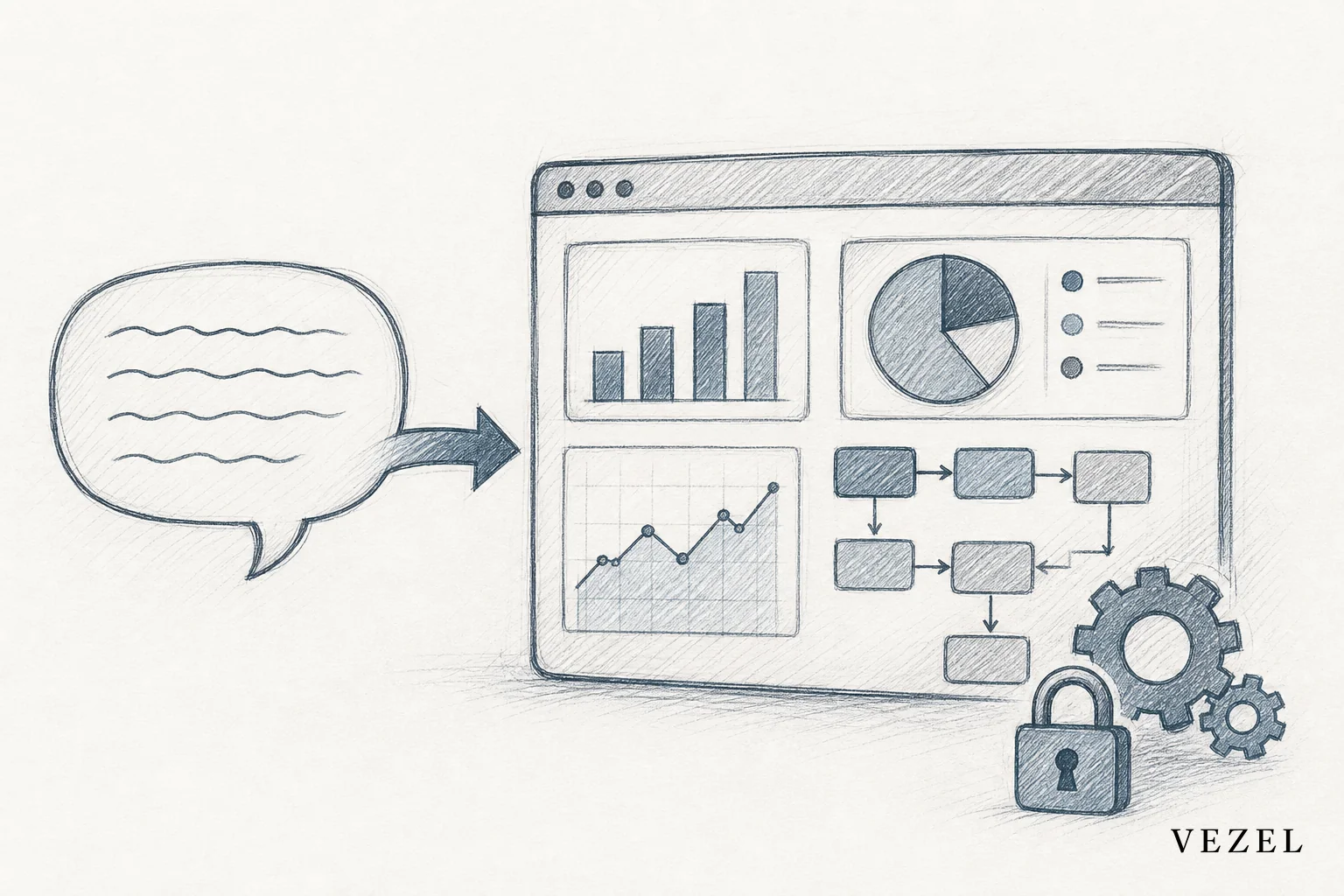
This is the same architecture covered in how to build custom dashboards inside your SaaS, how to embed a workflow builder in your SaaS, and how to inherit row-level permissions in SaaS tools. Each solves a piece of the same underlying problem: giving customers the ability to extend the product themselves without opening an engineering ticket or a services contract.
How to Tell If a Platform's Extensibility Model Is Actually Governed
Plenty of platforms describe themselves as "open" or "extensible." That's not the same as governed. Technically open usually means raw API access and a developer's willingness to wire things together. Governed means there's an actual control plane: publishing gates, version history, rollback, and permission inheritance that's enforced automatically, not documented in a wiki someone forgot to update.
When you evaluate a platform, ask three concrete questions:
- Does every generated extension execute under the requesting user's own role, or does it run through a shared service account that bypasses your existing access rules?
- Can you see a version history and roll back a published extension if a customer's team breaks something, or is publishing a one-way action?
- Is there a review or approval step before an extension goes live for a customer's team, or can anyone with access publish straight to production?
If a vendor can't answer these with a live demo, treat the "extensibility" claim skeptically. This is the gap our piece on how to publish and version extensions in your SaaS covers in more depth.
Cost and Margin: Where the Two Models Diverge
PSA cost is linear. Every new custom request means more consultant hours, which means more headcount, which means more cost that scales with your customer base rather than shrinking as you grow. Services revenue helps offset some of that, but it typically carries a thinner margin than your core subscription revenue, and it competes for the same product-savvy staff your engineering team wants.
Embedded AI extensibility runs on a different curve. The platform cost doesn't move much whether one customer or fifty customers build a dashboard this month, because the generation work happens through the platform rather than through billable hours. That preserves your subscription margin instead of diluting it with services overhead.
There's also a hidden cost PSA tools never show you: maintenance. A custom build delivered by a consultant doesn't disappear when the invoice is paid. It becomes a piece of undocumented logic your engineering team inherits the next time something breaks, or the next time that customer's data model shifts. Extensions generated through a governed platform stay versioned and owned by the platform, not orphaned in a codebase nobody remembers writing.
Speed to Delivery: Weeks of Consulting vs Same-Day Generation
A PSA-tracked implementation project, scoped, staffed, and delivered, commonly runs four to twelve weeks depending on complexity. That timeline shows up directly in your sales cycle. If an enterprise prospect won't sign until they see their specific workflow working, and building it requires a statement of work and a consultant queue, the deal sits.

Embedded extensibility compresses that timeline dramatically. A dashboard, report, or approval workflow generated through plain English and API auto-discovery can go from request to working demo in a single session, not a sprint. That's the difference between showing a prospect a mockup and letting them use the real thing before they've signed the contract. We cover the sales-cycle mechanics in more detail in how to shorten your enterprise SaaS sales cycle.
Where to Compare Extensibility Across Platforms
If you're trying to compare extensibility across low-code platforms, internal tool builders, and embedded AI layers, the comparison isn't apples to apples. Low-code platforms like Mendix hand your developers a framework to build a standalone application from scratch, which is a different problem than embedding extensibility inside a product your customers already log into. That distinction is walked through in Mendix vs Embedded Extensibility: What SaaS Needs and Low-Code Platforms vs Embedded AI Extensibility: 2026.
Internal tool builders like Retool or Superblocks solve yet another problem: giving your own engineers a faster way to build internal dashboards. They weren't designed for customer-facing use, and they don't inherit your product's existing permission model automatically. That gap is the subject of Internal Tool Builders vs Customer-Facing Extensibility.
When you're comparing platforms, look past the demo and check governance, API auto-discovery depth, security inheritance, and whether extensions are white-labeled to match your product's design system. Those four things separate a platform that scales with your customer base from one that just moves the bottleneck.
Which Model Fits Your SaaS Company?
Keep a services function if your customer base genuinely needs deep, bespoke integration work, complex data migrations, or true one-off consulting. That work benefits from a human relationship and doesn't repeat often enough to justify a platform investment.
Lean into embedded extensibility when requests repeat across customers with small variations, which describes most dashboard, workflow, and report requests in B2B SaaS. If your CS team hears the same "can we get a version of X scoped to our team" request from a fifth, tenth, and twentieth customer, that's not a services opportunity. It's a signal your product needs a self-serve extension layer, something explored further in Professional Services vs Embedded Extensibility: 2026.
Most companies land somewhere in between: a lean services team for the rare, truly bespoke engagement, and an embedded extension layer handling the repeatable 80%. That combination protects margin, keeps engineering focused on the core roadmap, and stops enterprise deals from stalling on a consultant's calendar.
If your engineering team is still absorbing customization requests that a governed extension layer could handle instead, it's worth seeing the difference live. Book a demo to walk through how API auto-discovery, security inheritance, and white-labeled generation work against your own product, see how it works end to end, or talk to an expert about where your PSA spend and your roadmap backlog overlap.