

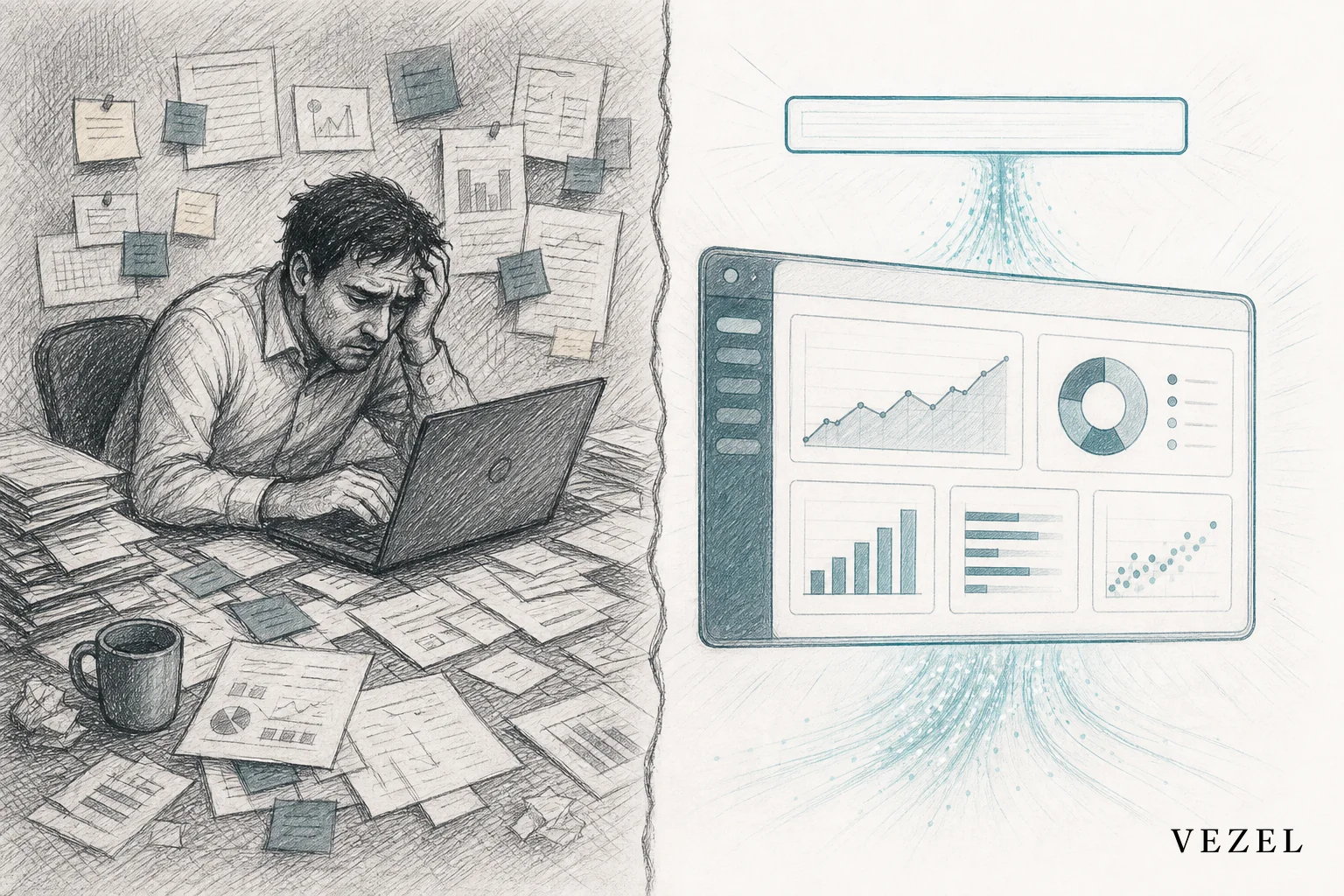
Professional services vs embedded extensibility SaaS comes down to who builds the custom dashboard, workflow, or report your enterprise customer just demanded, and what it costs you every time they ask again. Professional services teams deliver it by hand, billing hours and margin against every request. An embedded extensibility layer like Vezel lets the customer build it themselves, in plain English, inside your product, with zero engineering ticket and near-zero marginal cost.
Key Takeaways
- Services headcount scales with your customer count, not your revenue: every new enterprise logo adds implementation work, but the team delivering it grows linearly while ARR grows non-linearly, squeezing margin over time.
- Delivery time drops from weeks to hours: a scoped, quoted, and built custom dashboard through a services team commonly takes two to six weeks; a self-serve extension builder generates the same thing the same day.
- Professional services revenue is often near break-even: billable implementation work rarely carries the gross margin of the core subscription, which drags blended company margin down as services revenue grows as a share of the business.
- Governance separates real extensibility from an open API: a platform is only governed if it controls who publishes, what gets reviewed, and how permissions carry through — not just whether a developer could technically build something.
- Engineering time reclaimed: when self-serve extensibility absorbs one-off customer requests, engineering stops firefighting bespoke builds and gets back roadmap capacity for the core product.
At a Glance: Professional Services vs Embedded Extensibility
| Factor | Professional Services | Embedded Extensibility |
|---|---|---|
| Typical delivery time | 2-6 weeks per request | Hours, self-serve |
| Cost structure | Billable hours, project scoping, change orders | Platform subscription, near-zero marginal cost per build |
| Who builds it | Consultants or implementation engineers | The customer, in plain English |
| Gross margin impact | Often near break-even or loss-leading | Preserves core SaaS margin profile |
| Scalability | Linear with customer count and headcount | Scales without added services headcount |
| Governance model | Manual, consultant-managed | Governed marketplace: permissions, versioning, publishing review |
| Best suited for | Data migrations, complex integrations, strategic advisory | Dashboards, workflows, reports, AI agents, forms |
Why Every SaaS Company Ends Up With a Services Team
A sales rep closes an enterprise deal. Then the prospect's ops lead asks for a dashboard that matches their internal KPI structure, or an approval workflow that mirrors their existing sign-off chain. The product doesn't have it. Someone has to build it, so a professional services or implementation team gets assigned to the account.
This pattern is not a mistake. It's the natural result of a simple truth: customers still adapt to products more than products adapt to customers. For twenty years, services teams have been the release valve. They absorb the gap between what the shared product does and what each enterprise customer actually needs.
The problem shows up as the customer base grows. Every new logo adds another implementation queue item. Sales keeps closing deals that promise custom workflows before contracts even get signed. Eventually the services team can't keep pace, and the backlog starts looking a lot like the engineering backlog it was supposed to protect. That dynamic is explored in more depth in how to reduce SaaS engineering backlog from enterprise requests, though the underlying mechanism here is services capacity, not sprint capacity.
What Professional Services Actually Costs You
The obvious cost is headcount. Consultants, implementation engineers, and solutions architects all draw salaries, and their hours get billed against specific accounts. But the real damage often happens off the invoice.
- Scoping overhead: every custom dashboard or report starts with a discovery call, a statement of work, and a change-order process if requirements shift mid-build.
- Engineering leakage: "simple" custom requests routinely turn out to need an engineer anyway, because the services team can't touch the underlying API or data model safely.
- Churn exposure: when a services team promises a custom workflow that slips past the renewal date, the customer's trust in the roadmap erodes, not just their patience with a delayed feature.
- Knowledge silos: custom builds delivered by a rotating cast of consultants rarely get documented well enough for anyone else to maintain them later.
None of this shows up cleanly on a P&L line labeled "cost of professional services." It shows up as slower time-to-value, thinner services margin, and a growing pile of bespoke code nobody wants to touch. For a related breakdown focused purely on engineering hours instead of services economics, see Extensibility Platform vs Custom Dev: What's Cheaper?
How Embedded Extensibility Changes the Delivery Model
An embedded AI extension layer flips the delivery model. Instead of a consultant scoping and building a custom dashboard, the customer describes what they want in plain English, and the platform generates it directly inside the product they already log into.
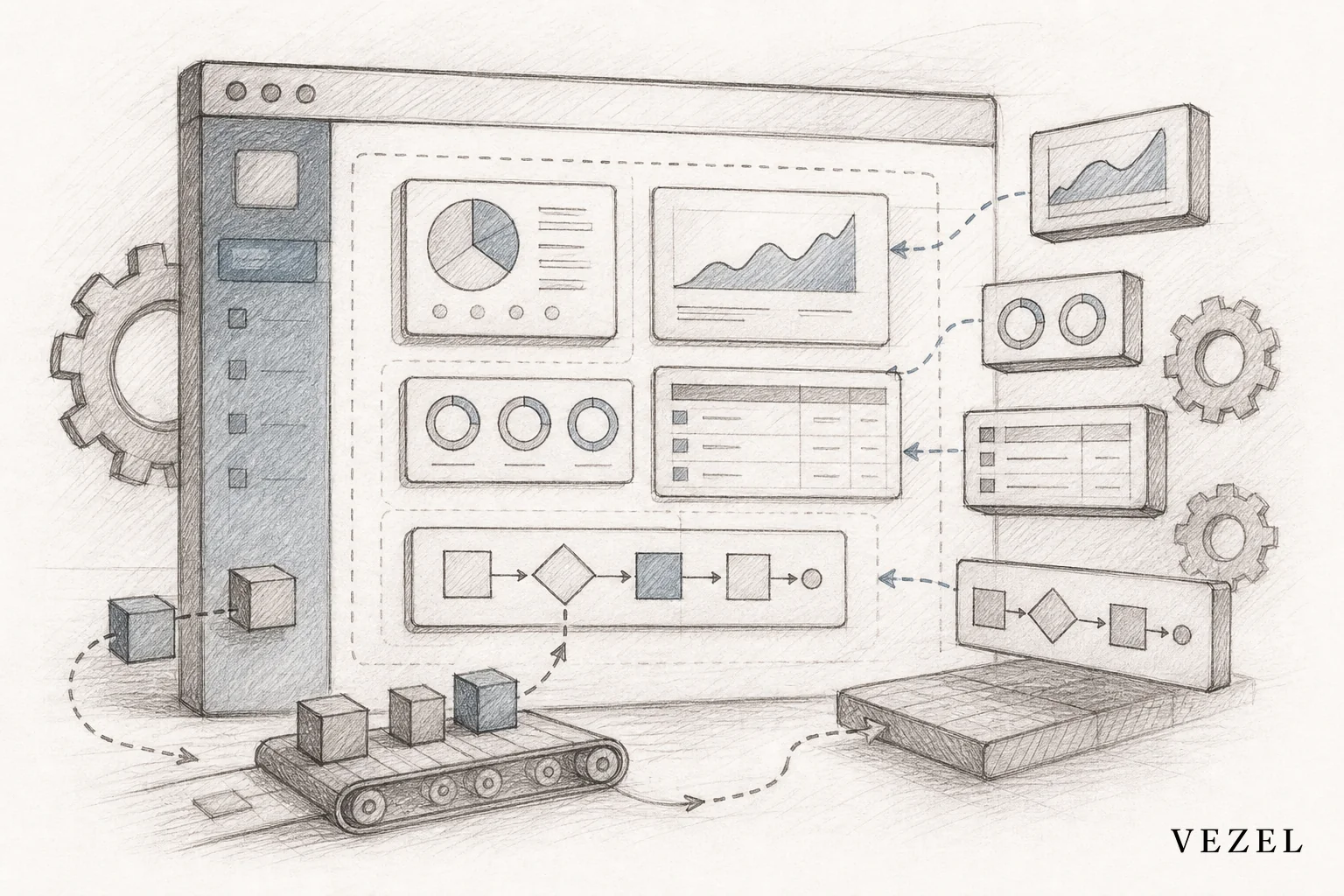
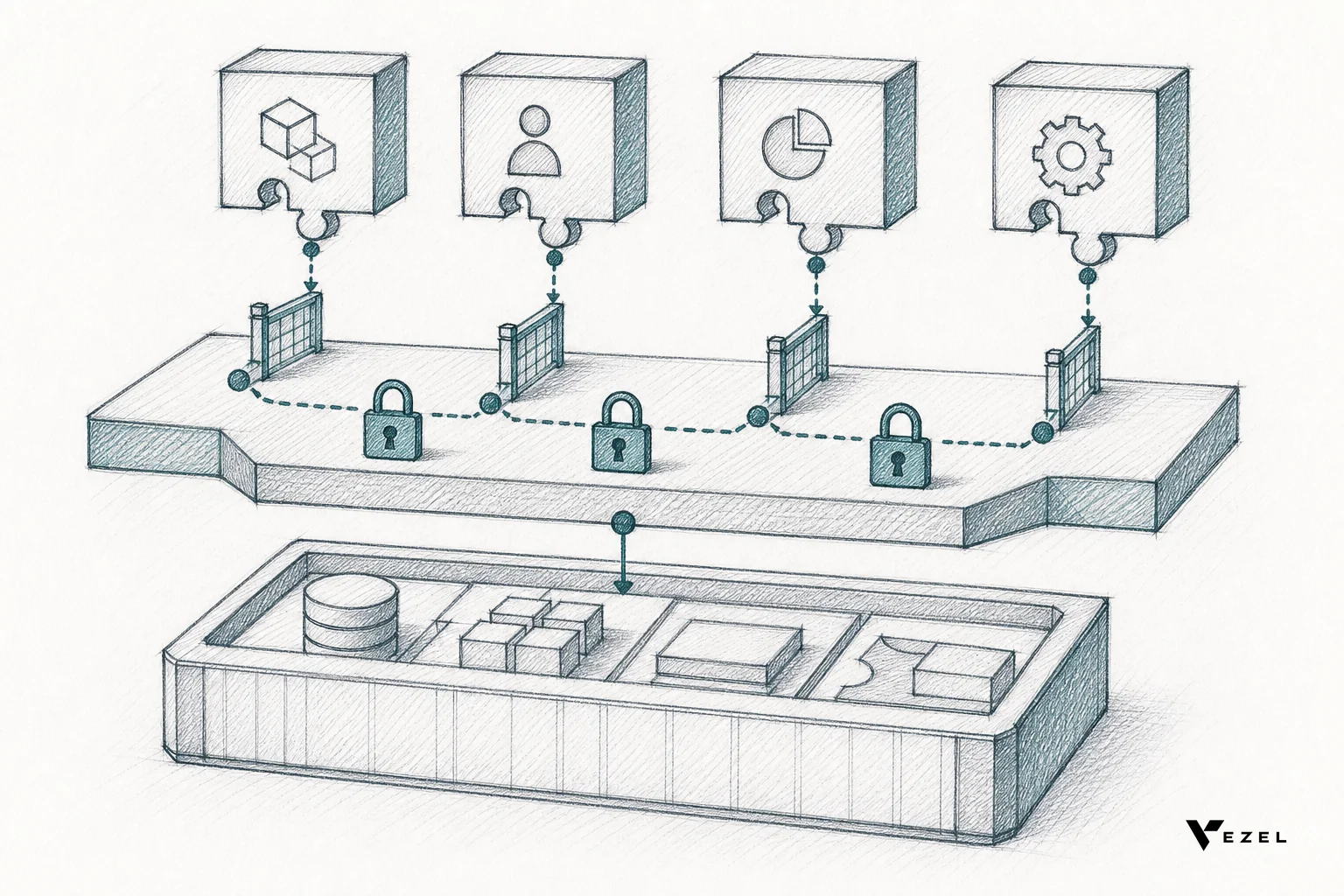
Three things make this possible without recreating the risk of unmanaged customization. First, API auto-discovery maps the extension to your existing data model and endpoints, so there's no manual integration work per build. Second, security inheritance means every extension runs under the requesting user's own authentication, role, and row-level permissions, the same approach detailed in how to inherit row-level permissions in SaaS tools. Third, a governed marketplace controls publishing, versioning, and lifecycle management, so what gets built stays visible and maintainable rather than turning into shadow IT, a risk covered more fully in how to prevent shadow IT in your SaaS platform.
This is what a self-serve customer dashboard build actually looks like day to day: the customer prompts, the extension inherits their permissions automatically, and it appears inside the product looking native because it's white-labeled to match your design system. There's a fuller walkthrough of the mechanics in how to build custom dashboards inside your SaaS.
Is a Platform's Extensibility Actually Governed, or Just Technically Open?
This is one of the most common questions SaaS leaders ask when evaluating extensibility options, and it matters more than most vendors admit. A platform can be technically "open" through public APIs, a low-code sandbox, or a scripting console, and still have no real governance. Anyone with access could build something, publish it wherever they want, and nobody controls permissions, versioning, or what happens when that person leaves the company.
Real governance means three things exist together: a defined publisher permission layer that controls who can build and release extensions, a review gate before anything reaches production users, and a versioning system with rollback so a bad extension can be pulled without breaking the customer's workflow. A governed marketplace, as described in how to publish and version extensions in your SaaS, is what separates a technically open platform from an actually manageable one. Ask any vendor: can you show me who published this, what it can access, and how I roll it back? If they can't answer clearly, it's open, not governed.
Margin Impact: The Number That Should Worry You
Professional services revenue rarely carries the gross margin investors expect from a SaaS business. Billable implementation work is priced against consultant time, and consultant time is expensive, unpredictable, and hard to scale. As services revenue grows as a share of total revenue, blended company margin trends downward, even while the core subscription business stays healthy.

Embedded extensibility changes this equation because the marginal cost of building one more customer-specific dashboard or workflow approaches zero. The platform subscription is fixed; the customer does the building. That keeps gross margin closer to the profile of the core product instead of diluting it with billable delivery hours. It also frees the engineering hours that used to get quietly absorbed into "simple" custom requests, capacity that shows up directly in how to reduce engineering roadmap pressure from customers as reclaimed roadmap velocity.
When Professional Services Still Make Sense
Embedded extensibility isn't a replacement for every kind of services work. Deep data migrations, complex third-party system integrations, and strategic advisory engagements still benefit from human expertise and hands-on project management. A consultant guiding a customer through a multi-system rollout is doing something fundamentally different from generating a KPI dashboard.
The distinction is between one-time, high-complexity engineering work and repeatable, customer-specific capability requests. Dashboards, reports, approval workflows, forms, and support agents fall firmly in the second category. Migrations and architecture consulting stay in the first. Most SaaS companies find the healthiest model uses both: services for the genuinely complex, extensibility for everything a customer could reasonably describe in a sentence.
How to Decide Which Model Fits Your SaaS Business
A few signals suggest your services team has hit its ceiling. Implementation backlogs stretch past a month. Sales starts quoting "custom workflow available in Q3" to close deals. Engineering keeps getting pulled into requests that were supposed to stay with the services team. If two or more of these sound familiar, the gap between your product and your customers' needs has outgrown manual delivery.
Start by asking which of your current services requests are truly one-off complexity versus repeatable customer-specific configuration. The second category, dashboards, reports, custom workflows, is exactly where a self-serve extension layer pays for itself fastest. If you're weighing this against other extensibility approaches, the comparisons in Low-Code Platforms vs Embedded AI Extensibility: 2026 and Internal Tool Builders vs Customer-Facing Extensibility are worth reading alongside this one, since they cover adjacent build-vs-buy decisions from a technical rather than a services-economics angle.
FAQ
How can I connect my own AI client to my own SaaS accounts?
Most modern embedded extensibility platforms connect through API auto-discovery, which reads your existing OpenAPI specification (or infers schemas from live responses when documentation is incomplete) and maps it to the data your extensions can use. Authentication and permissions carry through the same connection, so an AI client accessing your accounts inherits your existing role and row-level access instead of requiring a separate login or admin token, a pattern covered in more detail in Connecting AI Extensions to Legacy SaaS APIs: How-To.
Does embedded extensibility eliminate the need for professional services entirely?
No. It removes the repeatable, describable requests, dashboards, reports, workflows, forms, and agents, from the services queue, but complex migrations and strategic implementation work still benefit from consultants.
How fast is the difference in practice?
A services-delivered custom dashboard typically takes two to six weeks once scoping and contracting are included. A self-serve extension inside a platform like Vezel is generated the same day the customer describes what they need.
The margin math is simple: every custom dashboard your services team builds by hand costs you billable hours and roadmap attention. Every one your customers build themselves costs you almost nothing. If your implementation queue is the real bottleneck between signed contract and happy customer, it's worth seeing what a governed, self-serve extension layer looks like inside your own product. Book a demo to walk through how Vezel handles your specific dashboard, workflow, and reporting requests, see how it works end to end, or talk to an expert about where your services model is losing margin today.