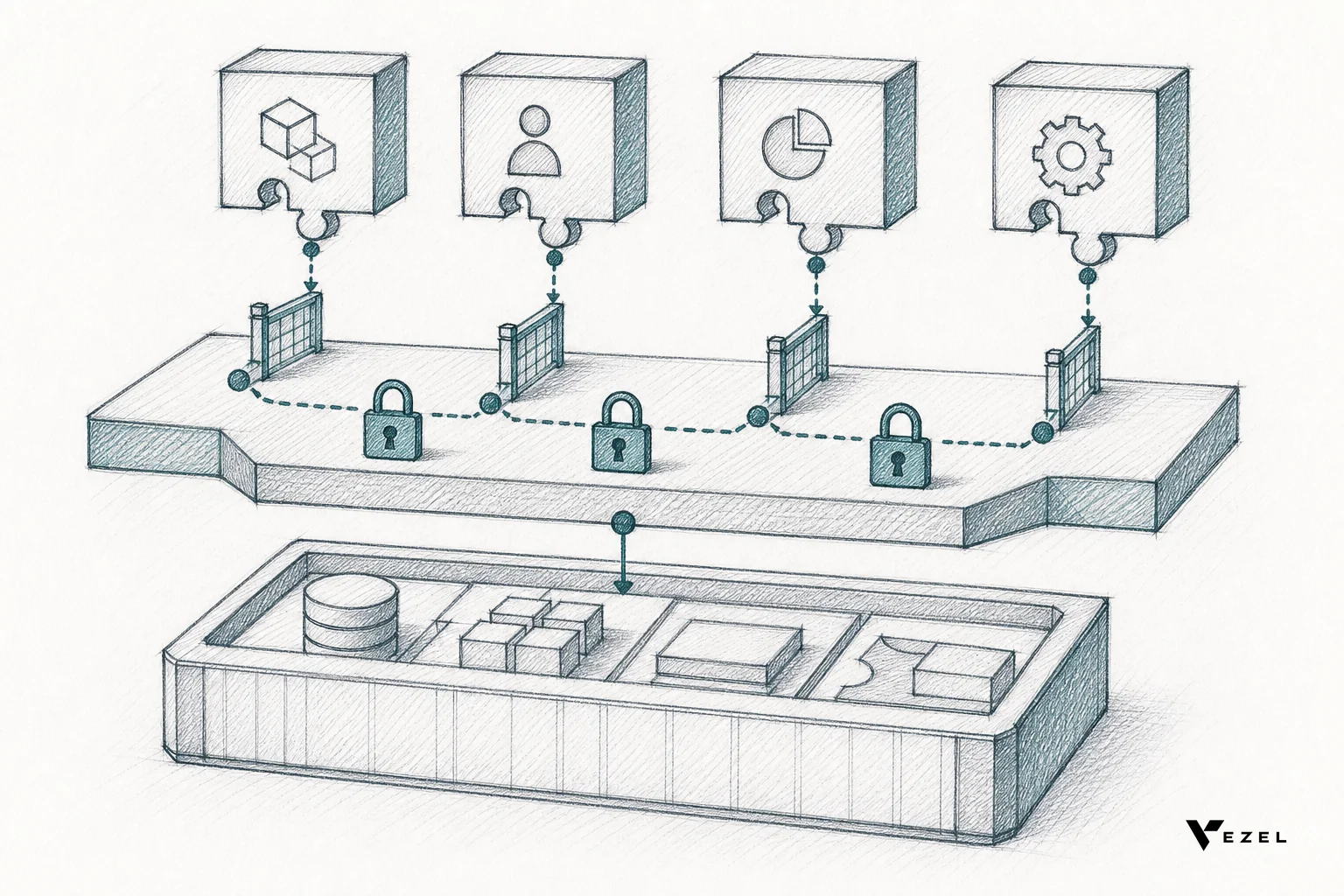



A governed marketplace for SaaS extensions is the control plane that sits between "customers can build things" and "customers can build things safely at enterprise scale." It governs who can publish a dashboard, workflow, or AI agent, what review it passes through, how versions are tracked, and which permissions it inherits from the host product. Without it, self-serve customization turns into shadow IT. With it, self-serve customization becomes a real product capability.
Key Takeaways
- Definition: A governed marketplace is a control plane for publishing, versioning, and discovering customer-built extensions inside a SaaS product, not a generic app store bolted on the side.
- The governance test: If a platform lets anyone publish anything with no review, no version history, and no permission checks, it's technically open but not governed.
- Three pillars matter: publishing rules, lifecycle management, and RBAC inheritance are what separate a governed marketplace from a free-for-all builder.
- The risk it prevents: ungoverned customization is the root cause of shadow IT and permission drift, where a custom-built tool shows a user data they were never supposed to see.
- The payoff: platform owners get self-serve extensibility for enterprise customers without adding engineering overhead or security risk.
At a Glance: Governed Marketplace Basics
| Attribute | Governed Marketplace | Ungoverned Self-Serve Tool |
|---|---|---|
| Who can publish | Defined by role/admin approval | Anyone with access to the builder |
| Version history | Tracked, with rollback | Usually none |
| Permission model | Inherits host RBAC and row-level access | Rebuilt manually, often incomplete |
| Discovery | Searchable catalog, scoped by role | Word of mouth or shared links |
| Audit trail | Full log of who published what, when | Rarely exists |
| Admin visibility | Centralized dashboard for platform owner | Fragmented across tools |
| Enterprise-ready | Yes, by design | Not without heavy manual work |
What Makes a Marketplace "Governed" Instead of Just Open
Plenty of SaaS platforms let customers build things. Custom fields, internal tools, connected spreadsheets, even embedded low-code builders. That's openness. It's not governance.
A governed marketplace for SaaS extensions is different because it treats every customer-built dashboard, workflow, report, or AI agent as a first-class object with a lifecycle. It gets published through defined rules. It gets a version. It gets discovered through a catalog scoped to the right roles. And critically, it inherits the same permissions the rest of the product already enforces.
Compare that to a standalone internal tool builder like Retool or a general-purpose app builder like Glide. Both are genuinely powerful for building something fast. Neither one was built to plug into a host SaaS product's authentication, publish extensions to specific customer segments, or give a platform owner a single place to see what exists across every account. That gap is exactly what pushes teams toward workarounds, a pattern covered in more depth in How to Prevent Shadow IT in Your SaaS Platform.
How Do You Tell If a Platform's Extensibility Model Is Actually Governed vs Just Technically Open
This is the question a lot of product and engineering leaders end up asking after their team has already shipped a self-serve builder. The answer comes down to five checks.
- Approval gates: Can an admin require review before an extension goes live for an account, or does anything a user builds ship instantly with no gate?
- Version history: If a customer-built workflow breaks after an update, can you roll it back to a prior version, or is the old one simply gone?
- Permission inheritance: Does the extension automatically respect the same row-level access and RBAC as the rest of the product, or does someone have to manually rebuild those rules?
- Audit trail: Is there a log showing who published what, when, and to which accounts?
- Centralized visibility: Can your platform team see every customer-built extension across every account from one place, or is it scattered and undiscoverable?
If the answer to most of those is no, you're looking at a builder, not a marketplace. It might be technically flexible. It isn't governed, and that distinction is exactly what turns into a support incident six months later.
The Three Pillars of Governance
Strip away the marketing language and a governed marketplace really rests on three mechanisms working together.

Publishing Rules
Not every user should be able to publish an extension to an entire organization. Publishing rules define who can create an extension, who can submit it for wider use, and whether it needs review before it goes live. A sandbox user might build freely. Publishing to a whole enterprise account is a different, gated action.
Lifecycle Management
Extensions change. A customer-built approval workflow gets updated when the business process changes. Lifecycle management means every extension carries a version, old versions stay recoverable, and deprecated extensions can be retired cleanly instead of quietly rotting in a corner of the product.
RBAC Inheritance
This is the one that actually prevents the security incidents. An extension built by a regional manager should never be able to expose another region's data just because it was built in an afternoon. When permissions inherit directly from the host platform's existing authentication and row-level access controls, that risk disappears by design instead of by manual review.
Why Ungoverned Customization Creates Shadow IT and Permission Chaos
Here's what happens without a governed layer. A customer needs a dashboard the product doesn't offer. Someone on their team spins up a spreadsheet, or connects a general-purpose builder, or asks IT for a workaround. It works, for a while. Nobody outside that team knows it exists. Nobody is tracking whether it still matches the current data model six months later.
That's shadow IT, and it's not a hypothetical. It's the default outcome of giving customers flexibility without giving platform owners a way to see or govern what gets built. The permission side is worse. A custom-built tool that wasn't wired into the host product's RBAC can easily surface data a user was never supposed to see, especially in row-level cases like healthcare, finance, or multi-region operations. For the full risk breakdown, see How to Prevent Shadow IT in Your SaaS Platform.

A governed marketplace closes that gap by keeping every extension inside the product's existing security boundary, visible to the people responsible for it, instead of scattered across tools nobody officially approved.
How a Governed Marketplace Changes the Model for Platform Owners
The shift is subtle but important. Instead of choosing between "lock everything down" and "let anyone build anything," a governed marketplace gives platform owners a middle path: self-serve creation with admin-level oversight.
Engineering builds the platform once. Publishing rules, permission inheritance, and versioning get built into the marketplace itself, not re-implemented for every single customer request. That's the difference between engineering absorbing every one-off customization request and engineering building the rails once, covered in more detail in How to Reduce SaaS Engineering Backlog From Enterprise Requests.
Enterprise customers, meanwhile, get something they've been asking for without saying it directly: visibility. Their admins can see exactly what's been published, by whom, and using what data, across their entire account. That's a very different conversation than the one that happens when a security team discovers an unofficial spreadsheet six months into a contract.
What This Looks Like in Practice
Picture an HR tech platform where an operations admin builds a new hire onboarding workflow, one that routes approvals through a hiring manager, then compliance, then a credentialing specialist for clinical roles. In a governed marketplace, that workflow gets submitted for review, published with a version number, and scoped to the specific teams that should see it. Related patterns are covered in How to Embed a Workflow Builder in Your SaaS.

Or picture a healthcare tech platform restricting AI agent publishing so only compliance-reviewed templates can go live for clinical teams, while operations teams get more publishing freedom for internal-facing dashboards. That kind of role-based publishing control is what makes deploying AI agents inside a SaaS platform viable at enterprise scale instead of a compliance liability.
In both cases, discovery matters as much as publishing. Customers should be able to browse a catalog of extensions relevant to their role and permissions, the same way they'd browse a curated app store, not dig through a shared drive of half-documented tools. That's the discovery half of the definition that often gets skipped when teams talk about "extensibility" but really mean "a builder with no catalog."
Governed Marketplace vs Unmanaged Extensibility Tools
| Dimension | Governed Marketplace | Retool / Superblocks | Glide / Mendix | No Extensibility |
|---|---|---|---|---|
| Built for | Customer-facing extensions inside a host product | Internal engineering tools | General-purpose app building | N/A |
| Publishing control | Role-based, reviewable | Developer-managed | Developer-managed | N/A |
| Permission inheritance | Automatic from host RBAC | Manual rebuild required | Manual rebuild required | N/A |
| Version/rollback | Built in | Limited | Limited | N/A |
| Customer self-serve | Yes, governed | No, requires developers | Partial, no coding but ungoverned | No |
| Engineering overhead | Low, ongoing | High, per tool | Medium, per app | Highest, custom builds |
For a deeper look at how these platforms compare on cost and scale, see Retool vs Embedded Extensibility for SaaS Products: Which Scales? and Glide vs Embedded Extensibility: What SaaS Needs.
How to Evaluate a Governed Marketplace When Choosing a Platform
If you're vetting extensibility vendors, ask these questions directly instead of watching another polished demo:
- Can an admin require approval before an extension is visible to an entire account?
- What happens when a customer-built extension breaks after a data model change, is there a rollback?
- Does the extension automatically inherit row-level permissions, or does someone have to configure that separately for every build?
- Is there a single dashboard where our team can see every extension published across every customer?
- Can we restrict AI agent publishing to reviewed templates for regulated industries like healthcare or finance dashboards?
A full evaluation framework, including questions about API auto-discovery and white-labeling, is covered in How to Choose an Embedded Extensibility Platform. According to the NIST Cybersecurity Framework, access control and continuous monitoring are foundational controls for any system that handles sensitive data, which is exactly what an ungoverned extension layer tends to skip.
FAQ
Does a governed marketplace slow down self-serve customization?
Not meaningfully. Publishing rules add a review step for wider distribution, not for individual creation. A user can still build a dashboard or workflow in plain English in minutes. The gate applies when it's published beyond their own workspace, which is a small tradeoff for avoiding the alternative: an unreviewed extension exposed to an entire enterprise account.
Can enterprise admins restrict what gets published to their org?
Yes, that's the point of publishing rules and RBAC inheritance working together. An enterprise admin can define who's allowed to submit extensions for their account and require review for anything customer-facing, including custom workflows connected to their operational data.
Is this the same as an app store like Salesforce AppExchange?
Not quite. AppExchange is built around developer-submitted packaged apps reviewed by Salesforce, aimed at a broad market. A governed marketplace for SaaS extensions is scoped per customer account, built for non-technical users creating their own dashboards, workflows, and agents in plain English, and reviewed by the platform owner or the customer's own admins rather than a public app store process.
The gap between "customers can technically build things" and "customers can build things safely" is exactly where most extensibility efforts stall. A governed marketplace is what closes it: publishing rules, lifecycle management, and RBAC inheritance working together so self-serve customization scales to enterprise customers without turning into shadow IT. If you want to see what that looks like inside your own product, you can book a demo, check out how it works, or talk to an expert about governing extensibility the right way from day one.